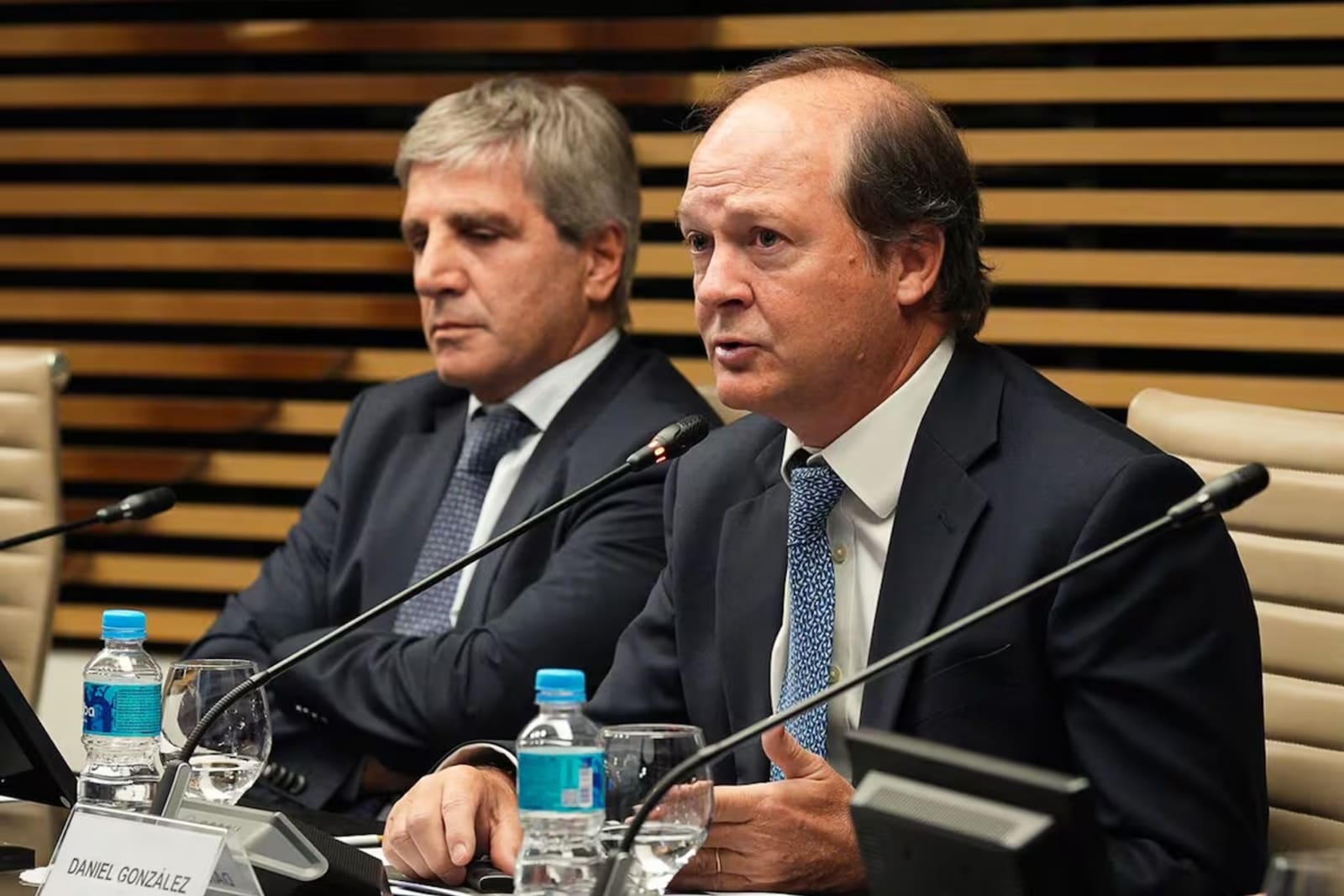
Daniel González resigned from the Secretariat of Coordination of Energy and Mining of Argentina and broke his silence about his departure from the government of Javier Milei.
The now former official revealed that the decision had been discussed for months with the Minister of Economy, Luis Caputo, but that both agreed to postpone it to avoid speculation about a possible internal crisis and to complete a series of strategic commitments.
“It’s a cycle that’s ending. I’m not a person with a political vocation or much of a public profile, except for this role. We’ve been discussing this with Toto Caputo for months. We felt this was the right time, and not before. We had to pass the cold zones law, and the biofuels law has already received preliminary approval,” González explained publicly.
“We also had to present the budget, we participated in Argentina Week in Paris with many companies, plus we had to accelerate with the Large Investment Incentive Regime (RIGI) because a large number of projects were coming in and we wanted to avoid the snowball effect,” he added.
The need to complete those commitments postponed a separation that had already been discussed with the head of the Treasury Palace, I understand that "now is a more reasonable time."
It is worth remembering that just over two years have passed since the official appointment to the position (formalized by Decree 811/2024, effective from August 28, 2024) .
At that time, the former CEO of YPF arrived at the Ministry of Economy to coordinate energy and mining policies under Caputo's leadership, participating in the coordination of investments, regulatory reforms and strategic decisions for both industries.
“It was two and a half years in the position. And just as it is very difficult for someone coming from the private sector to make the leap to the public sector, although it may seem contradictory, it is very difficult to leave,” he acknowledged.
Although no replacement has been announced for the coordination of both areas so far, this would not imply modifications in the orientation of current policies or other changes in prominent positions within the linked areas.
According to what Energía Estratégica was able to find out, both the Secretary of Energy of the Nation, María Tettamanti , and her counterpart in Mining, Luis Lucero , will remain in their positions, as will those teams responsible for monitoring the RIGI, one of the key tools of González's administration.
Furthermore, according to data released by the Ministry of Economy, the RIGI registered 16 approved projects for almost USD 30 billion, to which must be added another 25 initiatives under evaluation for around USD 111 billion (total of USD +140 billion and about 197,000 potential jobs).
The energy balance: electricity deregulation and pending reforms
The now former Secretary of Energy and Mining Coordination of Argentina was not indifferent to an analysis of his management and identified the opening of the market and less state intervention in price formation as the main changes introduced in the sector.
“The best thing we did in the energy sector was to step back, not intervene, and allow the private sector to flourish. We can no longer interfere in setting local prices; the market sets them. And the private sector responded tremendously,” he stated.
One of the central instruments of that transformation was Resolution SE 400/2025 in October of last year , which established the Rules for the Normalization of the Wholesale Electricity Market (MEM) and its Progressive Adaptation; which under the gaze of González “revolutionized the sector”.
Continue reading
Why? The regulations redefine the supply scheme through greater participation of bilateral contracts between generators, marketers and distributors , as opposed to the centralized contracting model managed by the Wholesale Electricity Market Management Company (CAMMESA).
Within this framework, it is envisaged that distributors will cover at least 75% of their seasonal demand through bilateral agreements , incorporating greater commercial responsibilities and price signals in the supply.
The reform continued this week with the publication of Resolution 293/2026 , which accelerates the liberalization of the Term Market (MAT) and expands the contracting possibilities for existing thermal and hydroelectric power plants.
The new timeline increases the limits from 20% to 60% from April 2027, to 80% in April 2028 and eliminates percentage restrictions in January 2029 , bringing forward by one year the full opening initially planned.
For renewable energies, the incorporation of a greater conventional supply implies a change in the competitive conditions of the contract market, because the new facilities will have to compete for supply agreements with power plants whose initial investments may already be amortized.
What remains to be done after González's departure
The Energy Secretariat has pending definitions regarding the Additional Reliability Reserve Service (SerCA) , designed to incorporate firm capacity through a combination of tenders and private contracting mechanisms.
One of the alternatives evaluated involves linking public calls with the dynamics of the Renewable Energy Term Market (MATER) , which assigns dispatch priority through quarterly calls according to the availability of electricity transport.
Tettamanti had anticipated that the regulations could be published within 15 days and had estimated the need to add around 1000 MW annually . However, the design is still being developed, with technical and commercial aspects yet to be defined.
Added to this is the pending appointment of authorities of the National Gas and Electricity Regulatory Entity (ENREGE) , an organization created to unify the regulatory functions previously exercised by ENRE and Enargas.
Despite these open issues, González highlighted the continuity of energy and mining policy under the presidential leadership: “I believe that a very significant transformation is underway in the energy and mining sectors. Without Milei's leadership, it would be impossible, but he is putting Argentina in a different position.”
However, it is worth clarifying that his time in the Government was also marked by differences with officials linked to presidential advisor Santiago Caputo , particularly regarding the financing of electrical infrastructure works.
One of the main points of contention arose around the AMBA I project, intended to expand transport capacity and strengthen the supply of the Buenos Aires Metropolitan Area.
González had promoted a tender at the end of 2024 through a stamp-based remuneration mechanism, but the initiative did not prosper due to opposition from other sectors of the Executive, and finally resulted in a public concession call launched only in August of this year.
The incident even exposed differences between the Ministry of Economy and the management of Energía Argentina SA (Enarsa) . However, González did not attribute his resignation to these disputes and maintains that the decision had been previously agreed upon with Caputo.
Thus, his departure leaves vacant the coordination of two strategic sectors , while the Economy Ministry continues to implement the normalization of the wholesale market, the opening of electricity contracting and the evaluation of RIGI projects.

 By Matías Medinilla

 By Ailén Pedrotti

 By Emilia Lardizabal