


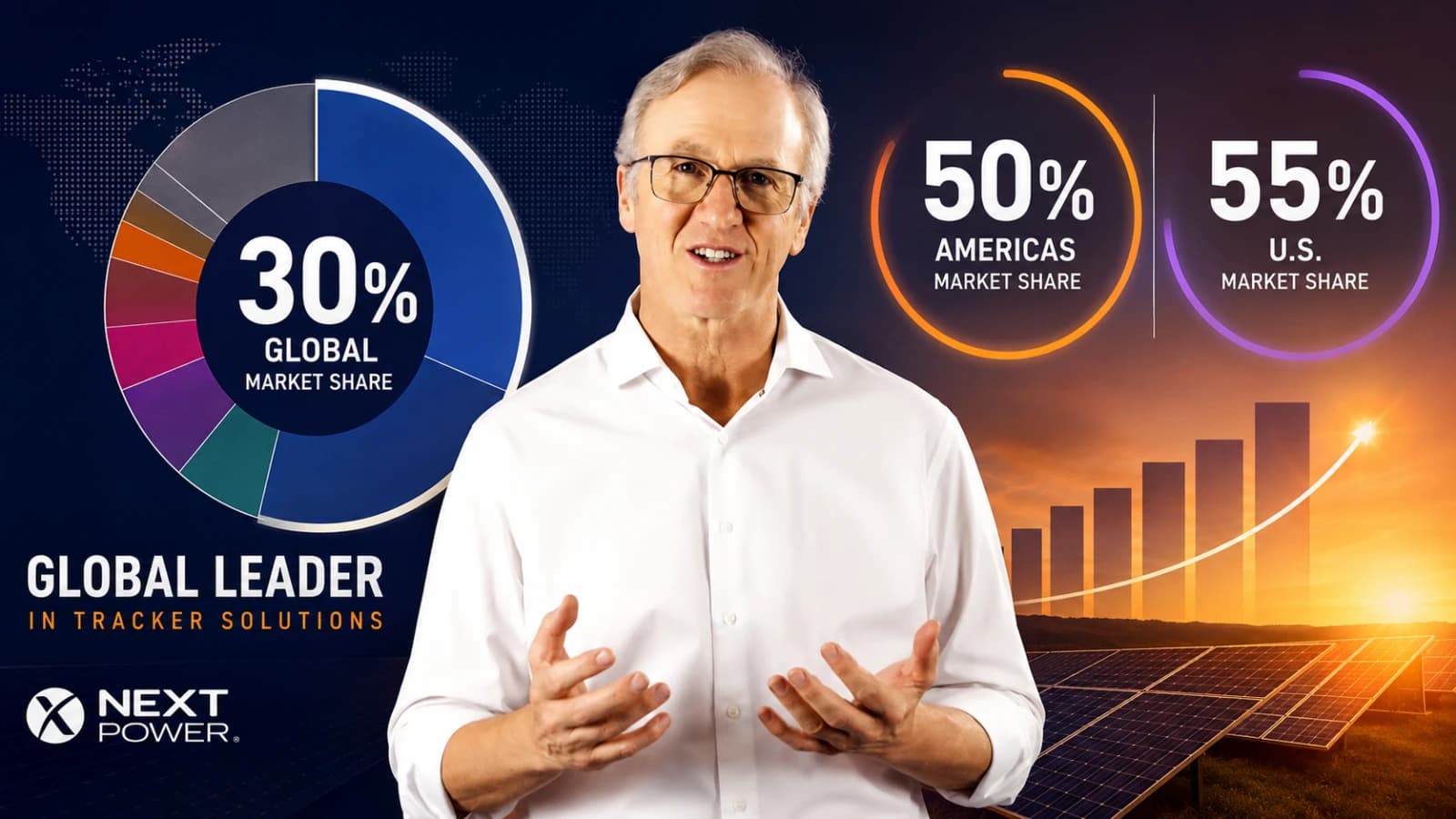
Daniel Shugar once again made LinkedIn more than just a corporate social network. The founder and CEO of Nextpower used his personal account to celebrate one of the company's strongest milestones in the global solar tracker business: in 2025, the company achieved a 30% market share worldwide, 50% in the Americas, and 55% in the United States, according to the annual market share ranking published by S&P Global.
The post, signed simply as “Shug”, had a rapid impact within the renewable energy ecosystem: in a few hours it accumulated more than 800 reactions and dozens of comments, with messages highlighting the company's leadership, internal culture and the consolidation of Nextpower as a dominant player in the US market.
But the interesting part of the message isn't just the percentages. Shugar chose to present the data without a classic triumphalist approach and without naming competitors. The graph he shared shows Nextpower's market share relative to the rest of the market, but avoids identifying the other companies.
The focus, rather than comparing brands, seems to be on demonstrating an evolution: how a company born and consolidated in the tracker business managed to move from technological leadership to scale leadership.

Globally, the chart shows a market of 133 GW of trackers shipped in 2025 , with Nextpower holding 30% of the share.
The gap with the second group is considerable: the immediate competitor appears with 13% , followed by another actor with 10% .
The rest of the market is divided between single-digit shares and an aggregate group of 17% , revealing an industry that is still fragmented, but with an increasingly marked leadership at the top.
The picture changes even more when looking at the Americas. In a regional market of 57 GW , Nextpower holds a 50% market share , while the second-largest player has 20% . Then come two groups with 10% market share and smaller shares of 4% , 3% , and 3% .
In other words: in America, the company not only leads, but occupies a position that more than doubles that of its main pursuer.
And in the United States, according to Shugar himself, the dominance is even greater: 55% market share .
The CEO's message is clear: Nextpower doesn't want to present this result as an end in itself, but as a consequence. "We don't set market share targets," Shugar stated in his post.
As he explained, the company focuses on innovation, tangible value for power plant owners, customer satisfaction, execution, and a high-performance culture.
For the executive, market share and financial results are the result of doing those things well.
That definition connects with another concept that Shugar has been repeating in his latest communications: the “acceleration towards quality”.
In their view, solar markets are rewarding systems that operate reliably in extreme weather conditions, produce more energy per watt installed, and reduce operating costs throughout the plants' lifetime.
This reveals one of the keys to Nextpower's current positioning. The company no longer seeks to be seen solely as a tracker manufacturer, but as a technological platform for solar power plants.
Shugar emphasized that the company invests more than $100 million annually in R&D to maintain that leadership and move towards a more complete solution for solar power plants.
This news also comes at a time of strategic expansion for the company. Just a few days ago, Nextpower announced a definitive agreement to acquire complementary assets from the power conversion business of Zigor Corporation and its US subsidiary Apex Power, a deal designed to accelerate its entry into the market for inverters, battery storage, and solutions for large electrical loads, including data centers.
This operation reinforces the platform concept. According to the company, the incorporated technology includes modular solutions for utility-scale applications, 1500V solar and storage projects, 600V and 1000V repowering, and readiness for 2000V architectures. Furthermore, the modular design can be configured up to 5.2 MVA.
The integration of trackers, eBOS, power electronics, software, and digital intelligence thus appears as Nextpower's next step.
The acquisition also contemplates a possible expansion of inverter manufacturing in the United States starting in 2027, in line with industrial relocation and the growing demand for critical energy infrastructure.
In his publication on the S&P Global ranking, Shugar also placed the growth of trackers within a broader trend.
He noted that global shipments increased by almost 20% in 2025 to reach 133 GW , and linked that progress to an increasingly competitive solar economy, the growth of battery storage and the need for firm and dispatchable power in networks such as ERCOT and CAISO.
The final takeaway is more political and market-driven than technological: while electricity demand grows, gas turbines face significant delays, and geopolitical instability puts pressure on LNG supply chains, Shugar sees favorable structural conditions for solar and storage to continue gaining ground.
For Nextpower, the message comes at a time of consolidation. The company recently reported record revenues of US$3.56 billion for fiscal year 2026, a backlog exceeding US$5.25 billion , and more than 160 GW of trackers shipped globally, in addition to having surpassed 25 GW sold in Latin America , as reported by Energía Estratégica in a previous article.
Beyond the numbers, Shugar's post sends a message: Nextpower wants to show that its leadership in trackers is not an end point, but the foundation from which it seeks to build a broader energy platform.
The 30% global share, 50% in the Americas, and 55% in the United States serve as a snapshot of the present. But the underlying message points to the next chapter: a company that wants to move from simply tracking the sun to increasingly controlling critical layers of the solar power plant of the future.