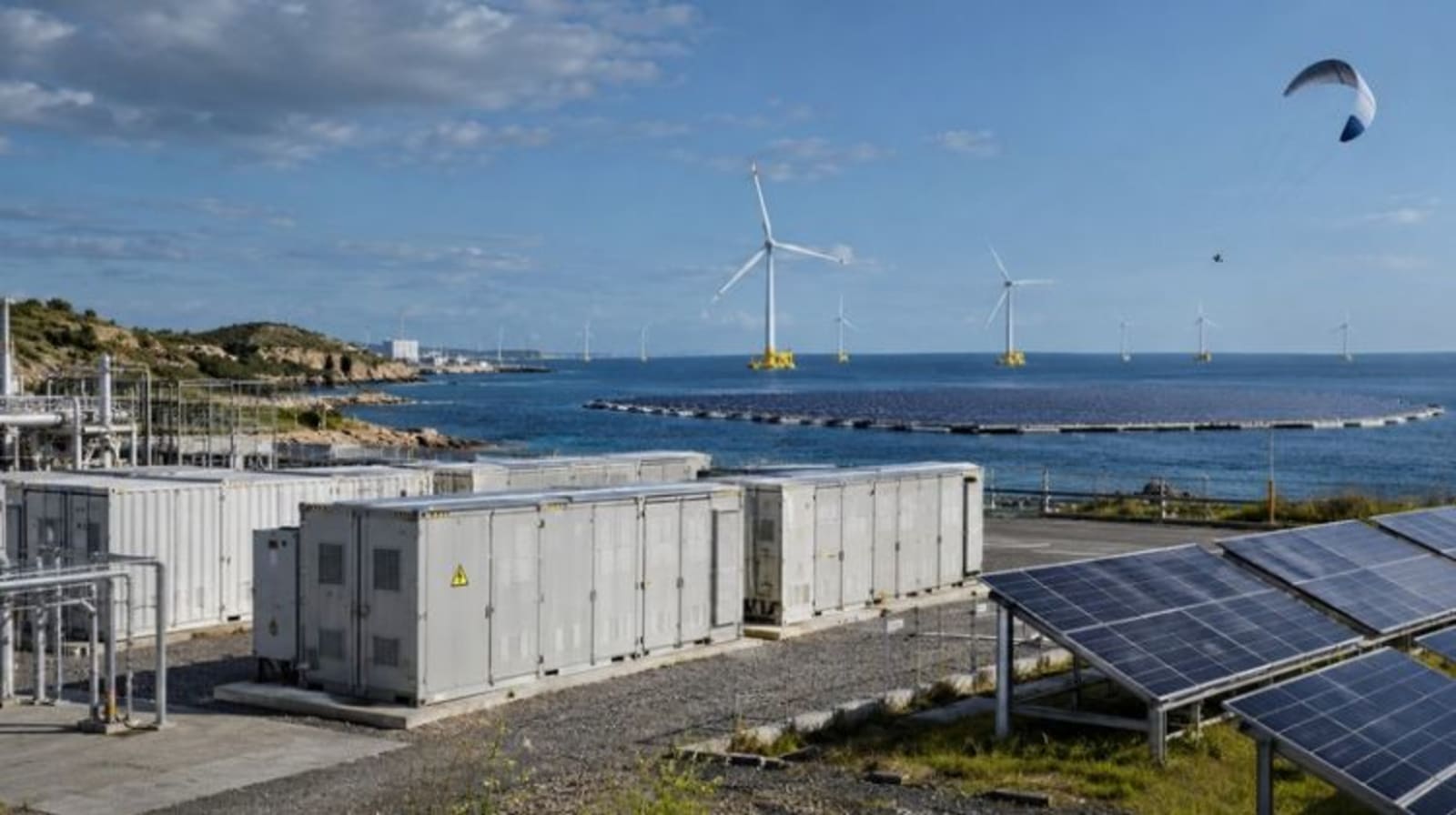
BESS capable of storing electricity for 18 hours, perovskite panels that outperform silicon, and wind turbines that float on the sea. Asia and Europe are advancing with renewable technologies that are beginning to reach new scales of development, while Latin America still shows differences in their commercial implementation.
The figures reflect this evolution: the UK is developing 47.7 GWh of long-life BESS, China is awarding 40 MWh of sodium batteries and testing a 1 MW perovskite plant , while Norway is already operating a 94.6 MW floating offshore wind farm.
From systems that extend renewable energy supply to underwater solar panels and comets that generate electricity, innovations are opening new opportunities for power generation and storage . Energía Estratégica analyzes specific applications , their capabilities, and the opportunities they could create for Latin America's energy transition.
From lithium to sodium: storage seeks to overcome new limits
One of the most significant bets comes from the United Kingdom, where the energy regulator Ofgem provisionally selected 16 long-duration storage projects totaling 7.6 GW of power and approximately 137 GWh of capacity .

The portfolio includes various technological solutions, but 11 projects correspond to lithium-ion battery systems , which concentrate 3,630 MW and 47.7 GWh.
Among the selected developers is Field, with five installations totaling 1.6 GW and around 26.8 GWh , designed to achieve autonomy of between 16 and 18 hours.
The difference compared to conventional BESS? These configurations aim to store larger volumes of electricity to supply them over extended periods, a relevant capacity for systems with high wind and photovoltaic participation.
However, the British projects are not yet operational . Their preliminary selection is part of the Cap and Floor regulatory scheme, which sets minimum and maximum revenue limits to reduce financial risks and facilitate long-term investments.
In this way, batteries are seeking to play a broader role in the integration of renewables, by enabling the use of surplus wind and solar photovoltaic energy during periods of lower generation. Long-duration storage is no longer solely dependent on pumped hydropower and is beginning to incorporate lithium projects with greater autonomy , although they still need to overcome the necessary stages to become operational.
Meanwhile, China is exploring another alternative: sodium-ion batteries , whose development aims to diversify the raw materials used in energy storage.
The manufacturer CATL was awarded 10 MW of power and 40 MWh of capacity for the Renqiu Zhihong project, located in Hebei province, which includes a total of 100 MW and 400 MWh.
The installation will combine 360 MWh of lithium iron phosphate batteries with another 40 MWh of sodium-ion batteries, allowing both technologies to be evaluated within the same infrastructure.
But there is one fact that still affects its competitiveness: CATL submitted an offer of 1.035 yuan per Wh, almost double the 0.518 yuan per Wh awarded to Envision Energy for the lithium block .
Although sodium offers potential advantages associated with the availability of raw materials, the tender demonstrates that its lower cost is not yet guaranteed on a commercial scale.
Beyond this award, cost and lifespan projections are beginning to position sodium as an alternative for stationary energy storage . A comparison published by AIN Energy X estimates prices of between $55 and $70 per kWh for this chemical, compared to $60 to $80 per kWh for lithium iron phosphate.
Looking ahead to 2028, projected sodium electricity prices are expected to fall to between $45 and $55 per kWh , while lithium iron phosphate is projected to be between $55 and $65 per kWh. These estimates contrast with the prices awarded in Hebei and reflect the gap between technological projections and current market conditions.
Another factor is durability: sodium batteries can last up to 15,000 cycles, compared to 6,000 to 10,000 cycles for lithium iron phosphate alternatives , according to the comparison. Their performance in extreme temperatures is also attractive for stationary applications.
The industrial leap is beginning to be reflected in contracts. CATL and HyperStrong signed a three-year supply agreement for 60 GWh of sodium-ion batteries , one of the largest commercial commitments announced for this technology.
The trend is also reaching the United States, where Juniper Energy has reached an agreement with Alsym Energy for the planned deployment of 500 MWh of sodium-based storage , primarily in California. Both agreements demonstrate the commercial interest in this chemical, although the committed capacities do not yet equate to operational facilities.
“In a state of mass production parity, the cost of the sodium cell could be less than half that of a lithium one,” said Ricardo Garro, Sales Director Latam Energy Storage Solutions of the company during his participation in the streaming “It had to be said and it was said” of Energía Estratégica.
Perovskite: China challenges silicon with panels that “work underwater”
Photovoltaic innovation is also advancing in China, where researchers from Nanjing University tested a 1 MW perovskite installation against a conventional 3.5 MW silicon plant.
During May 2026, perovskite panels generated 5.81% more electricity per unit of installed power than the reference system , a result that opens new perspectives for improving the performance of solar power plants.
The leap forward is also beginning to extend to industrial manufacturing. GCL is developing gigawatt-scale perovskite production capacity in China , with a 2 GW line announced for tandem modules combining silicon and perovskite, with projected efficiencies of up to 32%.
The technology is also part of other manufacturers' strategies. Yingli Solar anticipates its intention to incorporate perovskite into future tandem cells , with the aim of increasing energy conversion per square meter and expanding its commercial applications.
Continue reading
However, this progress comes with an additional challenge: China has proposed new controls on the export of 12 strategic photovoltaic technologies , including processes related to perovskite and tandem cells. This measure, still just a proposal, could restrict the international transfer of industrial knowledge.
But the applications go far beyond land-based power plants. Researchers from Yunnan University and the Southwest United Graduate School in Kunming have succeeded in generating electricity with perovskite cells submerged 10 meters below the sea, off the Weizhou Islands in China.
The experiment, published in the scientific journal Joule , incorporated photovoltaic devices into underwater robots and managed to produce 324 milliwatt-hours for two hours, exceeding the depth of previous tests, which generally did not exceed two meters.
Although still in the experimental phase, the technology could power ocean sensors, underwater cameras, and environmental monitoring equipment, reducing reliance on replaceable batteries or electrical connections from land.
Floating wind and solar power: the sea becomes a new energy surface
Innovations also extend to renewable energy generation, especially in territories where the depth of the sea or the availability of land represent limitations for new developments.
In Norway, Equinor operates Hywind Tampen, a 94.6 MW floating offshore wind farm consisting of 11 wind turbines of 8.6 MW each, installed approximately 140 kilometers from the coast. Its unique feature is that the turbines are mounted on floating concrete platforms, anchored to the seabed in waters 260 to 300 meters deep .
Although the offshore wind industry reached 92.5 GW installed worldwide by the end of 2025 , floating technology still represents a small portion of the market.
According to the Global Wind Energy Council (GWEC), only 278 MW correspond to floating offshore wind farms , equivalent to 0.3% of global offshore capacity. Of that total, Norway accounts for 101 MW, the United Kingdom for 78 MW, and China for 40 MW.
The remainder is distributed among France (27 MW), Portugal (25 MW), Japan (5 MW), and Spain (2 MW) . Furthermore, the agency notes that no new floating capacity was added during 2025, although projects are under development in Europe and Asia.
The outlook shows a change of scale: GWEC projects that floating offshore wind could reach 18.8 GW installed by 2035 , with Europe concentrating 64.7% of the new additions planned between 2026 and 2035, Asia-Pacific 35.2% and Latin America just 0.1%.
On the other hand, Spain is also making progress in an emerging application: floating marine solar energy .
In October 2026, BlueNewables, with the support of Naturgy, completed the installation of a 1 MW demonstrator in the Port of Valencia , consisting of two 500 kW platforms called Paiporta and Catarroja.
While the Spanish installation is still in the pre-commercial phase, Asia already has larger floating solar projects.
In Indonesia, Masdar and PLN commissioned the 192 MWp Cirata hydroelectric plant , located on a reservoir in West Java and inaugurated in November 2023. The facility has a capacity of 145 MW of alternating current and occupies approximately 250 hectares. Furthermore, its developers agreed to explore a capacity expansion.
What if electricity could be generated using kites? European companies like Kitepower are developing airborne wind systems that harness wind currents hundreds of meters high, eliminating the need for large conventional towers.
The technology uses kites connected by cables to ground stations, where the mechanical energy generated during flight is converted into electricity. Its potential lies in decentralized applications, isolated communities, and locations with logistical challenges , although it still needs to demonstrate its commercial competitiveness on a larger scale.
What potential do these technologies have in Latin America?
Although the solutions mentioned show different levels of commercial maturity, Latin America already has experiences that allow us to measure the opportunities and differences compared to Asia and Europe.
Chile boasts one of the most significant advancements in long-duration energy storage. In May 2026, ContourGlobal announced the commissioning of the BESS system at the Víctor Jara nuclear power plant, located in Tarapacá.
The project combines 231 MWp of solar power with 200 MW of storage, 1.3 GWh of energy capacity, and an autonomy of 6.5 hours , allowing it to supply electricity after sunset. However, this duration is still less than the 16 and 18 hours contemplated in the provisionally selected British projects.
Brazil, for its part, began to incorporate sodium-ion batteries into decentralized renewable applications.
In the Amazonian community of Tumbira, UCB Power and the Sustainable Amazon Foundation installed a 7.5 kWp photovoltaic plant with 38.4 kWh of sodium storage , intended to supply electricity in an isolated area.
In floating generation, Latin America also has a history of solar power, while floating offshore wind remains mainly in the planning and development stages.
Therefore, the regional challenge is not exclusively about incorporating non-existent technologies, but about expanding those that already have initial applications and evaluating new alternatives for larger-scale projects.
Financing conditions, storage regulation, electricity service remuneration, and the availability of transmission infrastructure will be key variables in determining which of these solutions find commercial opportunities in the various Latin American markets.
Thus, projects in Asia and Europe offer concrete references on new generation and storage configurations, while Latin America faces the challenge of translating that technological potential into viable investments adapted to the needs of its electrical systems.
 By Ailén Pedrotti

 By Emilia Lardizabal
 By Energía Estratégica
 By Florencia Guglielmetti