After closing 2025 with €81.2 million in revenue and an adjusted EBITDA of €11.1 million , Energy Solar Tech began to outline a new stage of international growth, supported by its engineering capacity, modular manufacturing and integration of electrical infrastructure.
The Spanish company, which recently expanded its industrial structure to over 16,000 m² of its own facilities , sought to transfer these capabilities to higher value-added projects, with special attention to solutions for data centers, BESS systems and medium and high voltage infrastructure .
In this context, internationalization acquired increasing importance within its strategy towards 2030, with the aim of diversifying its portfolio and developing commercial relationships in markets with energy demand and investment prospects.
In an interview with Energía Estratégica , Javier Solano, International Business Development Director of the Spanish company , confirmed:

“Latin America is an attractive region due to the growing demand for digital infrastructure and its high renewable energy potential. Chile, Brazil, and Mexico present particularly interesting opportunities, although each market requires a specific strategy due to its regulatory, electrical, and financial characteristics.”
The strategy is part of the company's diversification into three growth segments for the period 2027-2030: energy storage, data center solutions and internationalization .
However, its arrival did not follow a uniform export model.
The firm explained that it considered establishing a direct presence when the volume of opportunities justified it, while prioritizing building local business relationships and integrating electrical solutions.
Chile: expanding storage and long-term electricity contracts
Chile appears as one of the markets with the greatest immediate opportunities for electrical storage and integration solutions, driven by the growth of its renewable energy park and the need to shift solar generation towards periods of higher demand.
According to the National Electric Coordinator , the country had 2,283 MW of storage and 9,346 MWh of operational energy capacity as of March 2026 , while its projections for the end of the year pointed to 5,081 MW and 18,643 MWh .
The expansion responded to a structural need of the system: to manage renewable surpluses, reduce generation cuts and increase operational flexibility, especially in areas where the availability of solar resources exceeded the evacuation and consumption capacity.
In parallel, the National Energy Commission (CNE) continued developing the 2026/01 Supply Tender , with 15-year contracts and two blocks intended to supply regulated customers from 2029 and 2030.
The call for bids incorporated geographic and time-based segmentation, as well as mechanisms to support offers through generation and storage systems, both existing and under development. The deadline for submitting bids was December 2026, and the contract was to be awarded in January 2027.
The long-term signal was even more significant. In its 2026 Final Bidding Report, the CNE projected around 19,300 GWh of baseload energy annually for future bidding processes , given the need to secure new supply contracts over the next decade.
For suppliers like Energy Solar Tech, this scenario could expand the demand for substations, medium and high voltage infrastructure, prefabricated electrical installations and BESS integration , both in new projects and in installations intended to reinforce existing assets.
The opportunity is not limited to equipment supply. The growth of storage also demands greater connectivity, testing, integration, and operational coordination capabilities—services that align with the company's industrial offering.
However, the attractiveness of the Chilean market coexists with challenges of transmission, congestion and project profitability, which require careful evaluation of the location and effective connection capacity.
Brazil: two battery auctions and new incentives for data centers
Brazil presented an opportunity of a different nature. Unlike the Chilean market, where storage has already seen significant deployment, the country moved during 2026 towards its first specific tenders to contract power using large-scale batteries .
The Ministry of Mines and Energy established the basis for two capacity reservation processes: one intended for systems with national content and another open to storage solutions without that requirement.
The auctions were scheduled for December 2 and 4, 2026 , with 15-year contracts and a start of supply on August 1, 2028 .
The projects must include a minimum available power of 30 MW , an operating duration of at least four hours and a minimum efficiency of 85% , among other technical conditions.
This scheme introduced a long-term contracting signal for a market where the incorporation of storage seeks to reinforce the security of the National Interconnected System and manage surplus renewable generation.
For Energy Solar Tech, the mechanism could generate opportunities in engineering, grid connection infrastructure, and modular solutions associated with future awarded projects. However, the Brazilian manufacturing requirement in one of the auctions makes local industrial partnerships a particularly relevant factor for any participation strategy.
The Brazilian opportunity also extended to digital infrastructure.
In September 2026, the Government sanctioned the Special Tax Regime for Datacenter Services (Redata) , intended to stimulate new investments in data processing, artificial intelligence and cloud computing.
The program included tax incentives for five years for the acquisition of certain equipment, subject to conditions related to local investments, efficiency and electricity supply through renewable or low-emission sources.
The combination of both movements proved especially relevant: while battery auctions aim to add flexibility and power to the electricity system, Redata seeks to accelerate the installation of large digital consumers.
This scenario could favor solutions that integrate electrical engineering, prefabricated data centers, substations, energy storage and management systems , although their implementation will depend on contracting mechanisms, connection conditions and the effective application of incentives.
Mexico: a call for 935 MW and the challenge of developing electrical infrastructure
Mexico joined the international radar of Energy Solar Tech amid a reconfiguration of its electricity investment framework and the opening of new opportunities for renewable and storage projects.
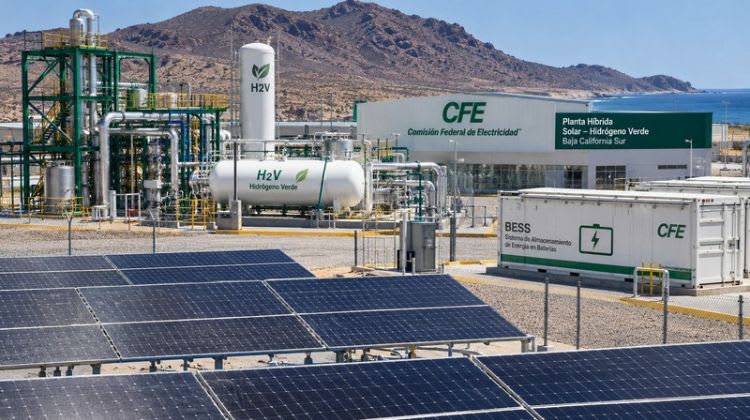
In May 2026, the Ministry of Energy launched a call for strategic generation and storage projects aligned with the sector's binding planning, including partnership mechanisms with the Federal Electricity Commission (CFE) .
The process identified a need for 935 MW of storage systems , distributed among different electrical regions and with a reference duration of three hours .
The areas considered included Baja California, Baja California Sur, North, Northwest, East, West and Peninsular, with differentiated requirements according to the needs of the system.
The call also sought to expedite the evaluation of permits and connection and interconnection studies, one of the relevant aspects for converting new energy developments into executable projects.
Following successive modifications, the registration period for storage was set until October 30, 2026 .
The process was part of a broader electricity expansion program. The National Electricity System Strengthening and Expansion Plan 2025-2030 envisioned incorporating 32,475 MW of new generation capacity , of which 22,376 MW would correspond to renewable capacity .
These investments present opportunities for manufacturers and integrators of electrical equipment, especially in modular solutions, connection infrastructure, industrial facilities, and storage systems .
For Energy Solar Tech, the Mexican opportunity could focus both on the execution of infrastructure associated with new energy projects and on the supply of electricity for industrial consumers and data centers.
However, the market also presents unique conditions. Private participation in certain projects is structured through schemes associated with the CFE (Federal Electricity Commission), while permits, network availability, and contracting mechanisms determine the viability and investment timelines.
In this context, the ability to establish relationships with local developers, operators, and integrators could be crucial in transforming commercial interest into an effective project portfolio.
From exporting equipment to establishing alliances: the expansion model towards 2030
Beyond the differences between Chile, Brazil, and Mexico, Energy Solar Tech's strategy aims to leverage a shared need: transforming the growth in electricity demand into available and operational infrastructure, without transferring all the complexity of the projects to their execution in the field .
Solano explained that the company will seek to adapt its engineering, modular manufacturing and energy integration capabilities to the needs of each country, with a model that contemplates a direct presence when there is sufficient commercial volume.
“Our entry model brings a direct presence when the volume of opportunities justifies it. Our value proposition is based on transferring our experience in electrical engineering, modular manufacturing, plug & play solutions and energy integration, adapting it to the needs of each market,” he noted.
The firm did not specify committed investments, acquisitions, its own offices or awarded projects in the three destinations mentioned, so its regional expansion is still being considered in terms of identifying and developing opportunities.
Regarding the objectives for 2027-2030, the executive avoided specifying a percentage of the business that should correspond to Latin America. Instead, he anticipated that international growth will be measured by a larger project portfolio, profitability, longer-term contracts, and greater commercial visibility .
“The goal is not simply to export equipment, but to develop local relationships and offer comprehensive solutions that address one of the main challenges of these projects: having reliable and rapidly deployable electrical infrastructure,” he concluded.
Thus, Chile offers a rapidly expanding storage market, Brazil is opening a window for industrial contracts and incentives, and Mexico is looking to implement new investments under its electricity planning . These three distinct scenarios could define where and how Energy Solar Tech is transforming its Latin American strategy into new business opportunities.
 By Emilia Lardizabal

 By Florencia Guglielmetti

 By Ailén Pedrotti