


The Canary Islands imported more than 60,000 concrete supports for photovoltaic installations in recent years , a volume that represented approximately 150 shipping containers and highlighted the archipelago's dependence on industrial supplies from the mainland.
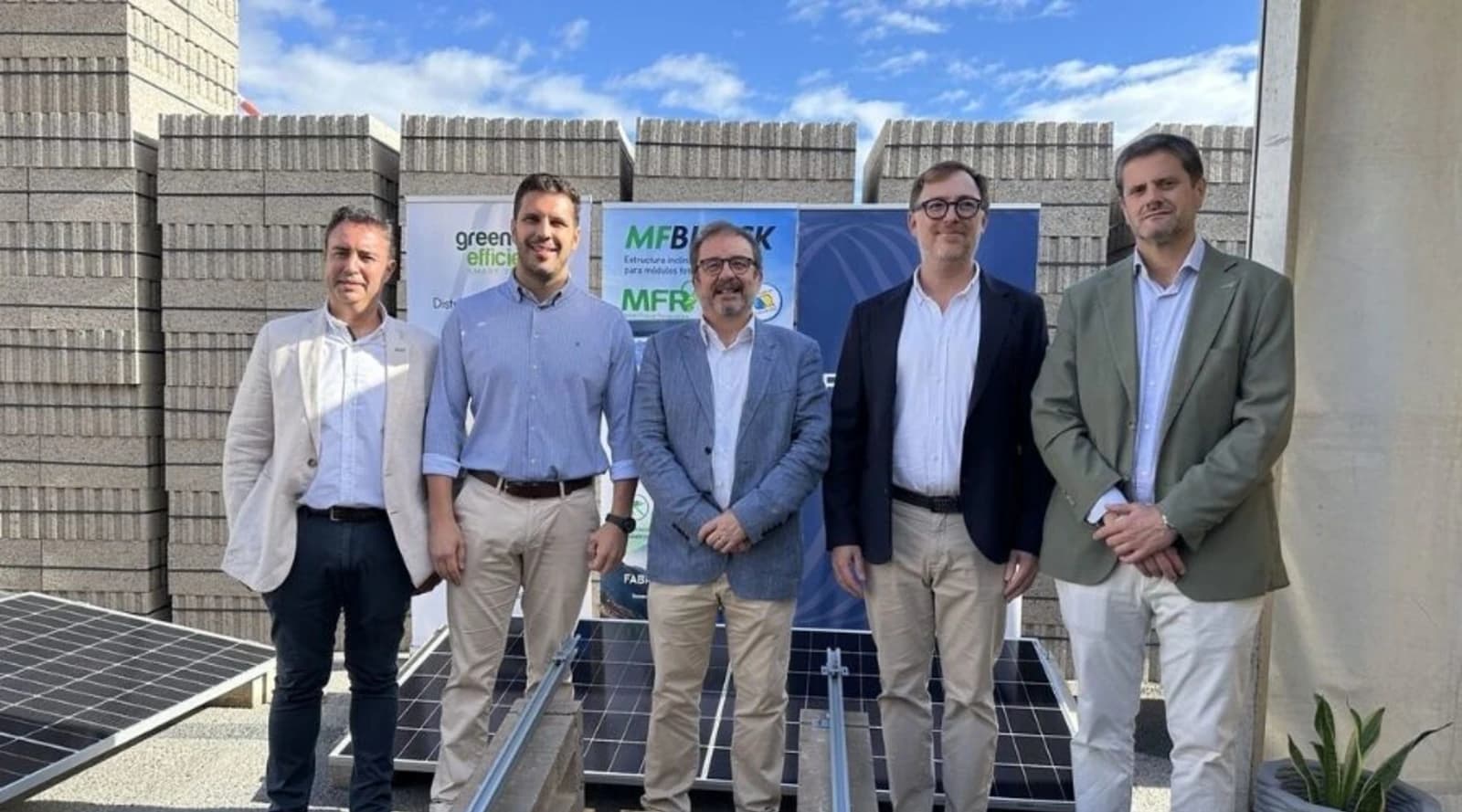
Faced with this situation, Prearsa, Green Efficient Solutions, and Metal Frame Renovables launched a new manufacturing line in the Arinaga Industrial Park, in the municipality of Agüimes, Gran Canaria . This was the first facility of its kind in the Canary Islands, officially presented on October 19th.
The initiative brought together capabilities in precast concrete manufacturing, photovoltaic equipment distribution, and structural engineering. After more than a year of joint development, the three companies began producing components designed to support solar panels , with the aim of supplying installers and distributors in the Canary Islands directly.
The new industrial activity was developed at the Prearsa facilities, which already had experience in prefabricated concrete elements and construction solutions based on recycled materials.

The project also included maintaining permanent stocks to meet orders from both Gran Canaria and the other islands, reducing the need to import these components from the Peninsula.
A new industrial business to reduce foreign dependence
One of the main economic arguments of the project was the logistical savings associated with the manufacture of heavy components within the archipelago itself.
According to estimates released by the participating companies, local sourcing could reduce costs by up to 40%, mainly due to the elimination of some of the expenses related to maritime transport.
The new line was designed to meet the demand of the Canary Islands market and allow local distributors to access island-manufactured support without depending exclusively on delivery times from the Peninsula.
Sebastián Martínez , CEO of Green Efficient, highlighted that the units imported in recent years also represented a missed opportunity to generate employment and develop technological knowledge within the Canary Islands.
The manager explained that transporting the 60,000 pieces had required approximately 150 containers, at a rate of about 400 units per load.
For his part, Alejandro Brito, manager of Prearsa, pointed out the contradiction of promoting renewable generation facilities while part of their structural components had to be moved from the mainland.
Local production sought to reverse this situation by utilizing existing industrial infrastructure and developing a specific supply chain for the solar sector.
The photovoltaic expansion of Gran Canaria opened up industrial opportunities
The inauguration was attended by Raúl García Brink, Councillor for Environment, Climate, Energy and Knowledge of the Gran Canaria Island Council , who toured the facilities together with representatives of the three promoting companies.
Continue reading
The official praised business collaboration as a tool to expand the local renewable energy industry and raised the possibility of developing new business opportunities in the African market.
During his speech, he recalled that the Cabildo maintained around 20 actions linked to renewable energies in different parts of Gran Canaria, including a 2 MW installation near Arinag a, equipped with four storage batteries.
He also highlighted the completion of photovoltaic installations totaling 500 kW in Jinámar , intended to boost an industrial energy community, although he warned about the administrative delays that were affecting their commissioning.
The development of new industrial capabilities coincided with the challenges Gran Canaria faced in increasing the renewable share of its electricity system.
In a previous interview with Energía Estratégica, García Brink explained that renewable sources represented approximately 23% to 24% of the island's electricity production, while nearly 70% of the electrical nodes had high levels of saturation.
The island official also identified the limited availability of land as one of the factors conditioning the deployment of new installations. In that context, he highlighted the use of rooftops, parking lots, and other already developed surfaces to increase photovoltaic generation without proportionally expanding land use.
This strategy gave relevance to structural solutions that would allow the integration of solar panels into existing infrastructures, a segment that the new manufacturing line in Arinaga targeted.
The commissioning of the plant thus added a new industrial link to the photovoltaic supply chain of the Canary Islands, with a production capacity whose use will depend on the development of projects and the demand from installers and distributors in the archipelago.
MFBLOCK: Solar structures without perforating the roofs
The first product incorporated into local manufacturing was the 10-degree MFBLOCK, a solution developed by Metal Frame Renovables that used prefabricated concrete pieces to support photovoltaic modules without the need to drill into the installation surfaces.
The system employed a self-ballasted configuration, in which the structure's own weight provided stability against wind loads. Its modular design simplifies assembly and reduces the need for intervention on industrial and commercial roofs.
According to the manufacturer's specifications, the MFBLOCK structures allowed the addition of up to six additional ballasts per support to adapt their weight to the technical requirements of each project.
The manufacturing process in Arinaga also incorporated circular economy principles. According to information released during the inauguration, the system included a composition with up to 85% recycled materials, while the responsible companies worked on incorporating recycled concrete and other materials with a lower environmental impact.
The companies planned to progressively expand their product range to meet the different photovoltaic configurations and installation conditions of the Canary Islands market.
