


The inclusion of the definition of renewable hydrogen in the General Law on Climate Change marks a new milestone for an industry seeking to scale up in Mexico. “ We believe it is a decisive step for the development of the industry ,” said Israel Hurtado , president of the Mexican Hydrogen and Energy Transformation Association , in a conversation with Energía Estratégica.
However, the executive clarified that the projects currently underway do not depend on this regulatory recognition, but rather were already progressing, driven by private sector interest. In this context, the real challenge now lies in economic competitiveness. Hurtado stated that currently, producing green hydrogen in Mexico costs between US$5 and US$6 per kilogram , and projected a gradual decrease to levels close to US$2/kg in the coming years , bringing it closer to the competitiveness of gray hydrogen.
To explain this expectation, Hurtado drew a parallel with the evolution of solar energy. He recalled that just over a decade ago, installing one megawatt of photovoltaic capacity in Mexico cost US$3.5 million, while today that cost is around US$600,000, after a drop of more than 80%. “When its use becomes widespread, costs will fall,” he maintained.
This scenario is beginning to take shape on a concrete basis. Mexico already has 27 clean hydrogen projects in various stages of development and three initiatives that are already producing hydrogen, albeit still at a pilot scale . For Hurtado, legal recognition does not change the immediate viability of these developments, but it does send a key institutional signal to attract investment and consolidate a regulatory roadmap.

“Beyond the inclusion of a definition of hydrogen, what it shows is the government’s willingness and interest in promoting the issue. And that, for us, is the most important thing,” he stated.
The approval of the bill in the Chamber of Deputies, with 450 votes in favor and no abstentions or rejections , is seen as an unprecedented institutional endorsement for a technology seeking to position itself within the country's energy transition.
Currently, three projects are already producing hydrogen in Mexico, although they are still under pilot programs aimed at validating technology and operating models. Two of these initiatives belong to Infra, with plants located in Querétaro and San Luis Potosí, where each development involved investments of approximately 100 million Mexican pesos, equivalent to about US$5 million.
Continue reading
As Hurtado explained, both plants produce around 500 cubic meters of green hydrogen per day and are part of a first learning stage for the industry.
In addition to these developments, a project spearheaded by the Federal Electricity Commission (CFE) has incorporated hydrogen fuel cell technology for backup power at some substations. According to the executive, this initiative has involved investments of approximately US$20 million.
Beyond the currently operational developments, the potential of the Mexican market is significantly greater. According to the updated project map of the Mexican Hydrogen and Energy Transformation Association, the identified portfolio represents potential investments of US$22,370.5 million, with the capacity to produce 196,707 tons of green hydrogen, 970,000 tons of green ammonia, and 2.1 million tons of green and blue methanol. This is in addition to the projected installation of 4,174 MW of new renewable generation capacity associated with these developments.
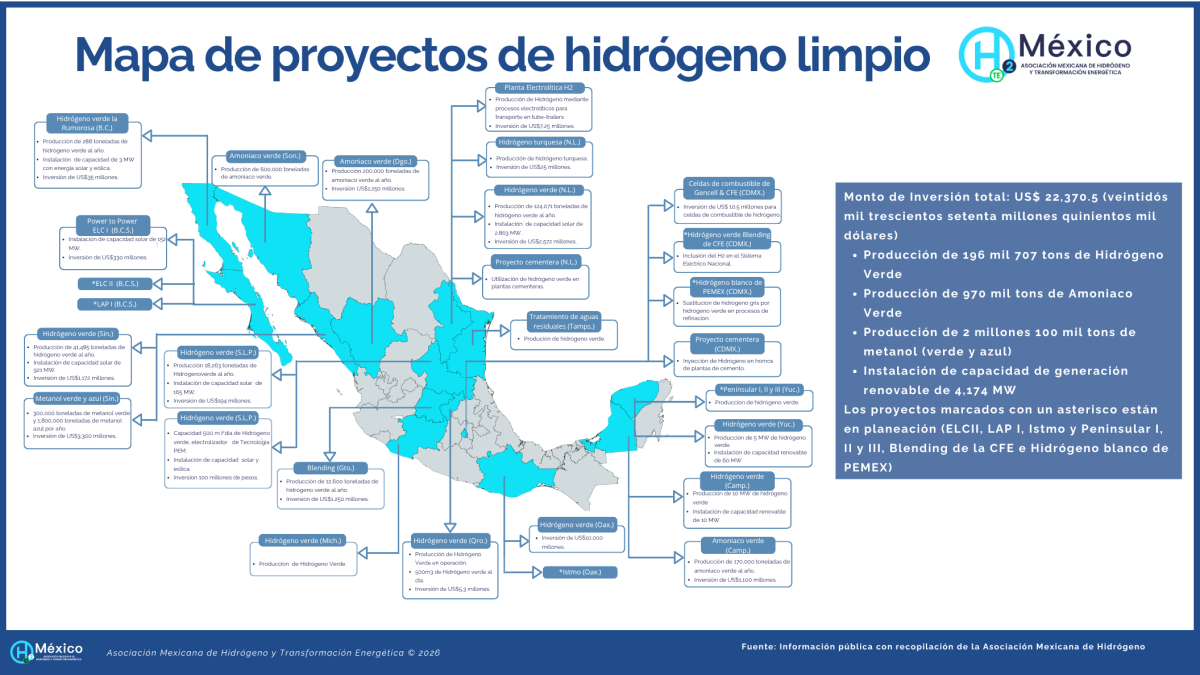
The pipeline includes initiatives distributed across strategic states such as Yucatán, Oaxaca, Campeche, San Luis Potosí, and Mexico City , although several of these projects are still in the planning phase. Among them are proposals related to hydrogen blending in the electrical grid, green hydrogen production for industrial use, and developments focused on derivatives such as ammonia and methanol, demonstrating that the country's commitment is not limited to fuel alone, but rather encompasses a broader strategy for green molecules.
The association believes that Mexico could position itself particularly competitively in the production of renewable hydrogen. This argument is based on factors such as the country's renewable energy potential, the availability of natural resources, and its strategic geographic location.
“Mexico could even have some costs that are lower than in other parts of the world,” Hurtado concluded.