


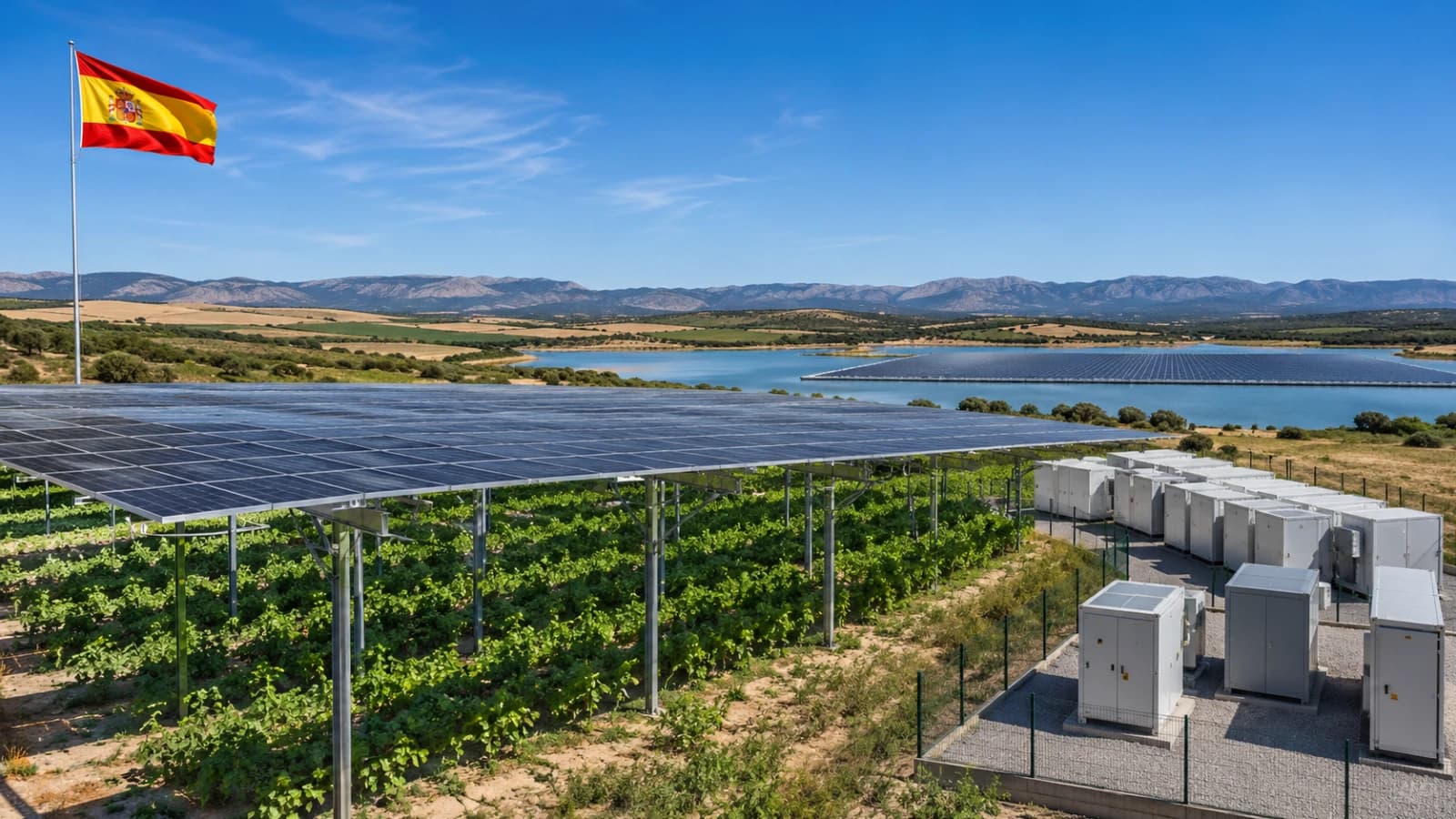
The second call for proposals for the Innovative Renewable Energies Program of the Institute for Diversification and Energy Saving (IDAE) reached an initial expanded allocation of 368.5 million euros for the whole of Spain , distributed among five lines of incentives.
In that first budget allocation, 178.82 million euros corresponded to Program 1 of agrivoltaics; 41.29 million to Program 2 of floating photovoltaics; 64.01 million to Program 3 of integration in infrastructures; 40.5 million to Program 4 of collective self-consumption; and 43.88 million to Program 5 of renewable heat pumps.
This analysis focuses on the four electricity programs that combine renewable generation and storage. The resolution under review allocates €382.3 million to 468 electricity projects totaling 1164.7 MW . Agrivoltaics accounts for 882.43 MW, while floating photovoltaics, the integration of renewables into infrastructure, and collective self-consumption together account for another 282.27 MW .
The official document distinguishes five programs and, within agrivoltaics, three subprograms defined by the arrangement of the modules in relation to the crops. All projects included in the first four categories incorporate energy storage.

Agrivoltaics accounts for three out of every four megawatts
Program 1 has become the flagship program of this call for proposals , with 118 projects and a total awarded capacity of 882.43 MW . These projects will receive €234.03 million in funding and will mobilize an investment of €747.62 million .
The average grant is €1.98 million per project , while the average investment reaches €6.34 million. Public funding represents approximately 31% of the planned expenditure , meaning that each euro awarded mobilizes more than three euros of investment.
The program is divided into three configurations. Subprogram 1.1 comprises photovoltaic installations interspersed with crops. Subprogram 1.2 finances structures over agricultural production with heights between two and four meters. Subprogram 1.3 is reserved for systems elevated above four meters.
The first category includes numerous industrial-scale developments. These include a 61.64 MW plant in Montoro , Córdoba, and two facilities of approximately 50 MW each in Mansilla de las Mulas and Villamoratiel de las Matas, León. The resolution also includes agrivoltaic projects located in Catalonia, the Valencian Community, the Balearic Islands, Aragon, the Canary Islands, and the Basque Country.
Within subprogram 1.2, a 75 MW project in Pozo de Guadalajara stands out, along with a nearly 50 MW installation in Alfajarín, Zaragoza. Two Solaria projects in La Portella, Lleida, totaling approximately 57 MW , are also included.
In the category of structures taller than four meters, the following stand out: a 52.03 MW initiative in Jarafuel , Valencian Community; another of 21.93 MW in Martos, Jaén; and a 20 MW development in Sierra Engarcerán, Castellón.
The portfolio thus combines large-scale projects with sub-megawatt installations. This diversity will allow for the evaluation of different crops, heights, shading systems, agricultural operations, and storage schemes.
Among the developers with the highest number of awards are Eki Agrivoltaics , with five projects; Climventures , with four; and Electra Caldense Distribució and Oleícola Berlangueña , with three each.
Also included are Solaria, Enervilla Renovables, Denersa, and Dargon Energy , with two projects per company. In total, the category comprises 99 unique beneficiary tax identification numbers (NIFs).
Catalonia leads the region with 30 projects, 221.40 MW and €52.30 million in aid . It is followed by the Valencian Community, with 24 initiatives, 143.53 MW and €46.30 million.
Castilla y León will receive 16 projects totaling 180.36 MW , while Andalusia will receive 110.10 MW through eight projects. Castilla-La Mancha will add 94.35 MW and Aragón another 67.68 MW.
The six regions account for more than 92% of the awarded agrivoltaic capacity . The distribution also shows that the number of projects does not necessarily determine leadership in capacity: Castile and León surpasses the Valencian Community in megawatts despite having eight fewer projects.
In total, the 118 agrivoltaic projects incorporate 1733.82 MWh of storage capacity . This figure is equivalent to almost two hours of storage for each MW of photovoltaic capacity awarded , although the ratio varies significantly depending on the configuration of the installations.
Subprogram 1.1 accounts for 1039.92 MWh , nearly 60% of the total agrivoltaic capacity. Structures between two and four meters high, under subprogram 1.2, contribute 291.98 MWh , while systems taller than four meters account for 401.92 MWh . This latter category exhibits the highest relative intensity, with approximately 3.18 MWh of storage per MW of solar , compared to 2.07 MWh/MW in the interconnected configuration and 1.15 MWh/MW in intermediate-height structures.

Floating photovoltaics receives the greatest relative support
Program 2 finances floating photovoltaic installations on reservoirs, irrigation ponds and other artificial bodies of water, always combined with storage systems.
The program awards 29 projects totaling 46.50 MW . These projects will receive €37.11 million and will mobilize an investment of €51.03 million .
Continue reading
The grant covers approximately 73% of the investment , the highest level of support among the four technologies analyzed. The average support reaches €1.28 million per initiative, compared to an average investment of €1.76 million.
Among the companies linked to the awards are Atlántica and Abengoa , in addition to companies, cooperatives and irrigation communities identified in the resolution by their corresponding NIFs.
The list includes 3.5 MW projects in Puerto Lápice , facilities ranging from three to 5.6 MW in Logrosán, and a six MW plant in Écija. It also incorporates developments of around 500 kW, primarily for irrigation reservoirs and artificial water features.
Extremadura leads the distribution, with five projects, 13.41 MW and €10.86 million in aid . Andalusia accounts for seven initiatives and 11.83 MW.
Castilla-La Mancha adds seven MW, Catalonia 7.46 MW and the Valencian Community 2.50 MW. The Region of Murcia, Castilla y León and Aragon complete the distribution.
Although the technology represents only 4% of the power analyzed , it absorbs almost 10% of the subsidies. The difference reflects the innovative nature of floating systems, as well as the costs associated with structures, anchoring, on-water operation, and storage integration.
Renewables and batteries are integrated into existing infrastructures
Program 3 awards 47 projects that combine photovoltaic, hydroelectric or wind technologies with batteries in existing infrastructures.
The total capacity reaches 165.69 MW , with €65.46 million in aid and a planned investment of €210.74 million . Each project receives an average of €1.39 million, while the average expenditure is approximately €4.48 million.
Greenvalis Energy leads in the number of contracts awarded, with six. Aigües de Barcelona, Empresa Metropolitana de Gestió del Cicle Integral de l'Aigua , has four.
Also appearing are Iberdrola; the Metropolitan Water Supply and Sanitation Company of Seville; Biotechnology Assets; L'Energètica; and Veolia Spain , with two projects each.
The diversity of beneficiaries demonstrates the potential to integrate generation and flexibility into water networks, industrial facilities, municipal infrastructure, and pre-existing energy assets .
Catalonia accounts for 16 projects, 65.32 MW and €20.31 million in aid . Cantabria reaches 30 MW through just two initiatives, while Castile and León adds 28.81 MW.
Asturias adds 11.62 MW; Castilla-La Mancha, 7.70 MW; and Aragon, 5.20 MW. The Valencian Community, Andalusia, Galicia, Extremadura, Murcia and the Canary Islands complete the distribution.
Among the larger projects are a 20 MW facility in Cantabria , a 20.55 MW project in Olmedo, and a project of approximately 28 MW in El Prat de Llobregat. The resolution also includes hydroelectric projects in Villar del Buey and Alcolea de Tajo.
Collective self-consumption dominates in number of projects
Program 4 comprises the largest volume of applications: 274 projects , equivalent to 59% of the initiatives analyzed. However, their combined capacity is limited to 70.08 MW.
The projects receive €45.69 million and mobilize an investment of €104 million. The average grant is €166,749 per project, while the average expenditure reaches approximately €379,573.
The smaller scale reflects the program's distributed nature, aimed at collective self-consumption with storage and the participation of vulnerable consumers . The portfolio includes municipalities, cooperatives, energy communities, and other local stakeholders.
Among the entities with the most awards are NIF A74255282 , with 69 projects; B25821356 , with 40; and B26615617 , with 29. Also noteworthy are P0800258F and A95758389, with eight files each.
Catalonia leads with 129 projects, 27.83 MW and €15.68 million in aid . Extremadura has 37 initiatives and 11.36 MW, while Andalusia has 26 projects and 9.10 MW.
The Valencian Community has 34 projects and 7.31 MW. Madrid, despite having only three initiatives, adds 5.48 MW.
The results show two deployment models. On the one hand, agrivoltaics and infrastructure integration account for the largest share of capacity and investment. On the other, collective self-consumption prioritizes territorial reach and community participation , while floating photovoltaics receives proportionally more public support.
With 882.43 MW , agrivoltaics exceeds the combined capacity of the other three electricity programs by more than three times. The true impact of this initiative, however, will depend on project implementation, their compatibility with agricultural production, and the capacity of storage systems to provide flexibility and improve renewable energy integration.