


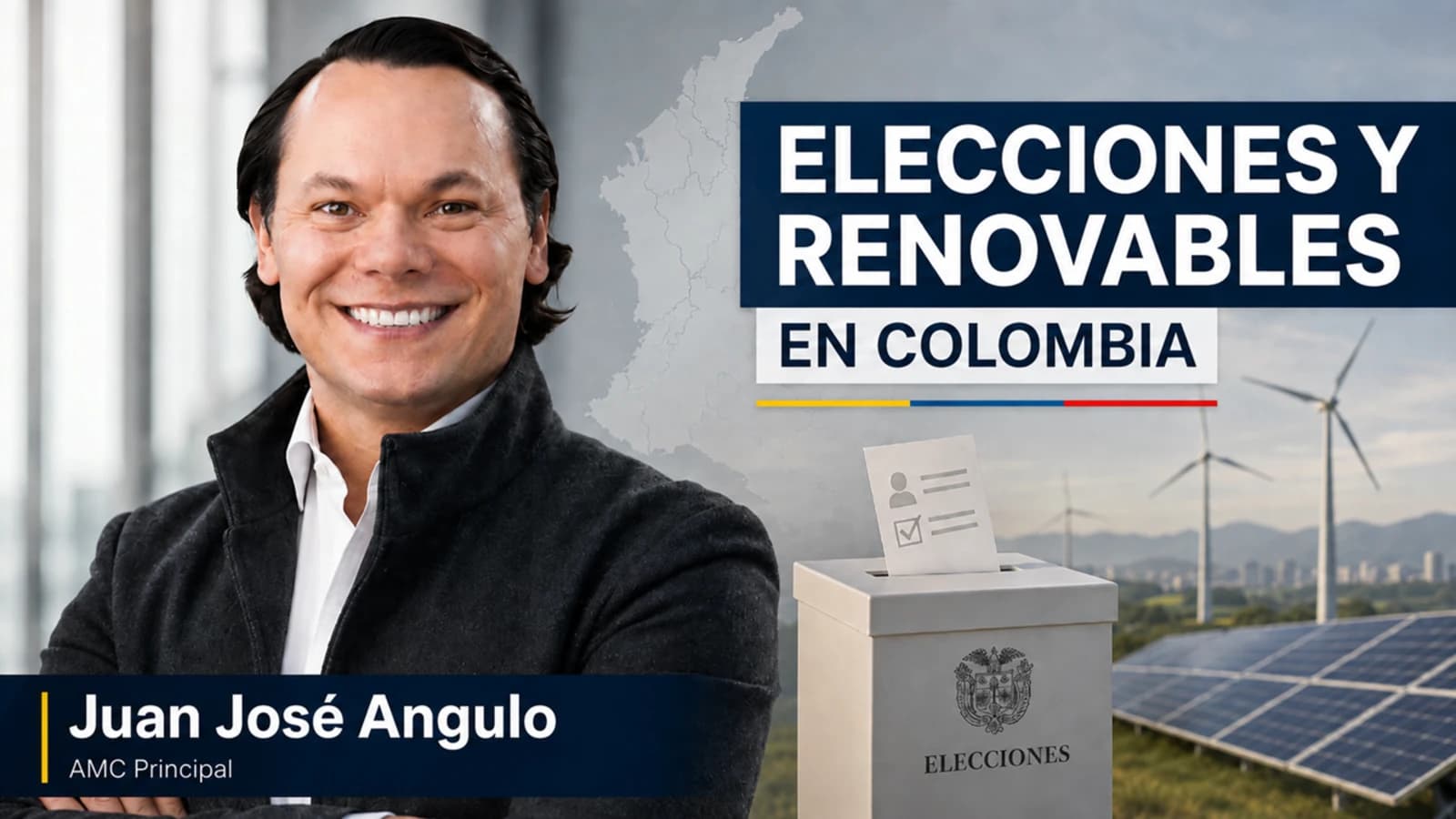
Colombia is approaching a new presidential election amid an increasingly sensitive energy debate: what kind of government does the country need to unlock renewable development?
The question was posed directly during the Strategic Energy streaming to Juan José Angulo, founder of AMC Principal, lawyer, consultant and one of the most active figures in the regulatory and transactional analysis of the Colombian electricity sector.
The question was straightforward: who benefits from photovoltaics? Which candidate offers the best conditions for renewable energy? Should the sector opt for continuity, change, or a broader vision of energy security?
Angulo declined to name names. But he did offer a fundamental definition: for renewable energy to grow, Colombia needs a government that provides security, unlocks infrastructure, and translates regulations into projects that are actually built.

The following are the main points of the interview.
—Juan José, before we get into energy: how is this election moment being experienced in Colombia?
—We are in a complex time. There is a popular saying that a smooth sea never made great sailors, and I think Colombia is going through precisely that kind of moment.
What happens in these elections will be decisive, not only for the future of energy, but also for the future of the country as a developing society. That's why it's so important that people go out and vote.
Colombia is risking much more than a sectoral agenda. It is risking what its future direction as a country will be.
—Do you feel there is a desire for continuity or a desire for change?
—I think the country is in the process of defining where it wants to go.
Energy is a cross-cutting issue. It's the foundation that allows us to achieve many of the goals a society sets for itself. That's why, when we talk about energy, we're not just talking about electricity: we're talking about development, competitiveness, well-being, and productive capacity.
If people actually turn out to vote, there could be surprises. There's an electorate that can still mobilize and that isn't necessarily fully reflected in the polls.
—When you look at the polls, very close scenarios appear. Do those numbers add up for you?
—When the information from different polls is synthesized, we start talking about technical ties. Mathematically, the result could go either way.
But in Colombia, there's always one key element: abstention. That can be a determining factor. Whoever manages to mobilize those who haven't yet decided to vote, or those who are undecided, may find a very important opportunity.
—Let's get to the energy point. Which of the candidates would benefit from renewables?
—I'm going to answer based on what I believe the renewable energy sector and the electricity industry in general need. Then everyone can draw their own conclusions.
My professional focus has been on renewable energy. I've spent a decade helping to build a sector that practically didn't exist in Colombia. But today, the sector is no longer at the same stage it was ten years ago.
Renewable energy has already proven its place. Now it needs to complete its maturation cycle. And for that, it requires the necessary context: robust electrical systems, grids capable of receiving that energy, and secure conditions.
—But let me ask you more directly: which candidate is best? Can you give me a name?
—I think that's still to be discovered.
We haven't had any major energy debates in this campaign, and that creates uncertainty. Some candidates have put forward ideas, while others allow us to anticipate certain approaches based on what they would represent as continuity or change.
But, for me, the key is something else: the candidate who most reinforces the notion of security will be a strategic ally of renewables.
—Security in what sense? Legal security?
—Regulatory security, institutional security, security to mobilize capital, security to build infrastructure, and energy security.
Renewable energy sources need the system to be able to receive their energy. They need transmission, connection, clear rules, permits, financing, and implementation capacity.
It's not enough for a candidate to say they support renewable energy. The key is whether they can create the conditions for those projects to become a reality.
—So, the sector isn't just looking at who promises the most solar or wind energy?
—Exactly. That's one of the great lessons of the last ten years.
Promotional mechanisms, such as auctions, are very important. They are necessary and have been a suitable incentive. But they are not sufficient.
Colombia had significant awards and important price signals, but a significant portion of that did not translate into built infrastructure.
—What was the problem?
—That the electricity industry cannot be solved solely on paper.
Laws, decrees, auctions, and resolutions are tools. But we shouldn't attribute more to them than they can deliver.
Then comes the physical reality of the market: the connection, the transmission, the territory, the communities, the permits, the lines, the towers, the financing and the construction.
That's where it's defined whether a project exists or not.
Does Colombia need more laws or does it need to better implement the ones it already has?
—Colombia has very high-quality laws. As a lawyer, and comparing it to other countries, I can say that the country has very well-made regulations.
There will always be things to improve, but the main problem isn't the lack of rules. The challenge is putting them into practice.
Institutions must commit to turning those normative statements into real infrastructure.
—When you talk to people in the sector, many seem to be asking for change. But the current government also announced measures for renewables. How do you explain that contradiction?
—Because the market has already learned that a regulatory signal or an auction is not enough.
A new auction can be a good sign. But investors also look at legal certainty, transmission capacity, reliable payments, the progress of permits, and whether the project is feasible.
The sector isn't just asking for more announcements. It's asking for real conditions for investment.
—Is that the cry for change that is being heard in the industry?
—Yes. Not necessarily a change understood only in partisan terms, but a change in the capacity to execute.
More laws won't build the infrastructure Colombia needs. What's required are managerial skills, executive capabilities, and an understanding of investor language.
Those who mobilize capital need to know that they will be able to develop the project, connect it, operate it, and recover their investment within a stable framework.
—In recent days there has also been debate about the reliability charge auction. What happened there?
—The reliability charge auction is one of the key mechanisms of the Colombian electricity system. It's the expansion auction and aims to guarantee new generation capacity to ensure the system's reliability.
Unlike a renewable energy auction or a long-term contract auction, the product being auctioned here is firm energy. Conceptually, it functions as demand insurance.
The system needs to know that it will have resources available in times of scarcity.
—The controversy arose because thermal projects were awarded.
—Yes, and there's a discussion there that we need to organize better.
We shouldn't view energy as an ideological competition between sources. Each source has its own attributes. Solar has some attributes, hydroelectric others, thermal others, and batteries still others.
As a country we need clean energy, but also reliable and competitive energy.
The attributes should not compete with each other. The system needs the sum of those attributes.
—Is the problem that the thermal power plant is awarded, or that Colombia depends on imported gas?
—The delicate point is that part of that thermal generation is powered by imported natural gas.
For years, Colombia chose natural gas as its transition fuel. But today, the country has lost its gas self-sufficiency and must import it. This introduces costs, contractual uncertainty, and additional infrastructure.
That's why the discussion can't be superficial. It's not just about saying "thermal power yes" or "thermal power no." It's about understanding what backup the system needs and under what conditions.
—How urgent is the reliability problem?
—Very urgent.
Colombia is entering a high-probability El Niño phase. Currently, thermal power plants account for approximately 12% of energy generation, but in a scenario of water stress, they could represent nearly 55% of the actual energy received by homes and industries.
This shows that we cannot view the system as separate sources. We must view it as a system.
—And how do renewables fit into that discussion?
—Renewables are essential, but they must incorporate the necessary elements to provide stability and reliability.
Solar energy, for example, has a huge opportunity in Colombia. But if we want it to play an increasingly important role, we need to complement it with storage, grids, and mechanisms that allow us to manage its variability.
Colombia's energy future must be considered from the perspective of energy security.
—The government announced an auction of long-term renewable energy contracts. Can this shift the balance towards clean energy?
—It can help, but you have to be careful with expectations.
The auction of long-term contracts is important because it can be a natural enabler for financing renewable energy projects. However, the projects awarded through this auction would not come online until around 2029 or 2030.
Colombia has short and medium-term needs that will not be resolved with projects that come in four years.
—So the auction wasn't enough?
—It's not enough on its own.
It may be a valuable signal, but the country needs to solve immediate problems of supply, connection, transmission and demand management.
Furthermore, we need to examine whether the awarded projects can actually be built. That is the central point.
—Is there also uncertainty surrounding the auction of the position?
—Yes. Although results have already been published, there are still projects that need to submit guarantees and fuel contracts.
Until that happens, it is impossible to say with complete certainty which projects will effectively close the mechanism.
We have to wait for the complete closure to know what generation capacity will actually be available by 2030.
—You mentioned the lawsuit as part of the solution. What do you mean by that?
—Colombia is launching a very important regulatory framework for remote self-generation.
This allows a company to analyze where it makes the most sense to produce energy and then distribute it to its various consumption centers in the country.
It could be a restaurant chain, an industry, a company with multiple locations, or any consumer with multiple points of demand.
—Does this change the landscape of the electricity sector?
—Yes, because players are starting to appear who are not traditional generators, but who can produce energy for their own consumption.
Demand is beginning to chart new courses in the electricity industry.
And this can be very relevant for industries, shopping centers, logistics chains, technology companies, and new consumer-intensive sectors.
—What new consumption patterns are putting pressure on the system?
—First, electric vehicles.
Electric vehicles are becoming a popular choice for families in Colombian cities. But this means a new energy consumer.
And there's a challenge: many people charge their vehicles when they get home, at times when solar power is no longer available. This puts stress on the system and requires us to consider batteries, flexibility, and demand management.
—You also mentioned data centers and artificial intelligence.
—Yes. The deployment of digital infrastructure is going to be enormous. Servers, data centers, and artificial intelligence are going to require a lot of energy.
Colombia must view the energy transition as an economic opportunity, not just as a supply problem.
With remote self-generation, a company could decide where to locate its servers based on climate, connectivity and proximity to fiber optics, and at the same time define where to produce the energy to supply that operation.
There's a huge opportunity there.
—Going back to the elections: if you had to summarize, which government is best for renewables?
—A government that provides security is needed.
Regulatory security, institutional security, energy security, security for investment, and security for execution.
The government that understands that renewables are not consolidated just with announcements, but with infrastructure, transmission, clear rules and construction capacity, will be the one that helps the sector the most.
—Even if he's not the one who talks about renewables the most?
-Exactly.
The best ally of renewables will not necessarily be the one who uses the word "renewable" the most in campaigns, but the one who manages to create the conditions for projects to be built, connected and operated.
That is Colombia's real challenge.
—What signal is the market waiting for today?
—The market expects certainty.
Investors want to know that if they participate in an auction or develop a project, they will be able to bring it to fruition. That the rules will be stable. That the institutions will be responsive. That the network will be available. That the permits can be processed. That the country understands the importance of infrastructure.
The energy transition isn't achieved through regulations alone. It requires action.
—So, does the election define the renewable future?
—It defines a very important part.
Colombia has already begun its process of incorporating renewable energy. That's not up for debate. What's at stake now is whether the country can reach a stage of maturity, where projects move beyond simply being awarded or announced and begin to operate effectively.
The next government will have to decide whether it wants to manage expectations or build infrastructure. And for renewable energy, that difference is crucial.