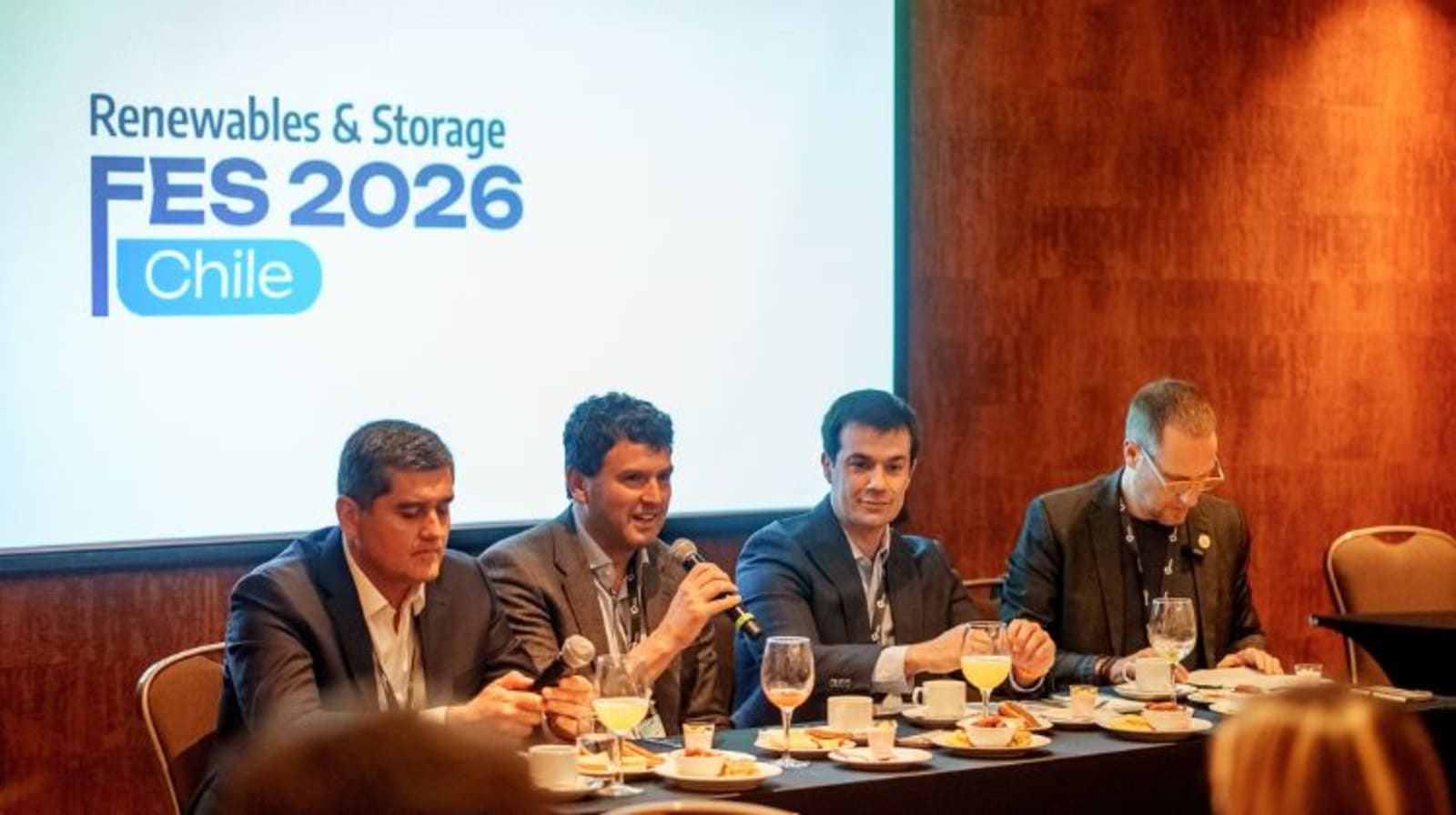
Chile's electricity demand faces a shift in its growth outlook. While large-scale copper mining anticipates a scenario dominated by contract renewals, desalination is projected to add between 2 and 3 TWh by 2030 , opening new opportunities for renewable energy generators, storage developers, and energy traders.
This was explained by Francisco Danitz, Corporate Manager of Energy and Water at Codelco; Ignacio Rodríguez, General Manager of Desala; and Felipe Flores, Energy Manager of Grupo Falabella , during the VIP Networking Breakfast "What do large consumers prioritize for optimal energy supply," held within the framework of Future Energy Summit (FES) Chile.
The three executives' perspectives put up to 4 TWh on the table between contract renewals and new projected demand , in addition to changes in the supply strategies of large consumers, who are beginning to demand greater flexibility, competitiveness and comprehensive energy solutions.
"We are talking about at least 1 TWh that we have to put out to tender, probably at the beginning of next year," anticipated Danitz of Codelco, who explained that the process was moved from the end of 2026 due to the need to specify the company's electricity requirements from 2030 onwards.

However, the state-owned company does not anticipate that this volume will represent new consumption, but will be primarily aimed at replacing contracts nearing their expiration.
The executive clarifies that copper mining, responsible for approximately one-third of the national electricity demand, does not foresee large increases in consumption in the short term.
"In the short term, we will probably see more contract renewals than new demand," warned the executive, who specified that Codelco's next tender includes renewable energy supply offers.
Desala, for its part, projects that Chile's installed desalination capacity will increase from approximately 11 cubic meters per second to more than 20 cubic meters per second by 2030 , driving new energy requirements for water production and transport.
"That adds a net electricity demand of between 2 and 3 TWh," said Rodríguez, who anticipated that the contracts associated with this expansion could be signed by 2028.
Growth will be primarily linked to multipurpose desalination projects , which combine mining supply with agricultural, industrial, and human consumption demand. This model introduces diverse consumption profiles and opens opportunities for flexible PPAs, renewable energy generation, and storage.
From the retail side, Grupo Falabella registers an electricity consumption of close to 500 GWh per year in Chile and recently concluded a new contracting process for the supply cycle that will begin on January 1, 2027.
"In terms of strategy, we have corporate targets for 2035 in scope 1 and 2 of Net Zero. Our current and future contracts are backed by renewable energy accreditation," said Felipe Flores, Energy Manager of Grupo Falabella, during the panel.
The company, which operates in seven countries in the region, is also committed to greater contractual flexibility, energy efficiency, self-generation and storage , with the aim of adapting its supply to the needs of its different facilities.
Thus, the perspectives of the three consumers show a reconfiguration of commercial opportunities in Chile : mining prioritizes renewals for large volumes, desalination emerges as a source of new demand, and retail moves towards supply schemes that incorporate complementary energy solutions.
Multipurpose desalination: up to 3 TWh and new opportunities for PPAs and BESS
The growth of desalination presents a commercial peculiarity: the transition from infrastructures built for a single mining client to multipurpose projects, capable of simultaneously supplying industrial operations, agriculture and human consumption.
Rodríguez explains that this model allows mining to be used as an anchor client, while other users incorporate different water needs and expand the potential market for developers.
In Desala's projects, between 60% and 70% of the water supply is allocated to mining and industry, 20% to agriculture, and 10% to human consumption , including rural services and backup contracts for water utilities. As a point of reference, the executive mentions Aguas Pacífico, which supplies users such as Anglo American Los Bronces and has a predominantly industrial distribution system, with a smaller share allocated to human consumption.
This composition modifies the energy profile of the projects. While mining activity requires a constant supply, certain agricultural consumers have seasonal requirements and the capacity to store the resource.
"The conclusion regarding the structuring of multipurpose PPAs is that creative and flexible structures will be sought that make the most of the day's solar energy to lower the weighted average cost of the PPA," explained the general manager of Desala.
The model proposes increasing water production during peak sunlight hours and maintaining supply to mining users at night. For renewable energy generators, this opens the possibility of structuring contracts with differentiated time blocks , adapted to the operation of desalination plants and the requirements of each type of consumer.
According to Rodríguez, the transport of water to consumption centers is one of the main factors that determine the energy demand of Chilean projects.
"For projects over 100 km in terms of electricity consumption, the ratio is 80% pumping and 20% desalination plant," he explained. Pumping stations can require between 10 and 20 MW approximately every 40 kilometers , depending on topographical conditions, and many are located in isolated areas without sufficient electrical infrastructure.
"I recommend that generators follow the pipeline routes and propose renewable self-consumption solutions with BESS at pumping stations," said the general manager of Desala.
However, these projects also face financial challenges, especially when the supply includes agricultural and human consumption customers who have different credit profiles than large mining buyers.
Rodríguez explains that industrial and mining consumers must support around 90% of project revenues to facilitate bankability , while complementary users allow for diversifying the economic and social impact of the facilities.
Furthermore, it highlights the interest of multilateral entities such as the International Finance Corporation and the World Bank, which consider the benefits linked to water security and agricultural development.
Looking ahead to the next five to ten years, the executive also anticipates opportunities associated with desalination systems and underwater infrastructure at depths close to 600 meters.
What financial conditions and supply guarantees do you require to sign a PPA?
The transformation of the Chilean electricity market is also reflected in the financial conditions and guarantees that large consumers demand from their suppliers for their upcoming supply contracts , especially in long-term agreements.
Continue reading
In the case of Codelco, the state-owned company seeks to establish alliances of between 10 and 15 years , with counterparties that offer financial backing, identifiable assets and the capacity to guarantee compliance with their commitments.
“We have a counterparty review policy and have adapted the regulations. The electricity market works extensively with Project Finance and SPVs that do not have audited financial statements. For a Project Company, we look at the underlying assets that support the offer, their status (RCA, financial close), and we request additional guarantees to avoid barriers to entry while still complying with regulations,” explains Francisco Danitz, Corporate Manager of Energy and Water at Codelco .
In this sense, the evaluation of special purpose companies (SPVs) is not limited to their financial statements , but also considers the projects that support the offer, their progress in the Environmental Impact Assessment System (SEIA) and the conditions necessary to finalize the financing.
“What we cannot do is hire a trader without assets,” Danitz emphasizes.
The executive clarifies that Codelco does not impose restrictions on the technological brands used in storage systems , while its financial and legal teams work to facilitate the closing of contracts without compromising internal contracting requirements.
Furthermore, in the event of any changes in ownership, the mining company requires that the new owners maintain conditions equivalent to or better than those of the original supplier.
However, the competitiveness of the electricity supply remains a central concern for Codelco , even with the goal of achieving 100% renewable energy supply for its electricity consumption by 2030.
“Chile continues to have high energy prices for large-scale copper mining not because of the generation itself, but because the ancillary payments are almost on par with the value of the energy,” Danitz warns.
According to the executive, reducing these additional costs is essential to improving the competitiveness of operations and facilitating new investments associated with mining electrification.
Furthermore, Grupo Falabella aims to achieve net-zero emissions in scopes 1 and 2 by 2035 , through a strategy that combines renewable supply, energy efficiency and complementary self-generation and storage solutions.
“In Chile, consumption is around 500 GWh per year. We recently closed a new contracting process for the next cycle, which begins on January 1st. Beyond the volume or the new contract, the important thing is to have an energy strategy that supports our sustainability strategy,” says Felipe Flores, Energy Manager of Grupo Falabella .
The executive identifies three priorities for electricity procurement : advancing renewable supply, incorporating contractual flexibility in response to the evolution of the electricity system, and complementing traditional supply with technologies that allow for optimized consumption.
"We evaluate BESS and solar panels by analyzing the total cost of ownership, demand management, regulations, and resilience. We apply it point by point locally in stores, shopping centers, and logistics centers to the extent that it delivers economic, technical, and operational value," noted the representative from Grupo Falabella.
Along those lines, the company also implements energy management systems and building automation, LED lighting and carbon dioxide refrigeration plants in supermarkets.
Codelco's strategy regarding BESS (Battery Energy Storage Systems) is based on a different investment approach . "Regarding BESS, the company will not invest its own capital in batteries or power lines; we prefer the outsourcing model with specialized third parties. We are analyzing BESS for off-grid operations that use diesel, although we face theft problems in isolated desert areas," stated the Codelco representative.
In the longer term, the electrification of haul trucks could become a significant source of new demand for Chilean mining.
"The bulk of our emissions comes from haul trucks (CAEX), which account for 80% of those emissions. A single truck can consume 4 or 5 MW. Imagine the technological replacement of 300 trucks for 5 MW; it's insane in terms of electricity demand," Danitz explained.
However, the executive places the mass electrification of these fleets on a horizon of around ten years or more , so its impact on demand would not materialize immediately.
Beyond electricity supply: what large consumers demand from their future partners
The perspectives of Codelco, Desala and Grupo Falabella show that large Chilean consumers are seeking commercial relationships that go beyond traditional electricity contracting , with greater participation of generators in technical, financial and operational solutions.
From Desala, Ignacio Rodríguez argues that suppliers should be involved from the design stage of water infrastructure projects , especially to identify opportunities for renewable self-generation, storage, and optimization of water transport.
“The message is to seek strategic partners who understand our business and support us in the long term to continue growing and advancing in corporate goals, beyond a simple sale of electricity,” says Felipe Flores, Energy Manager of Grupo Falabella .
From Codelco, Francisco Danitz highlights the need to establish alliances of between 10 and 15 years to optimize supply costs , in a context where additional charges from the electricity system represent a challenge to the competitiveness of mining.
“We must work together as an industry to make the Chilean electricity system more competitive and reduce side costs, which will trigger more investment and electrification,” concluded the corporate manager of Energy and Water at Codelco.
The perspectives of the three executives reflect a change in the opportunities of the Chilean electricity market: while mining prioritizes the renewal of large contracts, desalination projects to incorporate new demand and retail demands greater flexibility in its supply schemes.
In this scenario, renewable generators and developers will have to compete not only on price, but also on their ability to structure flexible contracts, offer financial backing and integrate storage and self-generation solutions , according to the needs of each productive activity.
RELIVE FES CHILE HERE:
Following its stop in Chile, the Future Energy Summit (FES) will hold the final event of its 2026 international tour on November 5th in São Paulo, Brazil. The event will bring together leading figures in the sector, from companies such as CATL, Huawei, Statkraft, CTG Brasil, Acciona Energia, and Casa dos Ventos , along with investors and industry associations, to analyze investment opportunities in renewable energy, energy storage, and upcoming electricity auctions. The event will take place at the InterContinental São Paulo Hotel, against a backdrop of anticipated contracting for BESS systems and the expansion of the Brazilian energy market.


 By Emilia Lardizabal
 By Ailén Pedrotti

 By Energía Estratégica