


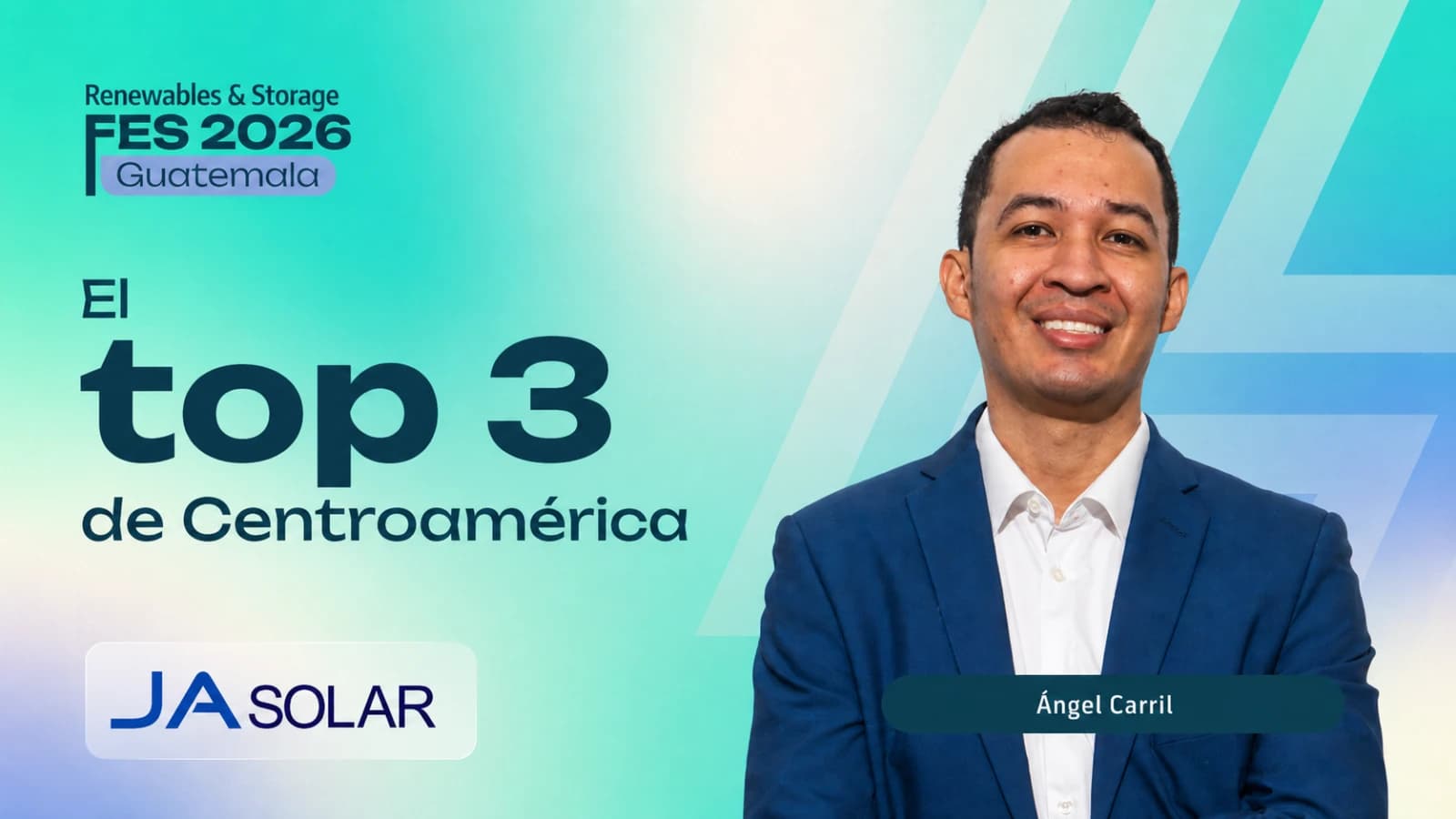
Guatemala, Panama and the Dominican Republic currently lead JA Solar 's regional map .
Ángel Carril , sales manager for Central America for the company, identified these three markets as the main centers of renewable development during an exclusive interview during Future Energy Summit (FES) Guatemala 2026.
“ We are present in each of these countries , especially Guatemala, Panama, and the Dominican Republic. These are key locations right now for the development of renewable energy in the region,” he stated.
The executive placed those three markets on the regional podium due to the volume of opportunities, the progress of tenders, and the participation of developers.

Guatemala gains momentum with PEG-5, Panama maintains highly competitive prices, and the Dominican Republic accelerates its solar deployment accompanied by batteries.
WATCH THE FULL INTERVIEW HERE: https://www.youtube.com/watch?v=9XaFb1ew5Os
Each country's position is a response to different circumstances. While the Guatemalan market is beginning to prioritize projects capable of delivering firm power, Panama is deepening its long-term contract scheme, and the Dominican Republic is incorporating energy storage as a condition for the entry of new renewable generation.
Guatemala takes the lead with PEG-5
Guatemala gained prominence within JA Solar's regional strategy after several years of photovoltaic growth. The awarding of the PEG-5 grant increased inquiries from developers seeking technology to improve the performance and profitability of their projects.
The process awarded 1,258 MW through 57 projects , of which approximately 73% correspond to renewable technologies . The tender registered an average single-unit price of USD 101/MWh , below current contracts, and showed a strong predominance of hybrid solar solutions with batteries.
Furthermore, the PEG-5 auction modified the investment criteria by prioritizing power plants capable of providing energy, power, and flexibility within specific timeframes. As a result, PV + BESS systems gained ground over other technologies due to their predictable delivery and their ability to meet firmness requirements.
Although wind power maintains one of the lowest levelized costs of generation globally, it lost competitiveness within this scheme. The auction design valued hourly availability and the ability to manage production, attributes that solar configurations with BESS were able to offer more precisely.
For JA Solar, Guatemala's progress is not limited to large plants. Demand ranges from residential installations to commercial, industrial, and utility projects.
“Guatemala is growing in all segments. From residential, commercial, and industrial to utility,” Carril noted.
The large-scale segment is currently receiving its main boost from the capacity contracted under PEG-5 and the prospect of new tenders. The company intends to support these developments by providing technical and commercial assistance during the design, construction, and commissioning phases.
“We hope to be that point of support, commercial and technical assistance for the development of these projects and that they lead to a successful point of operation,” explained the Sales Manager for Central America.
The Guatemalan agenda will continue with a new power generation tender. During FES Guatemala, authorities announced the preparation of PEG-6 to contract approximately 300 MW of firm power , after the previous process failed to meet all the required demand.
Progress is also expected on PET-4 , which aims to expand the transmission infrastructure and facilitate the integration of awarded projects. Expanding the grid will be crucial to avoid operational constraints in the face of increased solar power generation and growing demand.
Energy storage and electric transmission infrastructure appear to be the two main instruments for sustaining expansion. Guatemala differs from other Central American markets because the PEG-5 project demonstrated that batteries can compete within long-term contracts without relying exclusively on ancillary services markets.
The continuity of the PEG-6 and PET-4 projects will be closely watched by the private sector during the institutional transition prior to the general elections scheduled for 2027. The departure of Víctor Hugo Ventura from the Ministry of Energy and Mines raised questions about the timelines, although the appointment of Erwin Barrios was interpreted as a sign of continuity.
The appointment of Luis Rolando Barillas as Deputy Minister of Energy also strengthened the ministry's technical profile. The challenge for the new leadership will be to maintain the contracting schedule and provide predictability before the next change of administration.
Adding to this scenario are regulatory issues that could affect the development of the awarded assets. The implementation of the new Anti-Money Laundering Law requires updating the contractual models used by the electricity market, a crucial adjustment to avoid legal uncertainty in the PEG-6 project.
Similarly, several municipalities have begun requiring licenses or payments for the construction of solar installations without clear support in national regulations. The private sector warns that these conditions could increase costs and delay PEG-5 projects.
In this context of greater technical sophistication, JA Solar is preparing modules of up to 670 W to meet the demand for power, efficiency and better use of available surfaces.
“Customers are always looking for innovation and new technologies to make their projects more profitable,” Carril said, describing the requests received by the company.
The company is working on expanding its portfolio and positioning solutions adapted to both utility plants and commercial and industrial facilities.
Panama and the Dominican Republic complete the podium
Panama is among JA Solar's most visible markets due to the return of large-scale renewable energy tenders and the intensity of competition. The ETESA 01-25 tender awarded long-term contracts at an average price of USD 23.86/MWh , one of the lowest in the region.
Wind energy accounted for the majority of contracts due to its capacity factor and production profile. Four companies secured the largest volumes awarded, confirming investor interest in the Panamanian market.
Subsequently, the ETESA 01-26 Public Investment Program (LPI) expanded this scheme by awarding 22.6 TWh of renewable energy contracts for up to 20 years. The average price reached USD 33.7/MWh , below the reference value established for the process.
Carril linked these results to the reduction in technological costs and the measures adopted by governments to facilitate new investments.
Continue reading
“The bids were very competitive; this was something we had been seeing for some time. It reflected the drop in prices not only at the technological level, but also due to measures taken by various governments to incentivize the development of renewable energy,” he stated.
Panama plans to hold four new tenders between 2026 and 2028 to reduce its exposure to the spot market and guarantee supply through long-term contracts. The plan includes a phased addition of generation capacity, accompanied by transmission infrastructure upgrades and a greater use of battery storage.
Although energy storage was not mandatory in recent tenders, the increasing penetration of variable energy sources is shifting the debate toward flexibility. Authorities project a progressive integration of BESS systems by 2029 to improve reliability, manage demand, and facilitate renewable energy integration.
The country also maintains sustained growth in distributed generation. Photovoltaic self-consumption exceeds 196 MW installed , mainly due to the growth of the commercial and industrial sectors.
The Panamanian Chamber of Solar Energy proposes that future auctions should recognize the contribution of batteries and distributed resources. The goal is to value the reliability, demand management, and other operational services, in addition to the price of the electricity produced.
Panama generates approximately 75% of its electricity from renewable sources , primarily hydroelectric, followed by wind and solar. The increasing use of variable technologies raises the need for robust grids, flexible capacity, and mechanisms to compensate for services other than electricity generation.
Interconnection with Colombia also gained momentum through the Pan-American Electricity Initiative. This initiative identifies 16 strategic projects to expand regional trade, strengthen security of supply, and facilitate the entry of larger volumes of renewable energy.
The appointment of Rodrigo Rodríguez as head of the National Energy Secretariat was welcomed as a sign of continuity for bidding processes and the investment agenda. The combination of planning, competition, and long-term contracts consolidates the country's position as a regional leader.
The Dominican Republic completes the podium outlined by JA Solar. The renewable energy market is experiencing a surge based on the combined integration of photovoltaic generation and storage.
The EDES-LPI-01-2025 tender received bids for 1655 MWp against an initial demand of 600 MW, an oversupply that demonstrated the developers' interest. The process concluded with the awarding of 325.69 MW of new capacity, accompanied by BESS systems equivalent to 50% of the contracted power .
The remaining lots were left unawarded because the bids exceeded the reference price. Following the award, the electricity distribution companies proceeded with signing the power purchase agreements to finalize the acquisition of the assets.
The mandatory storage marked a paradigm shift and placed the Dominican Republic among the first Latin American countries to integrate BESS as a structural requirement within a competitive procedure.
Authorities are already preparing a new tender to contract the remaining 300 MW , in addition to a process aimed at adding 200 MW of battery storage to existing solar parks . This latter approach would strengthen grid stability without relying solely on new greenfield developments.
During FES Caribe, representatives of the sector anticipated processes to incorporate more than 800 MWh of storage in the short term and a projection of close to 2000 MW of BESS capacity during the next few years.
The market is also projected to reach approximately 2 GW of installed solar capacity by 2027 , accompanied by at least 600 MW of battery storage capacity already awarded or under development. This expansion responds to growing demand, the need to reduce fossil fuel consumption, and the stability requirements of the National Interconnected Electric System.
The Dominican Republic made progress in 2026 with the approval of a specific technical framework for BESS systems. The regulation establishes requirements for design, security, operation, and connectivity, while authorities are preparing broader rules to recognize the services these assets can provide.
The country also launched an expression of interest to develop up to 1,200 MWh of storage through private investment , tightened approval requirements for solar and wind power plants, and updated regulations applicable to distributed generation.
The massive blackout caused by a failure at the Punta Catalina power plant once again highlighted the need to strengthen the grid's resilience. Diversification, battery storage, and transmission modernization gained prominence as tools to reduce the risk of widespread outages.
“JA has a strong presence throughout Central America and the Dominican Republic, where we have an incredible market share, and we have been growing year after year,” Carril highlighted.
The manufacturer has a team dedicated to the region and seeks to maintain its participation in each new call for bids.
Global prices and project profitability
The expansion of these three markets comes as the Chinese photovoltaic industry undergoes a reconfiguration of its trading conditions . Changes to export tax benefits could impact module prices and alter some developers' projections.
Carril acknowledged that the modifications could affect planning, although he noted that the global oversupply had driven prices to exceptionally low levels.
“The oversupply of modules and capacity had led to prices that were arguably in a very low range,” he noted.
The correction represents a partial retreat from those lows, but it doesn't necessarily return the market to levels incompatible with investment. Numerous projects were structured approximately two years ago with higher costs than current ones and would still have room to absorb the adjustment.
“Even with this element of eliminating a benefit, the projects will continue to be profitable,” the executive assured.
The high participation in the Guatemalan and Panamanian auctions reinforces this interpretation. Developers continue to submit proposals and move forward with initiatives despite the possibility of increased equipment costs.
“I believe the impact hasn’t been that significant and the projects will continue to develop,” Carril concluded.
The ranking revealed by JA Solar reflects a broader transformation of the regional market. The cost per MWh remains relevant, but investment decisions increasingly incorporate variables such as firmness, flexibility, access to transmission, and contractual predictability.
Guatemala is moving forward with hybrid projects and preparing new contracts; Panama is deepening its long-term auctions and beginning to discuss the value of flexibility; the Dominican Republic is integrating batteries as a requirement and developing specific rules for their operation.