


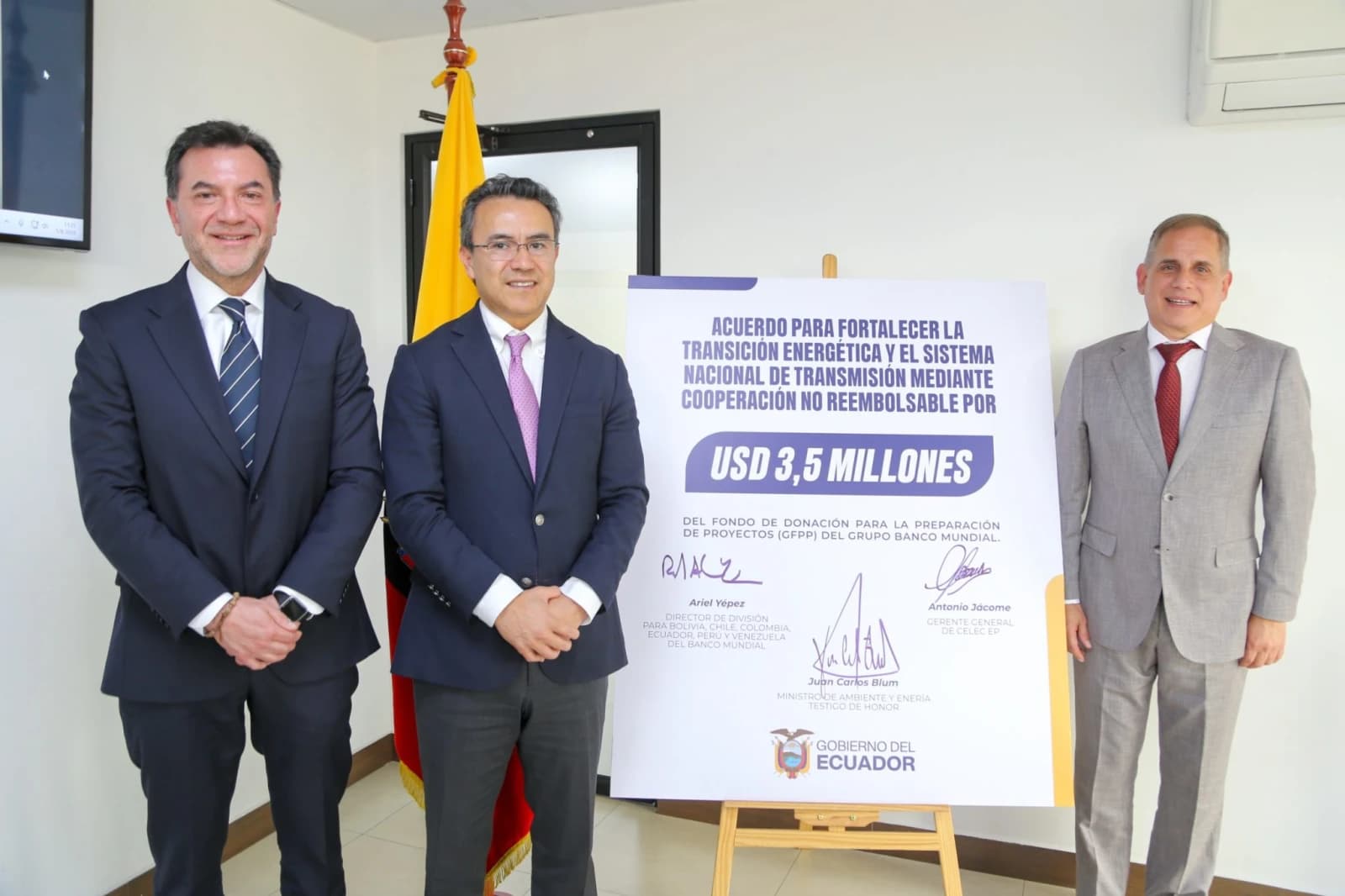
Ecuador received a donation of USD 3.5 million from the World Bank Group to advance the technical preparation of new electrical projects and strengthen the security and reliability of the national system.
The agreement was signed by the Ministry of Environment and Energy, the Ecuadorian Electricity Corporation (CELEC EP), and the multilateral organization. The funds come from the Project Preparation Grant Fund and do not need to be repaid.
The funding will not be used directly for the construction of power plants or networks. Its purpose is to develop studies, analyses, and technical assistance that will allow priority generation and transmission initiatives to reach a more mature stage.
The preparation will include sector-specific analyses, demand projections, technology assessments, and engineering studies. With this information, the government will seek to mitigate risks and lay the groundwork for subsequently mobilizing public and private capital.

The program will last 18 months and will be geared towards projects considered strategic for the modernization of the Ecuadorian electrical system.
Among the initiatives mentioned is the San Gregorio–Palestina transmission line, which requires detailed engineering studies to reinforce the National Transmission System and improve the electricity service in the Palestina canton.
“This agreement allows us to have detailed engineering studies for critical projects,” said Jorge Antonio Jácome , general manager of CELEC EP.
The Minister of Environment and Energy, Juan Carlos Blum, stated that the agreement is part of the government's strategy to incorporate different sources of generation and strengthen energy sovereignty.
“We must have several sources of electricity generation that allow us to achieve energy sovereignty and enhance the service on a national scale,” he said.
The planning process will seek to identify which alternatives can provide robust capacity, greater resilience, and lower emissions. It will also establish investment priorities and define the technical and financial conditions necessary to develop each project.
The World Bank emphasized that adequate preparation is crucial for initiatives to subsequently access financing and move towards implementation.
“Having a more reliable and resilient electrical system is fundamental to boosting economic growth, attracting investment and improving the quality of life for Ecuadorian families,” said Ariel Yépez , director of the organization for Bolivia, Chile, Colombia, Ecuador, Peru and Venezuela.
Studies to turn plans into fundable projects
One of the main challenges of the Ecuadorian electricity sector is to transform the identified needs into projects with sufficiently developed engineering, permits, schedules and economic structures.
The donation will cover that preliminary stage, which usually determines whether an initiative can obtain funding or remains stuck in the planning phase.
Demand studies will help define where new generation capacity will need to be added or existing grids expanded. Technology assessments will allow for comparison of alternatives based on their cost, availability, environmental impact, and capacity to meet system needs.
In transmission, the analyses should identify saturated corridors, new connection needs, and works capable of improving the reliability of the supply.
Technical assistance could also facilitate the preparation of documents for future tenders, contracts, and private participation schemes.
Once the 18 months of work are completed, the challenge will be to turn the studies financed by the World Bank into concrete works and secure the necessary resources for their construction.