

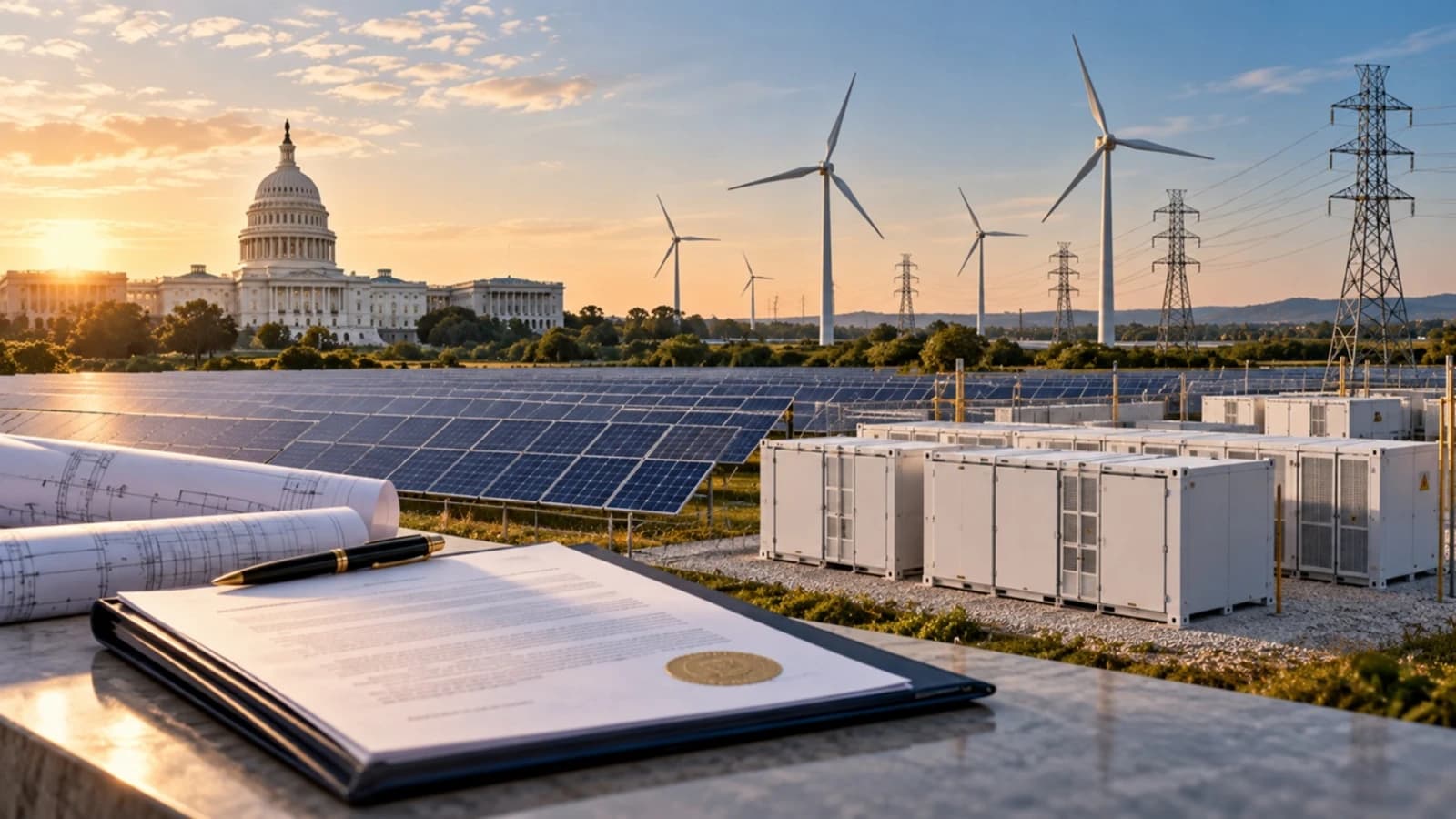
Four US senators introduced a bipartisan bill seeking to reform federal permitting processes and accelerate the development of new energy infrastructure, in a context marked by growing electricity demand and delays affecting renewable projects.
The so-called Bipartisan American Jobs and Affordability Act of 2026 (BAAJA) was championed by Republican Senators Shelley Moore Capito and Mike Lee , along with Democrats Sheldon Whitehouse and Martin Heinrich .
The initiative aims to shorten administrative times without abandoning environmental protections and includes specific provisions for solar, onshore and offshore wind energy projects, energy storage and electricity transmission .
One of the central points appears in Section 1402, which would allow developers to legally challenge decisions by federal agencies when they believe that a permit was improperly denied or suffered unjustified delays.
To do so, applicants should demonstrate the existence of a “pattern of discriminatory treatment” in the authorization processes.
The measure is especially relevant for the US renewable energy industry, after increased federal scrutiny and the extension of permitting processes under the One Big Beautiful Bill Act (OBBBA) put around 450 solar projects at risk, equivalent to several GW of capacity.
According to the data cited, these developments represent 36% of all new energy capacity planned in the United States .
Added to this is the economic impact resulting from projects that were suspended, cancelled or reduced.
An analysis by E2 estimated that the cancellation, closure, or reduction of 216 clean energy projects between January 2025 and May 2026 meant an approximate loss of USD 68 billion in private investment for the US economy.
The organization attributed these setbacks to changes in federal policies, particularly the OBBBA, along with broader restrictions on clean energy development and permits for solar and wind projects.
Federal permits affected approximately 11 GW in 2025
The weight of federal authorizations was also reflected in a study conducted by Crux among 50 solar and wind project developers and permitting specialists.
The survey determined that federal requirements impacted approximately 11 GW of capacity during 2025 , causing delays or cancellations.
According to the analysis, a significant portion of developers even began strategically selecting the locations of their projects in order to avoid the application of these requirements, a situation that specialists consider a significant distortion of the market.
Hasan Nazar, director of Government Affairs and Public Policy at Crux , argued that the reform could bring greater predictability to the federal permitting system, although he cautioned that some components of the agreement still remain open.
“Some components of the agreement are still being defined, including the possibility of restoring the usual order in the granting of permits for wind and solar energy,” he noted.
The reform also aims to accelerate transmission
The project is not limited to renewable energy generation.
Its provisions also include accelerating the construction of power lines and new transmission capacity , with the aim of allowing more generation to be added to the electrical system.
Furthermore, it stipulates that data centers must assume all transmission costs associated with their demand .
“The American people want lower energy bills and more clean energy. Our permitting reform plan brings us much closer to both of those goals,” Whitehouse said.
He added: “If we succeed in passing this bill, we will flood the electrical grid with clean and affordable energy, and we will make data centers start paying their fair share.”
The Solar Energy Industries Association (SEIA) supported the proposal.
Its chief executive, Tim Pawlenty , emphasized that this is the type of bipartisan initiative needed to respond to the growth in electricity consumption, contain energy prices, and facilitate the implementation of solar and storage systems.
“This is precisely the kind of bipartisan action the United States needs to meet growing energy demand, put downward pressure on energy prices, and deploy more affordable and reliable solar and storage systems for American families and businesses,” he said.
Questions about environmental protections
The initiative, however, also sparked criticism.
The Southern Environmental Law Center (SELC) expressed concern that the reform could weaken environmental protections and facilitate the development of new oil and gas projects.
The organization also questioned the Trump administration's policy towards renewable technologies.
“The Trump administration has illegally stalled and obstructed the development of wind and solar energy, while paving the way for fossil fuels,” SELC said.
He added that the White House's assurances regarding a possible halt to restrictions on solar and wind projects "should be taken with extreme skepticism."
The next step will be legislative. The bill is scheduled to be put to a vote in the Senate after the midterm elections on November 3, 2026 .
If it receives the green light, it must then be approved by the House of Representatives before reaching President Donald Trump for his eventual enactment.