

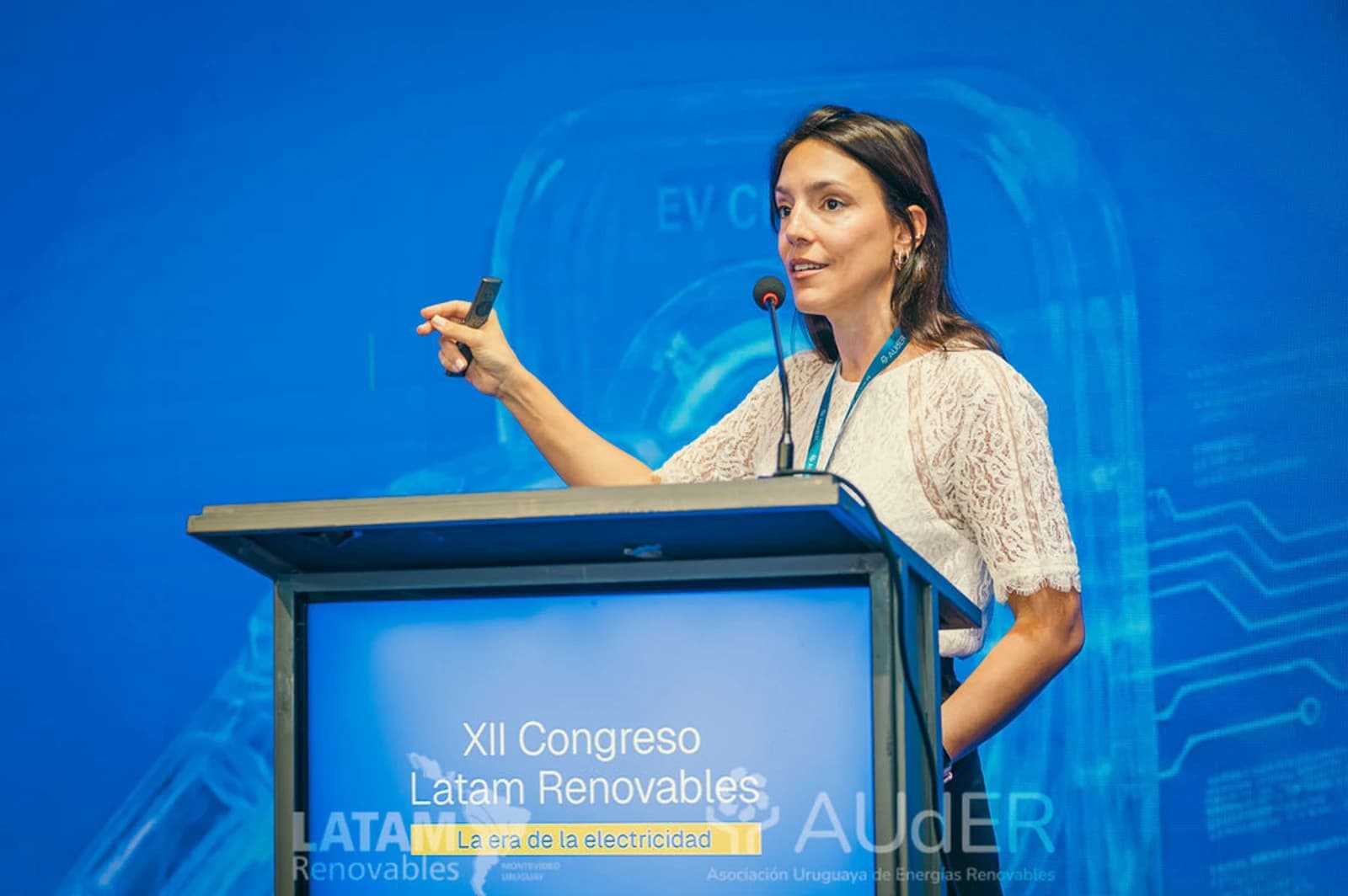
“If we talk about the short term, Argentina appears today as the most dynamic market for the growth of the commercial and industrial segment,” said María Paz Cristófalo , commercial manager of Utility at Efergía , in dialogue with Energía Estratégica , when comparing the three markets in which it operates.
The company's analysis is supported by the progress of distributed generation. In July, Argentina reached 4,891 user-generators and 165.5 MW installed under Law 27,424, compared to 3,771 users and 119.2 MW at the end of 2015. In seven months, the accumulated capacity grew by 38.8%, adding 46.3 MW.
The commercial and industrial segment accounted for 132.1 MW distributed across 2,089 installations , equivalent to almost 80% of all the power incorporated into the national grid. The residential sector, despite serving 2,525 users, reached 13.2 MW. In addition, 1,053 applications for another 43.9 MW were pending.
“Tariff restructuring and the need for companies to improve their competitiveness are accelerating investments in energy efficiency, solar generation, and storage. Today we see a growing demand from the productive sector seeking greater predictability in its energy costs,” Cristófalo stated at the XII LATAM Renewables Congress, organized by the Uruguayan Renewable Energy Association (Auder).
The scenario was also favored by the expansion of the power limit for distributed generation. The injection cap increased from 2 MW to 12 MW in September 2024, and the regulations were subsequently updated by Resolution 287/2025.
The current regulation classifies as major user-generators those who install equipment of more than 300 kW and up to 12 MW. It also established that distributors can only object to the injection through substantiated technical studies submitted to the jurisdictional regulatory body.
Efergía anticipated that it would close 2026 with significant growth compared to the previous year, driven mainly by commercial and industrial projects and by the incorporation of hybrid solutions.
However, he warned that the increased interest still coexists with two structural constraints.
“The main factor that is repeated, both in distributed generation projects and in utility scale projects, is the lack of financing,” he noted.
Added to this was the available capacity in the transport and distribution networks, which began to limit the incorporation of new generation in certain areas of the country.
“Energy storage solutions are becoming increasingly important, as they allow for the optimization of existing infrastructure and offer technically viable alternatives in the short and medium term,” the company noted.
Storage gained centrality in all three markets
Although Argentina led the immediate outlook for the corporate segment, storage emerged as the main cross-cutting opportunity in Argentina, Uruguay, and Paraguay.
“Just a few years ago it was considered a complement to solar systems; today, in many projects, it is the main decision factor,” the expert stated.
The company projected that storage would register higher growth rates than the traditional solar market over the next few years, as costs fall and its applications become more widespread.
During 2025, 108 GW of battery storage capacity was added globally , 40% more than the previous year. Nearly four-fifths of that new capacity corresponded to utility-scale projects.
In parallel, the total installed cost of grid-scale BESS fell 93% between 2010 and 2024, from USD 2,571 to USD 192 per kWh , according to IRENA.
For Efergía, the opportunity in Argentina was linked to demand management, backup power, and leveraging a constrained electrical infrastructure. In Uruguay, the focus was on flexibility, resilience, and consumption optimization. In Paraguay, off-grid applications and backup power in the face of quality or continuity issues gained greater importance.
Uruguay will redefine the conditions for microgeneration
When discussing Uruguay, Efergía placed the main question on the regulatory front.
“Uruguay is probably the most mature market from a regulatory point of view of the three countries and has been a regional benchmark in renewable energy. However, today it is in a moment of transition,” he noted.
The warning coincided with the announcement made during the XII LATAM Renewables Congress, where the National Energy Directorate presented a technical proposal to modify the conditions of microgeneration from 2027.
The proposal has not yet been approved and is still being adjusted. It would maintain self-consumption but modify the allocation of costs and the valuation of surplus energy for new projects.
Among the alternatives presented were the explicit separation of supply, network and backup costs, or the continuation of the current tariff accompanied by a charge related to the energy produced and consumed.
Continue reading
The energy injected into the grid could cease to be referenced to the retail tariff and instead be linked to the hourly spot price. In parallel, authorities were analyzing a UTE product that would stabilize this price and provide greater predictability for financing.
The official diagnosis behind the review was that Decree 173/010 had been designed at a time when distributed generation was displacing fossil fuel production. Under that system, the energy delivered by the microgenerator to the low-voltage grid is compensated at the same price as the current energy charge.
The energy mix changed: Uruguay ended 2025 with 98% renewable electricity generation and 13,040 GWh delivered to the National Interconnected System. Hydropower contributed 46%, wind 34%, biomass 14%, and solar 4%.
“The definitions adopted by the energy authorities will be key to determining whether new opportunities are created to boost investments in distributed generation or whether, on the contrary, a scenario of greater uncertainty is introduced for some market segments,” Cristófalo warned.
For the company, storage maintained a perspective less conditioned by the reform.
“The energy storage segment maintains very positive prospects and continues to show growing interest, driven by the search for greater flexibility, resilience and optimization of energy consumption, regardless of any changes that may occur in the regulation of distributed generation,” he said.
Paraguay opened the framework, but tariffs limited self-consumption
In Paraguay, Efergía observed a smaller market with different needs than those of Argentina and Uruguay.
“Paraguay is a smaller market, which still has a long way to go in regulatory terms,” Cristófalo said.
The country moved forward in May 2026 with Decree 6034, which regulated Law 7599/2025 and established the operational framework for self-generation, cogeneration and distributed generation with non-conventional non-hydroelectric renewable sources.
The regulations enabled residential, commercial and industrial users to produce their own energy and inject surpluses into the National Interconnected System.
For the company, the main barrier continued to be economic.
“Historically low electricity rates have reduced the attractiveness of investments in grid-connected solar energy,” he said.
ANDE's current tariff set a rate of 404.97 guaraníes per kWh for low-voltage industrial users. In the medium-voltage industrial category connected to a station or substation, the energy rate was 262.78 guaraníes per kWh during peak hours and 153.37 guaraníes during off-peak hours, in addition to charges for reserved power.
Therefore, Efergía found the main Paraguayan opportunities in solutions for isolated sites, backup in the face of quality or reliability problems of supply and off-grid applications, with greater prominence of batteries than of traditional solar systems connected to the grid.
A regional strategy supported by hybrid systems
The differences between the three markets also shaped Efergía's objectives.
“Beyond the volumes sold, our focus is on developing the market: training, providing local technical support, and bringing increasingly sophisticated solutions to our clients,” the specialist noted.
The alliance with Huawei played a central role in that deployment. Efergía indicated that it had been working with the technology company for more than five years as a Value Added Partner and that the relationship had already exceeded 1 GW of commercialized power in the region.
The figure was reported by the company itself. Its website also identified Huawei among its strategic alliances and highlighted an offering that includes solar inverters and storage solutions.
“More than just marketing technology, our goal is to add value to the entire chain, supporting our clients with specialized technical support, training, solution design, and a deep understanding of the markets where we operate,” he said.
The link allowed him to integrate photovoltaic generation, batteries, monitoring and energy management into residential, commercial, industrial and utility scale applications.
The comparison revealed three distinct scenarios: Argentina accelerated due to the recovery of the economic signal and corporate demand; Uruguay was impacted by the redefinition of the microgeneration regime; and Paraguay began to implement a new regulatory framework, with storage and isolated solutions as the niches of greatest interest.
“Technology is no longer the barrier. The region’s great challenge lies in creating the necessary financial, regulatory, and infrastructure conditions to accelerate its adoption,” concluded María Paz Cristófalo.