


EGE Haina is preparing a significant expansion in the Dominican Republic. The company plans to add 1,000 MW of renewable energy and 400 MW of natural gas as part of a portfolio transformation aimed at adapting to a more complex stage in the electricity market, where the expansion of clean generation demands greater operational flexibility, backup power, and clearer regulatory signals.
The roadmap reflects the repositioning of a company historically linked to a diversified parent company, with assets in HFO, coal, natural gas, solar and wind power , which is now redefining its growth in the face of a system that has already begun to feel strained by the speed of renewable energy incorporation.
“Transformation isn’t driven by trends; it’s not because everyone else is doing it,” warned Rosina Hernández , Head of Sales for North LATAM, Central America & the Caribbean at EGE Haina , during the private sector’s featured discussion at FES Caribe. She added, “If we look at the long term, companies that don’t transform are destined to disappear in the future.”
The strategy also includes one of the most innovative developments in the Dominican market: the country's first solar-wind hybrid , with more than 100 MW , located in the northern zone.

Hernández explained that the project combines complementary generation profiles to optimize operation: solar production during the day and wind generation at night, a configuration designed to improve efficiency and support a matrix with greater renewable participation.
The executive also maintained that maintaining thermal capacity will continue to be necessary to ensure energy security while renewable participation grows, which is why the plan includes 400 MW of natural gas as strategic backup.
The context helps explain this combination. The Dominican Republic ended 2025 with 2,700 MW of installed renewable energy capacity and 80 projects in operation , consolidating a rapid expansion of clean energy generation. But this growth also opened a new discussion about system integration, storage, and operational capacity.
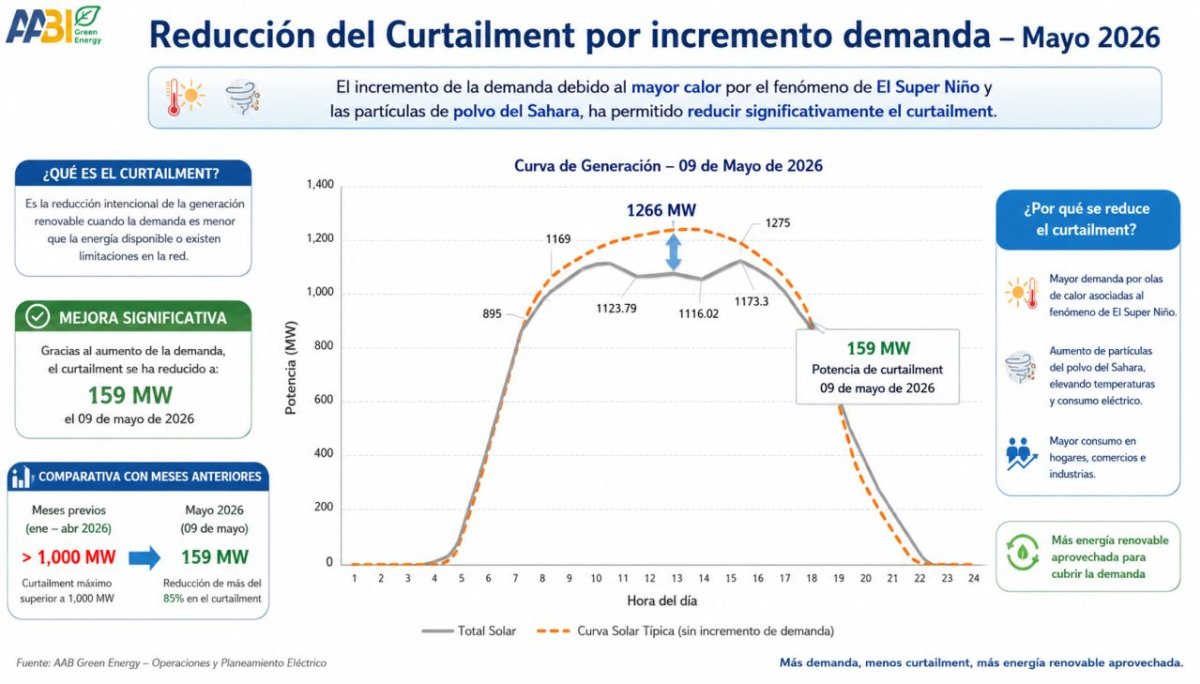
During his participation in FES Caribe, Hernández warned that in the first quarter of 2026 alone, more than 220,000 MWh of renewable energy were lost, equivalent to $18.7 million valued at marginal cost, as a result of operational restrictions.
This data reflects a reality that is becoming increasingly visible in markets with high renewable energy penetration: curtailment. In other words, available energy that cannot be absorbed due to grid, dispatch, or demand limitations.
The Dominican Republic is thus beginning to face challenges similar to those already observed in other more advanced markets in energy transition, where renewable growth forces an acceleration of investments in storage, transmission and operational flexibility.
Meanwhile, demand patterns themselves began to signal the new scenario. In May, the National Interconnected System (SENI) reached a record high of 3,938.87 MW , according to a report by AABI Group , driven by high temperatures and changes in consumption patterns—a trend that helped absorb a greater proportion of clean energy generation at certain times of the day.
But at EGE Haina, the focus is on structural solutions: “We need the introduction of storage systems to provide the flexibility that the market needs right now,” Hernández said.
Continue reading
The discussion is not insignificant. Just weeks after officials outlined an ambitious agenda for storage and new tenders at FES Caribe, the market received a much more cautious signal.
The Dominican Republic ended up awarding 325.69 MW in the public tender EDES-LP-NGR-01-2025 , well below the 600 MW initially planned, in a decision associated with network restrictions that generated unease among actors in the sector.
The contrast was even more striking because, just weeks earlier, there had been talk of expanding the process to 605 MW , fueling expectations of a more aggressive move to accelerate battery deployment. This was compounded by a wide dispersion in awarded prices—ranging from USD 0.085/kWh to USD 0.131/kWh —reflecting a process influenced by multiple technical and economic variables.
This scenario reinforces one of the central arguments of the private sector: the challenge is no longer just about launching competitive processes, but about building consistent signals to attract investment.
Hernández specifically warned about this point. While acknowledging regulatory progress for some ancillary services, he stressed that clear definitions are still lacking regarding how the value that batteries can contribute to the system will be compensated.
Recent instability within the National Interconnected System (SENI) has further reinforced this discussion. The blackouts experienced in recent months have brought back to the forefront the need to strengthen operational support, resilience, and modernization of complementary services.
“We face the challenge of regulatory synchronization , ” Hernández stated, referring to the need to coordinate regulation, operations, and economic signals to sustain the transition.
From that perspective, the executive acknowledged official progress, from thermal power tenders to new renewable energy processes and announcements related to energy storage. But she insisted that achieving the country's goal of 30% renewable energy by 2030 will require greater coordination between public policy and the private sector.
EGE Haina seeks to position itself precisely at this inflection point. The company not only outlined a capacity expansion, but also a redefinition of its role within the Dominican market: growing in renewables, maintaining natural gas backup, and advancing towards technologies that support a more flexible and resilient operation.
“We need that regulatory synchronization to happen hand in hand with the State and the private sector,” Hernández concluded.
Relive the first day of FES Caribe: https://www.youtube.com/watch?v=OfB3DaSHJSM
FES's next stops
The Future Energy Summit tour will continue with FES Guatemala on May 14 and FES Mexico on May 19, where key players from the public and private sectors will address the challenges and opportunities linked to the expansion of the energy system, new investment schemes and the execution of strategic projects.
To access the full FES 2026 tour schedule, learn more about it and be part of the meetings, the FES digital platform is available, while all events will have a live broadcast through the official Future Energy Summit YouTube channel.
For inquiries and more information, please contact info@futurenergysummit.com