


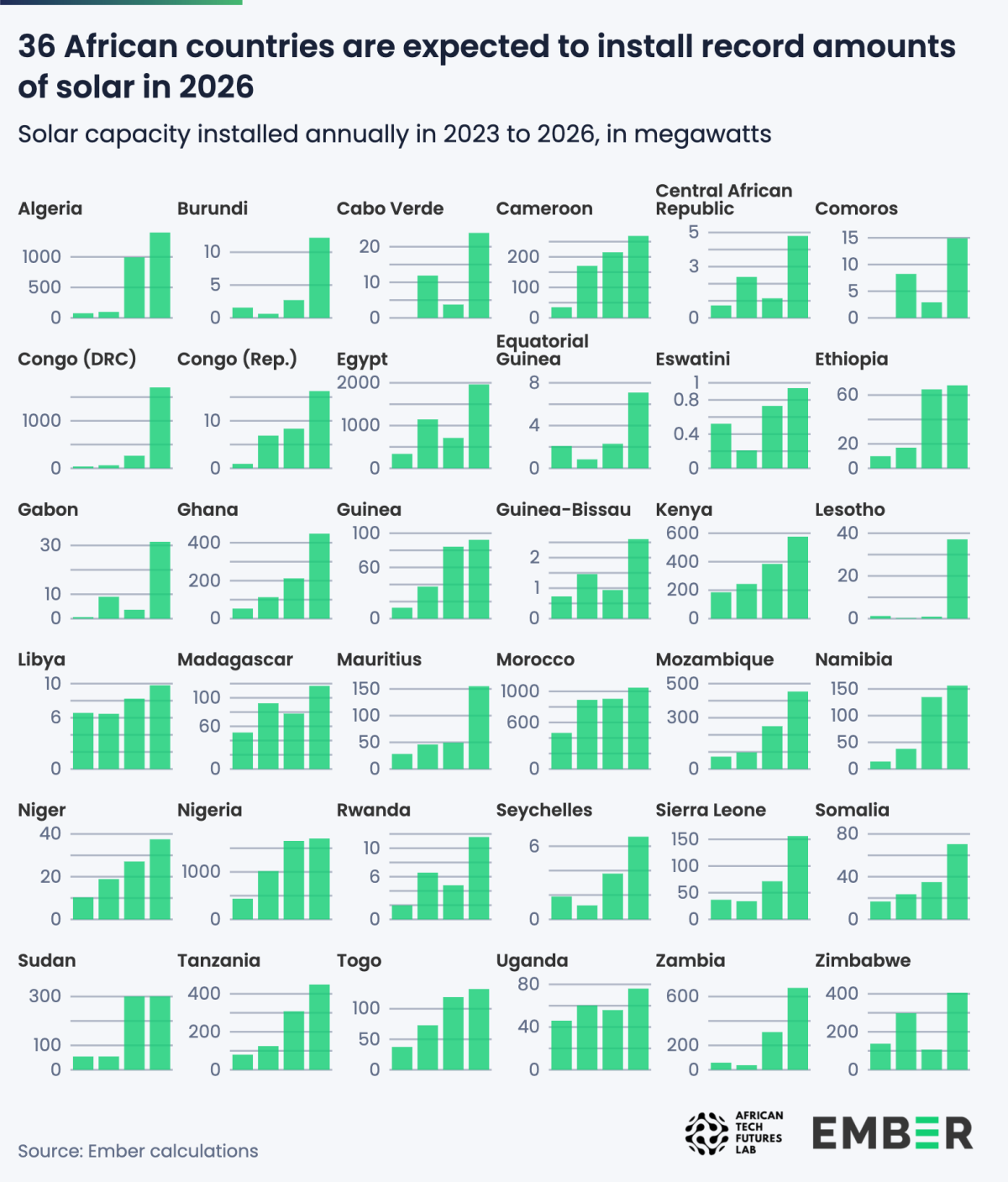
Africa is on track to install a record 17 GW of solar power during 2026 , 45% more than the previous year and enough to mark the continent's third consecutive peak, according to a new analysis by Ember in conjunction with the African Tech Futures Lab.
The data also reveals a transformation that official statistics have yet to fully capture: three-quarters of the solar capacity installed in Africa between 2023 and 2025 corresponded to distributed generation , a segment that remains outside national records in many markets.
The expansion is also geographically widespread. A total of 36 of the 54 African countries will install more solar capacity in 2026 than in any other year , while 19 markets are experiencing year-on-year growth rates exceeding 100%. The Democratic Republic of Congo leads the way with 544%, followed by Zimbabwe with 282% and Egypt with 176%.
“ It’s incredible to see so many companies and individuals, in so many African countries, choosing to install solar power ,” said Dave Jones, Chief Analyst at Ember , regarding a trend increasingly driven by the decisions of companies and consumers.

The move towards new markets also reduces South Africa's relative weight. The country once accounted for more than half of the continent's photovoltaic imports , while by 2026 it is projected to account for less than a fifth of installations.
The reduction in technology costs appears to be one of the factors behind this trend. “ Solar panels have become so cheap that the economic equation is compelling ,” Jones stated.
To quantify a market that traditional statistics fail to fully capture, Ember and African Tech Futures Lab used customs data on Chinese exports of solar modules and tracked shipments to each destination country .
Subsequently, they applied a calibrated installation rate based on patterns observed in the European Union and five other markets, where around 73% of exported panels are installed within six months of shipment .
With records of Chinese exports available until June 2026, the methodology allows for estimating African installations for the entire year several months before its closing .
The scale of these new additions is beginning to alter the continent's electricity balance. The 17 GW planned for 2026 alone would generate around 23 TWh annually , a volume equivalent to the average annual growth in Africa's electricity demand over the last decade.
Furthermore, in more than half of the continent's 54 countries , production from new solar capacity this year would exceed the historical rate of increase in demand.
Ten markets, which together comprise around 190 million inhabitants , would incorporate enough photovoltaic capacity during 2026 to increase their annual electricity generation by more than 10%.
The greatest relative impact would occur in Sierra Leone, where the new solar would account for 97% of annual electricity generation , followed by Togo with 24%; Somalia and Djibouti with 21% each; and the Democratic Republic of Congo and Comoros with 14%.
They are joined by Namibia and Liberia, with 12% each; Chad, with 11%; and Lesotho, with 10% .
Given this trend, Jones believes some countries are already making a leap toward faster, safer, and cleaner energy growth. “ Countries are already making a leap toward faster, safer, and cleaner energy growth ,” noted the Chief Analyst at Ember.
Decentralization, however, introduces a challenge for the planning of electrical systems: a substantial proportion of the facilities are not being properly monitored by governments, regulators, and network operators .
Continue reading
“ But much of this growth remains hidden: national governments need to improve the collection of solar data ,” Jones warned.
The statistical deficit is significant. Only South Africa, Tunisia, and Tanzania currently publish information on solar capacity on a quarterly or higher frequency , according to the survey.
Researchers found official photovoltaic power data for only 36 of the 54 African countries , while only 14 had data for 2025. Even in these markets, the report considers it likely that the records underestimate actual installations.
The gap becomes relevant for the management of electrical systems, given that the capacity used by planners to develop their strategies may differ from the capacity that is actually operating , especially due to the deployment of distributed resources.
“ Across Africa, distributed energy resources are expanding rapidly and, in many cases, are exceeding grid capacity ,” said Joel Nana, Research Director of African Tech Futures Lab and Project Manager of Sustainable Energy Africa .
Furthermore, decentralized expansion is progressing with a different dynamic than that envisioned in numerous official strategies. “ This transition is chaotic and disruptive, and is far from the orderly model foreseen in national strategies ,” Nana stated.
This scenario forces a review of demand projections, network capacity, infrastructure needs, investment decisions, and system operation , as the volume of distributed assets that do not always appear in the records increases.
“ Policymakers must begin to respond to this change ,” remarked the Research Director of African Tech Futures Lab.
The institutional response is beginning to move forward. At least 15 African countries have solar registration and permitting systems in advanced stages , while several have already put them into operation.
For Ember and African Tech Futures Lab, these mechanisms are fundamental for operators, regulators and planning officials to have a more accurate picture of the market they must manage , particularly given the growing importance of decentralized facilities.
Manufacturing quadruples, but China maintains 94% of the market
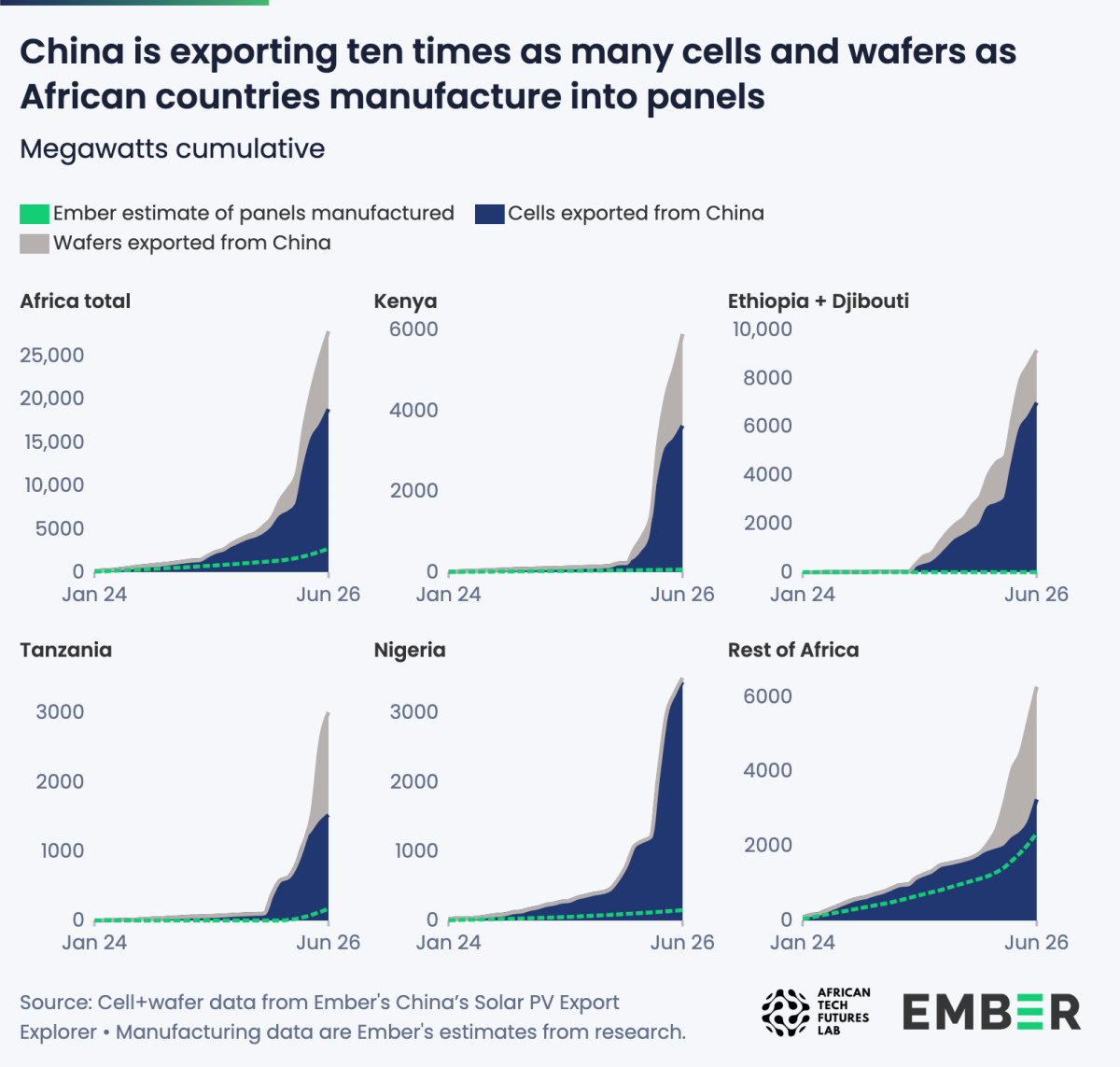
The transformation also extends to the industrial chain. African solar panel manufacturing is expected to quadruple by 2026 to approximately 3.5 GW , driven by the commissioning of new plants in Egypt and Tanzania.
The increase in production capacity has not yet significantly reduced external dependence. 94% of the modules installed in Africa continue to be imported from China , while much of the continent's new production is destined for the United States.
Therefore, the expansion of local factories does not automatically translate into a greater share of modules manufactured in Africa within their own market .
The industrial segment also presents measurement challenges. Manufacturing data is limited, and there is little government or public documentation on African production capacity and the destination of the panels .
The evolution of the sector thus reveals a market that is increasing in scale and decentralizing faster than the systems used to measure and plan it . This progress is no longer concentrated primarily in large projects and in South Africa, but is now spreading to businesses, consumers, and dozens of new markets.
With this new configuration, knowing how much distributed capacity exists, where it is located, and how it modifies the behavior of the networks becomes crucial for African electricity planning , in parallel with the growth of installed GW.
“ Governments that anticipate this will be in a position to reap all the benefits ,” concluded the Chief Analyst at Ember.