


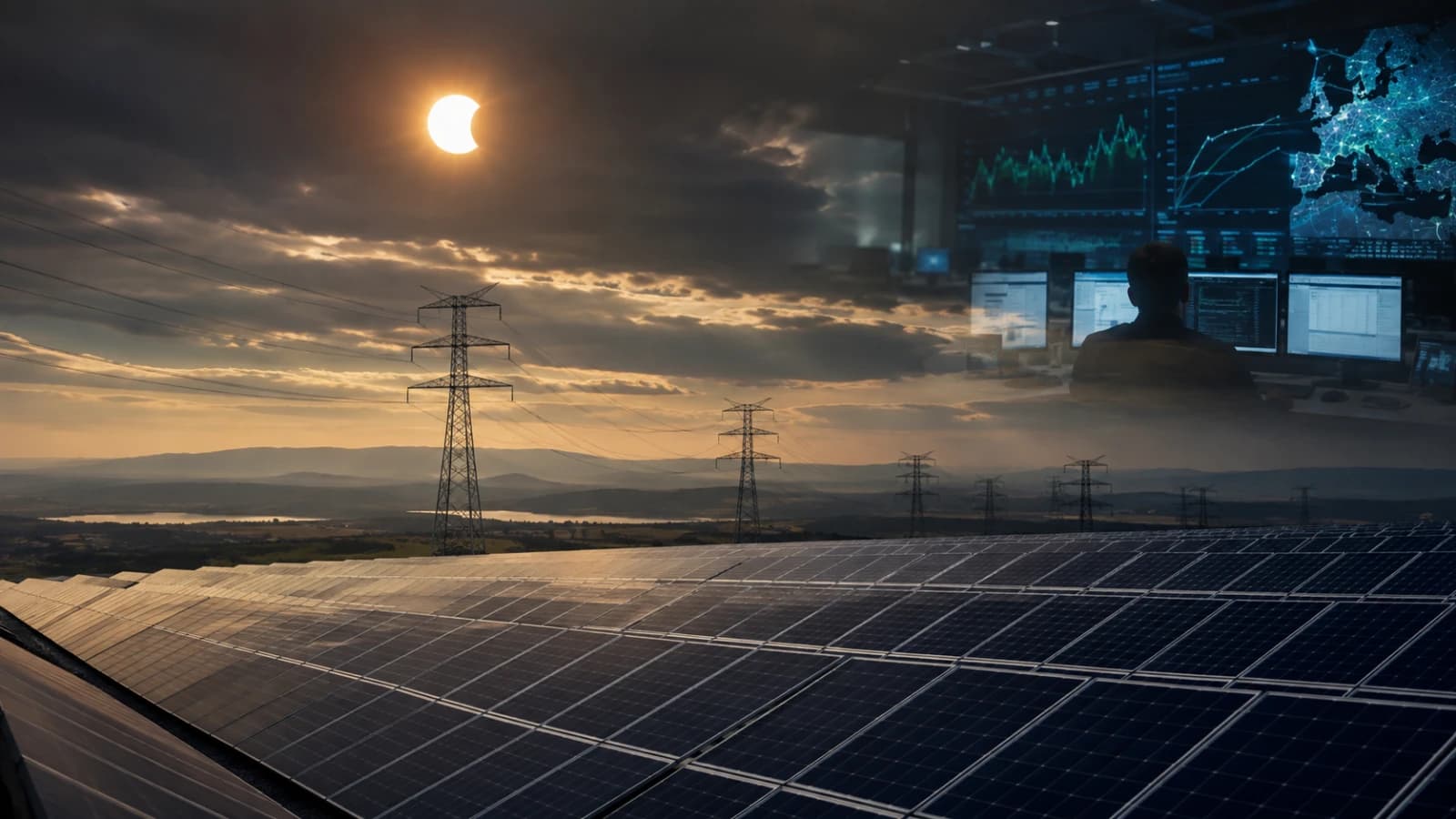
The solar eclipse of August 12 tested the European electricity system's ability to respond to a reduction of up to 9.7 GW of photovoltaic generation , according to the clear sky scenario previously prepared by the European Network of Transmission System Operators for Electricity (ENTSO-E).
The main operational challenge lay not only in the volume of power that could be temporarily taken offline, but also in the speed of the drop and subsequent recovery of solar production. The phenomenon was concentrated between 7:15 PM and 9:30 PM CEST, when photovoltaic generation was already beginning its evening decline.
Europe weathered the event without significant systemic disruptions , supported by reserves, hydroelectric and thermal power generation, coordination among operators, and consumption management mechanisms. The experience showed that a variation of several GW of photovoltaic capacity can be managed when there is foresight and sufficient response capacity.
The system's behavior also confirmed that a decrease in renewable generation does not necessarily require replacing it with an identical volume of conventional power . The outcome depends on the time of day, consumption patterns, the proportion of distributed generation, and the availability of flexible resources.

France provided one of the most significant aftermath data points of the eclipse. RTE had anticipated a decrease of approximately 1800 MW in photovoltaic production under certain conditions, but the weather reduced the level of solar generation prior to the event.
As a result, the drop ultimately attributable to the eclipse was approximately 700 MW , significantly lower than the scenario considered by the French operator.
The most significant change, however, occurred on the consumption side. French electricity demand fell by around 1800 MW during the event , according to real-time monitoring by RTE.
The operator attributed this trend to the behavior of citizens who temporarily suspended certain energy consumption activities to observe the eclipse. The reduction in demand ended up being more than twice the photovoltaic loss attributable to the event , thus alleviating the need for compensation on the supply side.
The French episode demonstrated the extent to which changes in consumption can alter the net effect of a rapid disruption in renewable energy generation . In this case, the approximately 700 MW reduction in solar production coincided with a much larger contraction in demand.
Spain, for its part, had prepared for one of the most severe scenarios. Red Eléctrica anticipated a potential reduction of up to 5 GW of solar power generation during the peak of the eclipse.
That volume was roughly equivalent to 13% of the peak electricity demand on a typical Wednesday in August , although that comparison did not imply that the system needed to incorporate another 5 GW of conventional generation.
The phenomenon occurred when the Spanish photovoltaic curve was already moving towards its natural late afternoon decline and did not coincide with the usual peak consumption, two factors that reduced the additional pressure on the operation.
For this reason, the 5 GW should be interpreted as the maximum scenario used by Red Eléctrica to prepare the system and not as a confirmed real post-event loss .
With the information available, there is still no official report from the Spanish operator that would allow us to specify how many MW of photovoltaic production were not injected exclusively as a result of the eclipse.
The preparedness strategy included increased operational reserves, enhanced monitoring, and coordination with other European operators , with the aim of absorbing temporary variations without compromising demand coverage.
Portugal provided one of the clearest examples of another determining variable for the operation: the speed of the generation ramps .
REN had estimated a reduction of approximately 450 MW of centralized solar generation between 6:30 p.m. and 8:30 p.m. , equivalent to 45% of the photovoltaic production planned for that period .
That volume represented about 7% of the expected national electricity consumption , while the maximum descent rate could reach 35 MW per minute .
The magnitude of that ramp-up required resources capable of reacting in just a few minutes. For real-time operation, the speed at which available power changes can be as critical as the total amount of energy that is no longer produced.
REN also incorporated the effect of photovoltaic self-consumption into its forecasts. When generation behind the meter decreases, users need to draw more electricity from the grid , so part of the impact appears as an increase in net demand.
Portugal prepared hydroelectric and thermal reserves , in addition to strengthening coordination with other European systems. The grid remained stable during the event, becoming a representative case of ramp management in markets with increasing solar penetration.
The United Kingdom presented a different set of challenges due to the prevalence of distributed solar generation. A significant portion of its installations are connected behind the meter and are not directly monitored by the transmission system operator.
For NESO, this configuration means that distributed photovoltaic production reduces the visible demand on the transmission grid . If the panels generate less electricity, the amount of power the system must supply automatically increases.
Continue reading
During the eclipse, therefore, a lower distributed solar production and an increase in net demand observed by the operator could coincide.
NESO expected a reduction of around 700 MW , although its scenarios considered an impact of up to 1.3 GW . The event also coincided with the afternoon period when consumption begins to pick up as people return home.
The British response incorporated measures from the consumer side. Octopus Energy incentivized its customers to shift their consumption outside the eclipse window by offering one hour of free electricity with a limit of 16 kWh .
The initiative transformed demand response into an additional source of flexibility. Part of the consumption could be temporarily shifted to reduce pressure on the system instead of covering the entire variation with new generation.
Germany was also among the markets with the greatest exposure due to its high photovoltaic capacity. Solcast had previously modeled an approximate loss of 1,400 MWh of solar energy and a maximum recovery ramp of 13,600 MWh.
These figures were based on a preliminary estimate, not a subsequent official measurement. Monitoring of the event confirmed that the temporary reduction in photovoltaic injection did not compromise the security of German supply .
The effect was primarily associated with an earlier-than-expected decline in afternoon solar radiation. Based on the data collected, there is still no official, definitive figure that would allow us to attribute a specific loss of solar power in Germany solely to the eclipse .
For France, Solcast had calculated a loss of approximately 560 MWh and a maximum recovery ramp close to 6550 MW per hour , although subsequent analysis by RTE provided a more concrete reference on the impact on power, close to 700 MW.
Iceland offered a contrasting example. Despite being among the areas with the greatest dimming and registering an estimated loss of close to 3% of its daily solar irradiance , the effect on its electrical system was significantly less.
The Icelandic energy mix is dominated by hydroelectric and geothermal generation , so a temporary reduction in irradiance has a much smaller systemic impact than in markets with a higher photovoltaic share.
The comparison between countries showed that the astronomical intensity of the eclipse does not, by itself, define its energy impact . Installed solar capacity, the composition of the energy mix, the level of consumption, the timing of the phenomenon, and the availability of flexible resources all influence the final result.
The event also coincided with a period of growing prominence for photovoltaics in Europe. During June and July of 2026, the technology accounted for 25% of all electricity generation in the European Union during those two months , according to a report published by Ember .
Production reached 52 TWh in June and 55 TWh in July , monthly highs that helped sustain the grids during heat waves, while other technologies faced restrictions due to high temperatures and drought.
During the episodes analyzed by Ember, daily solar generation was up to 17% higher in France and Hungary and 5% higher in Spain compared to the rest of the days in June and July .
This contribution coincided with a sharp increase in refrigeration-related consumption. Daily electricity demand rose by up to 28% in Italy, 23% in Hungary, 14% in France, and 13% in Spain compared to the reference period used in the study.
The main tensions arose after sunset. The biggest price spikes were concentrated during the early evening hours , when photovoltaic production decreased, demand remained high, and the need to resort to thermal generation increased.
Ember identified this development as a sign that Europe needs to expand its flexibility resources. Batteries, demand response, and interconnections are among the key tools to support the growth of solar capacity.
Energy storage would allow some of the electricity produced during peak sunlight hours to be shifted to the evening period, improving the alignment between photovoltaic output and consumption patterns . The organization particularly highlighted this resource in light of increasingly demanding summers for the grid.
The eclipse presented a unique challenge because operators knew precisely when production would decline and when it would begin to recover , allowing them to schedule reserves and coordinate resources in advance.
The challenges will be greater in the face of less predictable weather events. As the share of photovoltaics increases, the discussion about renewable energy expansion will become increasingly linked to the available capacity to manage rapid generation fluctuations .
The balance sheet for August 12 showed that Europe went through a major solar disruption without significant problems for security of supply , but it also confirmed the growing importance of ramps, storage, interconnections and active demand participation in electricity operation.
The next stage of the European solar expansion will require not only incorporating new renewable capacity, but also ensuring that the grids have sufficient resources to absorb inputs and outputs of several GW in increasingly demanding periods.
