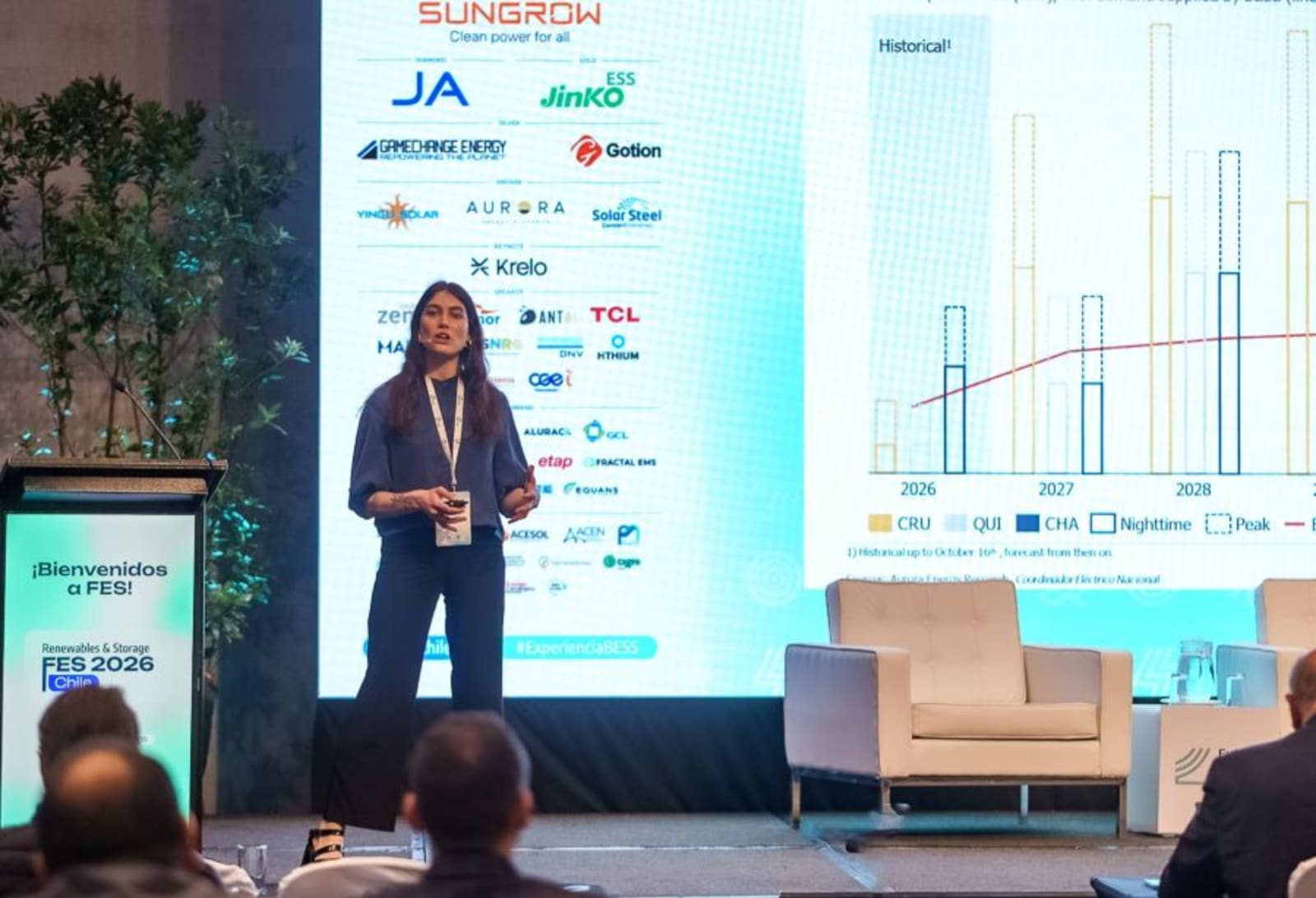
The success of energy storage is beginning to present a paradox in Chile: batteries are reducing the very price differentials that fueled their expansion . With an installed capacity equivalent to one-third of peak demand, their role in nighttime dispatch is transforming the price curve and raising questions about the future profitability of projects that depend on energy arbitrage.
How far will this phenomenon go? Aurora Energy Research anticipates that the hours with zero marginal cost at night could triple in some regions , even if hydrological conditions cease to be exceptionally favorable. This projection stems from their market models, which show how storage reduces nighttime prices by displacing more expensive generation, while moderately increasing daytime prices during peak load periods.
The warning was presented by Amparo Corvalán, Power Market Advisor at Aurora Energy Research , during her keynote address at Future Energy Summit Chile 2026, where she focused on a discussion that is becoming increasingly urgent for developers, operators, and investors.
"Batteries significantly reduce nighttime prices and slightly increase daytime prices," explained the specialist, comparing projections for the Chilean market with a hypothetical scenario without storage.

The transformation is already visible. During October 14 and 15 , the Crucero node recorded near-zero nighttime marginal costs, with values predominantly ranging between zero and three per MWh, according to the data displayed. During those periods, renewables accounted for approximately 70% of generation, and hydroelectricity set the prices, benefiting from a 59% year-on-year increase in its production during October.
This abundance of supply is compounded by a structural difficulty: electricity demand barely grew between 2024 and 2025 , so the addition of new capacity does not find an equivalent increase in consumption.
"We could attribute this scenario to exceptional hydrology. However, our projections indicate that periods of zero prices during the night will continue to occur," Corvalán warned.
From record expansion to the challenge of pricing energy
How did Chile get to this situation? At the beginning of 2024 it had only 200 MW of storage , but the publication of Supreme Decree 70, which enabled the recognition of battery power, accelerated investments until reaching the 3700 MW presented by Aurora in October 2026.
The mechanism allowed for crediting up to 100% of the power output of certain systems, depending on their duration, and opened an additional source of revenue to finance large-scale installations. Its implementation also helped reduce renewable energy curtailment, displace thermal power plants, and provide reserves through ancillary services, consolidating Chile as one of the most advanced Latin American markets in this technology.
However, power recognition did not resolve how to value stored electricity . Currently, the scheme used takes the average charging cost as a reference, a methodology that can assign a zero value to the energy acquired during daylight hours, regardless of the savings that its use will subsequently generate.
What happens when a battery stores cheap electricity to replace more expensive generation several hours later? The debate revolves precisely around this economic benefit and how to incorporate it into dispatch decisions.
Continue reading
"Chile values stored energy according to its average charging cost. If a battery charges at zero price during the day, that same value is assigned to the energy, even if it later displaces more expensive generation," Corvalán explained.
In this context, Supreme Decree 32 paved the way for incorporating the opportunity cost of manageable resources into electricity scheduling. Aurora examined six methodologies, ranging from the current scheme to different proposals based on the so-called dual variable , which estimates how much the system would save by having an additional unit of stored energy.
The alternatives include tie-breaking mechanisms, simplified calculations, and limits within which operators could decide when to perform their charging and discharging cycles. However, all these options share a common element: they belong to a cost-based market model , where valuation depends primarily on the parameters used by the National Electric Coordinator.
"The auction market remains an unexplored alternative in Chile. For investors, the key is that any transition has clear and defined rules," said the Aurora representative.
A marketplace of offers to avoid cannibalizing storage?
The sixth methodology analyzed envisions battery operators submitting price bids, while the Coordinator maintains a reference value obtained through its own models. This combination would allow for the incorporation of additional commercial variables, such as supply contracts and energy attributes, which are not currently fully reflected in the opportunity cost calculations.
Aurora's comparison showed that cost-based alternatives manage to increase the valuation compared to the current mechanism, although their results remain relatively similar. Why? Because batteries tend to set prices when there is abundant capacity available, thus reducing their own opportunity cost . The bid-based model, on the other hand, showed greater economic differentiation within the scenarios examined.
To illustrate this possibility, Corvalán referred to US markets such as Texas and PJM, where scarcity signals acquire considerable relevance and can translate into prices of several thousand dollars per MWh during exceptional situations. These experiences show a different approach to the Chilean one, although their eventual adaptation would require considering the particularities of a system that maintains centralized dispatch based on costs.
"Chile is possibly one of the few systems with such a high storage capacity that it still maintains a cost-based market," the specialist noted.
The discussion will have a concrete regulatory timeline. According to the schedule presented by Aurora, the public consultation would begin in May 2027, and the Coordinator would have until June 2028 to implement the new methodology . For investors, the predictability of this transition will be crucial, especially given the increasing competition among projects and the evolution of revenues from the energy market.
"Opportunity cost is not simply a technical parameter: it determines how batteries participate in price formation, enter the merit order, and receive their remuneration," Corvalán remarked.
The decision will be crucial for an industry that has already demonstrated its ability to attract capital and transform electricity dispatch, but now faces the challenge of sustaining its business model in a scenario of greater technological penetration and smaller time-of-use price differentials.
"Chile established a clear signal of power that allowed the development of the batteries. Now that they are operational, we need an equally clear signal for energy," he concluded.

 By Ailén Pedrotti

 By Emilia Lardizabal

 By Florencia Guglielmetti


 By Energía Estratégica