


The PEG-5 law modified the criteria Guatemala uses to evaluate new investments in electricity generation , and Yingli Solar is already developing its strategy based on this new scenario. The company identifies opportunities in utility projects, solar solutions with batteries, high-power modules, and services backed by long-term warranties.
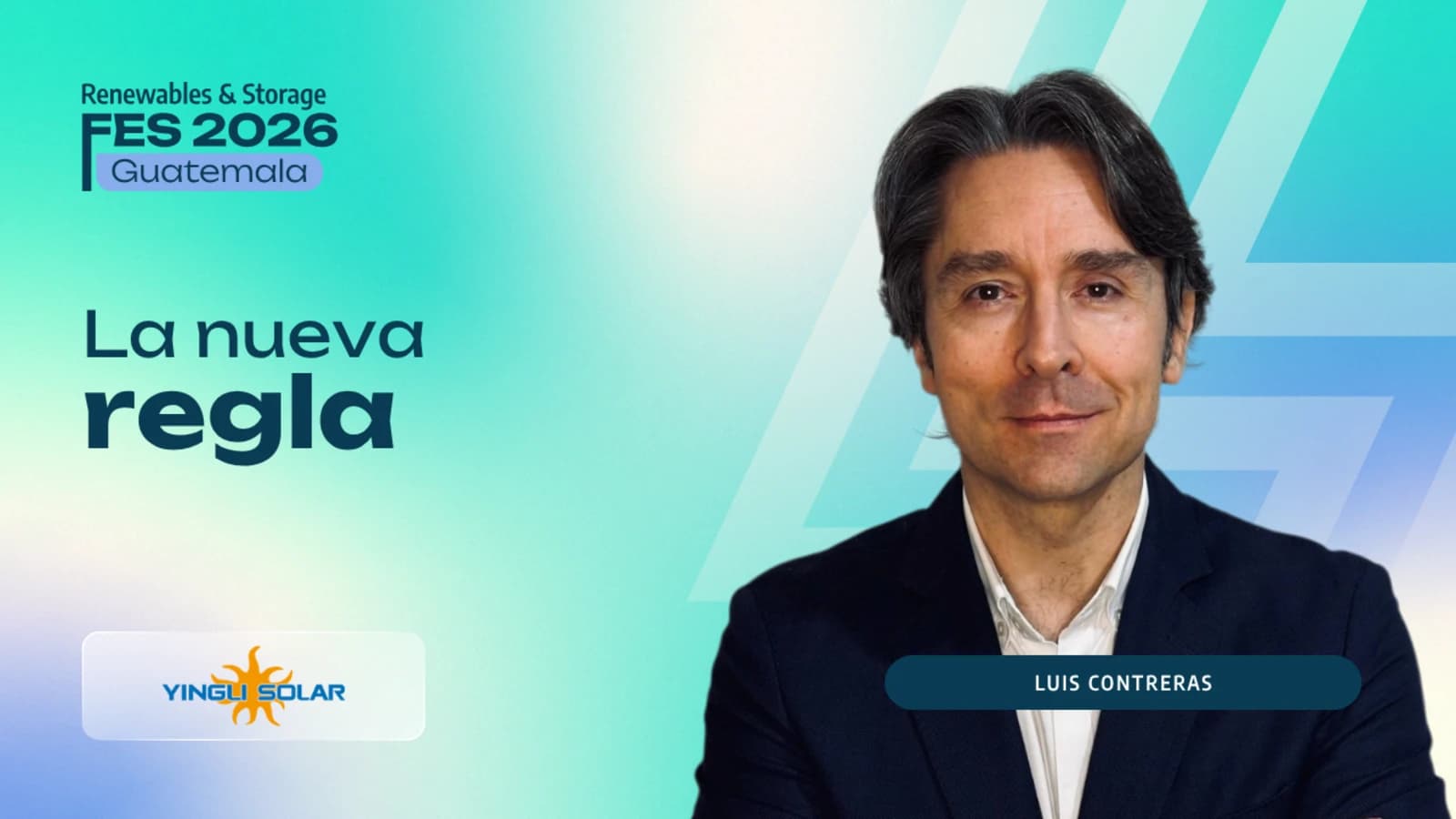
For Luis Contreras, Managing Director for Europe and Latin America at Yingli Solar , the tender confirmed that competitiveness no longer depends solely on the lowest generation cost. The ability to deliver energy at the required times, provide flexibility, and sustain performance for decades has become central.
“ The combination of photovoltaic modules and batteries is key ,” Contreras stated in an interview with Energía Estratégica during the first edition of Future Energy Summit Guatemala 2026 .
WATCH THE FULL INTERVIEW HERE: https://www.youtube.com/watch?v=Ndy1-Q9FfHA

The bidding process confirmed that the lowest levelized cost of energy does not by itself guarantee the competitiveness of a project if the technology cannot supply power and electricity at the times required by the system.
In that scenario, hybrid solar projects with batteries gained prominence compared to other renewable sources , including wind power, even though the latter maintains some of the lowest levelized generation costs internationally.
The ability to store photovoltaic production and shift it to periods of peak demand gave proposals with BESS systems greater predictability. The call for proposals prioritized the capacity to respond to specific hourly requirements, over the pure cost of generation.
The PEG-5 tender awarded 1,258 MW across 57 projects , of which approximately 73% correspond to renewable technologies . The process achieved an average single-unit price of $101 per MWh , below current contract values, and solidified energy storage as a central component of new electricity capacity.
Although wind power maintains a competitive LCOE, photovoltaic systems with batteries offered greater predictability in meeting firm power requirements . This shifted the analysis towards the overall value that each asset contributes to the system's operation.
“Photovoltaic solar energy once allowed us to bring in very cheap energy, and the battery will allow the systems to be managed, providing flexibility and quality to the grid,” the executive explained.
The PEG-5 redefines the value of projects
The outcome of the call marked a turning point for Guatemala because storage ceased to be an optional differentiator and became an essential attribute to guarantee reliability, stability, and responsiveness.
Batteries enable the management of solar production, reduce exposure to hourly variability, and improve compliance with contractual commitments. This capability is especially important in a system that will need to integrate more renewable generation while facing transmission constraints and sustained demand growth.
Contreras considered that Guatemala has especially favorable conditions to accelerate that process.
“ The market is super interesting because it combines a fantastic solar resource, a need for sustainable energy with reliable capacity, a need for infrastructure improvement, and a sustained and increasing energy demand ,” he highlighted.
From Yingli Solar's perspective, the PEG-5 also helped to organize the market and provide a clear signal for manufacturers, developers, investors, and financial institutions.
“We hope that the bidding process has helped to bring order to the market and, without a doubt, it presents a scenario that will be accompanied by the hybridization of technologies,” the executive stated.
The new dynamics changed the way equipment is selected, since developers need to guarantee the performance of assets during contracts that can extend for several decades.
The initial price of the module remains relevant, although it is no longer the sole deciding factor. Generation capacity, performance at high temperatures, efficiency under varying irradiance levels, and annual degradation now determine the economic outcome of projects.
“ We are no longer just talking about selling cheap, but about bringing other types of attributes: from the efficiency and performance of the module in the face of different weather conditions, irradiance and temperatures ,” Contreras explained.
This analysis is especially important in markets like Guatemala, where environmental conditions can impact production and the lifespan of components. Equipment with a lower acquisition cost doesn't necessarily offer better results if it experiences greater degradation or generates less electricity during operation.
“ Degradation is a critical technical aspect for projects ,” warned the Managing Director of Yingli Solar.
This variable directly affects cumulative production and projected revenue over the contract's term. For this reason, developers and financiers are increasingly analyzing degradation curves, guarantees, and certified technology performance in greater detail.
Contreras pointed out that developers are looking for equipment with real and proven improvements in generation and reliability, two variables that directly affect the competitiveness of the LCOE throughout the plant's useful life.
In this way, the levelized cost ceased to be measured solely based on the purchase price . The total production of the asset, losses, degradation, operating costs, and availability over 25 or 30 years determine the true competitiveness of the facility.
Continue reading
Guarantees and bankability for the new capacity
Yingli Solar aims to establish itself in this cycle with modules featuring N-Type TOPCon cells, primarily targeting the large-scale segment. The company offers equipment with power outputs of 730, 750, and up to 765 Wp for utility installations.
“The Utility sector is the one that has historically given us the most success and in which we perform best,” Contreras stated.
The manufacturer also highlighted warranties as a key element in facilitating financing. Its modules come with a 30-year power warranty and a 15-year product warranty , conditions designed to support developers, owners, and financial institutions.
“ Customers, like financial institutions, are very focused on approaching brands that can provide that stability ,” the executive remarked.
Bankability takes on added importance when projects incorporate storage. Hybrid installations combine modules, inverters, batteries, management systems, and dispatch strategies, increasing technical and contractual complexity.
Therefore, support during development, construction, and operation became another selection factor . Clients demand specialized support and post-commissioning assistance, in addition to the supply of components.
“And finally, there is the technical support during development and after-sales service once the projects are built,” Contreras pointed out.
The company also sees opportunities in the commercial and industrial sectors. While Honduras shows particularly intense activity, Guatemala presents room for self-consumption projects linked to industries with high electricity demands.
“We are not talking about small 1 MW projects; we are referring to 15 to 20 MW projects installed on the roofs of textile factories or in agricultural industries ,” the executive explained.
These consumers view solar power as a tool to reduce costs and strengthen their competitiveness. Their level of knowledge of the electricity market also allows some companies to move into new activities.
According to Contreras, several industrial clients end up becoming independent energy producers and marketers , after developing internal capabilities to manage their consumption and contracts.
The price of the module finds a new equilibrium
Guatemala's evolution coincides with an adjustment in the global photovoltaic market. After several years of oversupply, strong manufacturing expansion, and exceptionally low prices, the fiscal measures implemented in China could generate an increase of up to 15% in the value of solar panels during 2026 .
The change would mark the end of the "ultra-cheap" module era, although Yingli Solar believes the technology will continue to maintain competitive levels for developers.
“ Prices will stabilize and will continue to provide great competitiveness to the projects ,” Contreras projected.
The expansion of production capacity in Asia, mainly in China, accelerated cost reduction and allowed for the development of advanced technological solutions in very short periods.
“We could say that we have never before been in such a highly competitive situation,” he said.
This evolution offers advantages for both established and emerging markets. Established markets can continue to improve the efficiency and flexibility of their projects, while emerging markets have the opportunity to adopt mature technologies and leverage international experience.
For Guatemala, this situation represents an opportunity to incorporate high-power modules, BESS systems, and advanced management tools without going through all the stages taken by other markets .
However, the expansion of power generation must proceed in coordination with the grid infrastructure. During the Future Energy Summit in Guatemala, authorities announced a new tender, called PEG-6, aimed at contracting approximately 300 MW of firm power , given that PEG-5 did not cover all the required demand.
The PET-4 initiative was also announced, a new transmission tender aimed at preventing bottlenecks and facilitating the connection of awarded projects. Expanding the grid will be crucial for the new capacity to become operational without restrictions.
Storage will help manage production and reduce pressure on certain points in the system, although batteries do not replace the transmission infrastructure needed to keep pace with the growth in demand and installed capacity.
Guatemala is thus positioned as one of the most dynamic markets in Central America for the development of BESS. Unlike other countries in the region, PEG-5 demonstrated that energy storage can compete within long-term contracts and provide firm power without depending exclusively on ancillary service markets.
For Yingli Solar, the opportunity combines Utility projects, industrial self-consumption, high-power modules, long-term guarantees, and hybrid solutions capable of responding to the new demands of the system .
“Without a doubt, the Utility segment is key to our strategic expansion, but the development of the commercial and industrial sector is extremely interesting to us and offers great opportunities,” Contreras concluded.
The PEG-5 tender left a mark that goes beyond the 1258 MW awarded . For Yingli Solar, the new Guatemalan electricity market will be defined by the ability to deliver energy when needed, provide flexibility to the grid, and support investments with reliable technology for decades to come.