


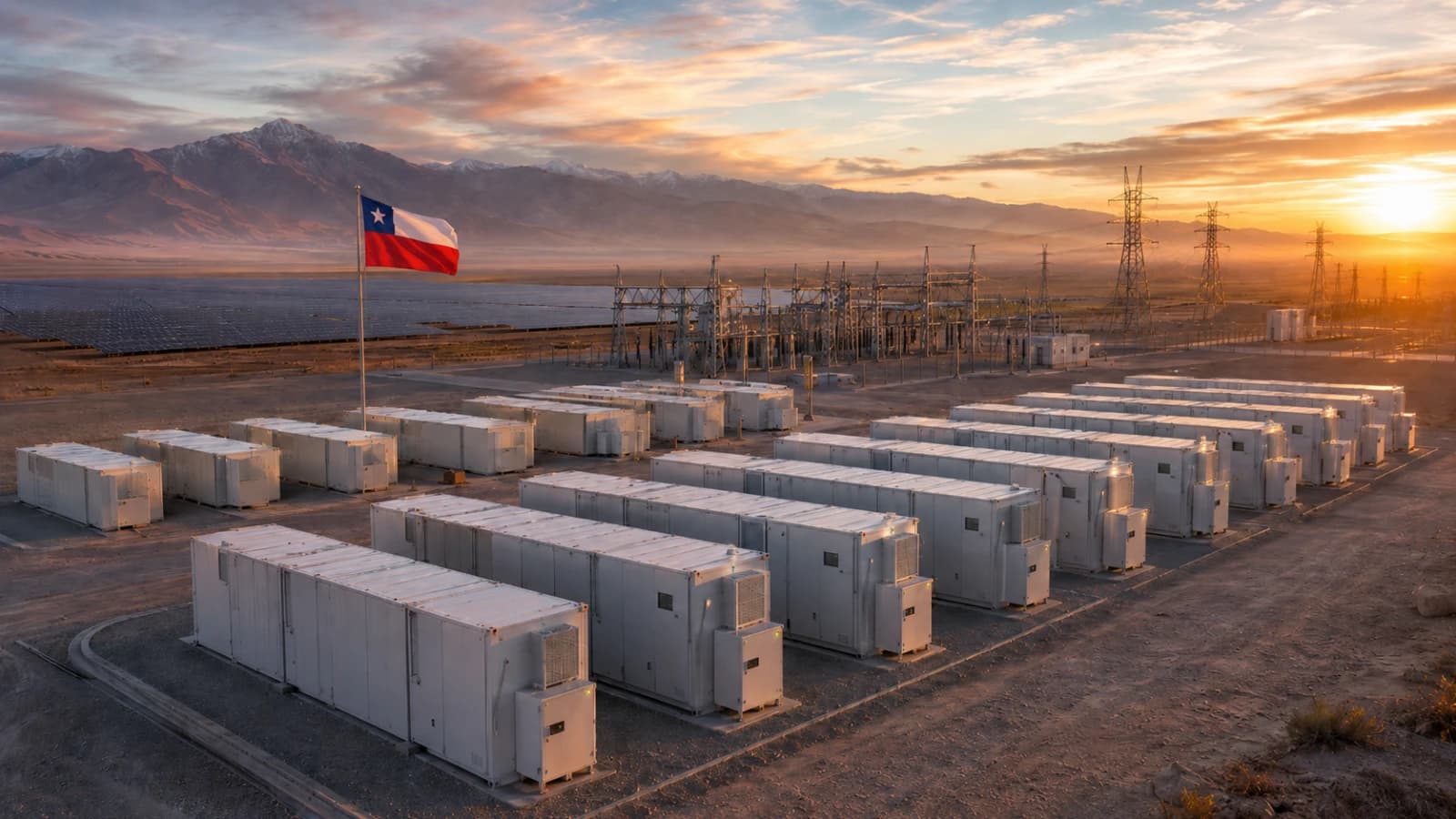
Chile is at a crucial juncture for energy storage, and 2027 appears to be a turning point for its electricity market. The introduction of new BESS systems will allow for the capture of a greater proportion of midday photovoltaic surplus, shifting it to the afternoon and evening hours and reducing the economic exposure of solar projects to periods of zero marginal cost.
In contact with Energía Estratégica, Miguel Iglesias Hurtubia, Founder & CEO of ENERGYASSET , projected that the country will exceed 20,000 MWh of installed storage capacity by the end of 2026 , while the assets currently under construction will begin to have a deeper impact on spills during the following year.
“ The impact of BESS systems on curtailment is already structural. They have gone from being a pilot technology to the main tool for revenue management and network support ,” Iglesias stated.
The starting point is a National Electric System (SEN) under increasing pressure from the hourly concentration of renewable generation. According to data provided by the government, curtailments exceeded 7 TWh during 2025 , while instantaneous solar share reaches 60% at certain times.

The main transmission infrastructure does not always have sufficient capacity to carry all the available energy production from areas with the greatest renewable resources. The result is a combination of wasted energy and a reduction in projected revenues for photovoltaic plants , especially during peak generation periods.
Faced with this situation, batteries allow for capturing production during periods of oversupply and shifting it to periods of higher demand and better price signals. Iglesias also noted that by mid-2026, more than 1,850 MW of storage capacity would already be operational and connected to the grid .
The magnitude of the pipeline confirms the change in scale. Energía Estratégica identified approximately 29 GW of storage projects in the pipeline in Chile , with more than 17 GW already having a favorable Environmental Qualification Resolution , a portfolio that expands the requirements regarding permits, connection, transmission and revenue models as developments progress.
2027 as a turning point
The transformation planned for 2027 will be determined by the ability to shift solar generation between different time slots. A greater presence of batteries will allow for the absorption of surplus energy at midday, when marginal costs can fall to zero, and the use of that energy after the drop in photovoltaic production.
“ From 2027 onwards, batteries are managing to capture the midday oversupply (hours of zero marginal cost) to inject it into evening and night windows ,” explained the Founder & CEO of ENERGYASSET.
The addition of storage also changes the financial profile of renewable assets. A hybrid power plant can manage the timing of its energy injection and reduce its dependence on periods of high photovoltaic generation, grid congestion, and depressed prices.
“ This not only alleviates spillovers due to transmission restrictions, but also stabilizes asset cash flows — a critical factor for debt structuring in generation portfolios —,” Iglesias noted.
The stability of these revenues gains importance in the financial structuring of new developments, since the ability to shift generation reduces exposure to episodes of zero or very low prices and improves the predictability of flows destined for debt service .
The progress of construction projects could significantly alter the curtailment problem during the next year.
“ By 2027, with the entry of the projects currently under construction, daytime discharge will tend to be substantially mitigated, shifting the technical challenge towards the algorithmic optimization of loading and unloading cycles ,” the executive stated.
With a larger fleet in service, the operational discussion will shift towards dispatch strategy, cycle management, cell degradation, price signals, and the possibility of combining different services on the same asset .
The Chilean regulatory framework has already begun to incorporate part of this transformation. The Ministry of Energy's Decarbonization Plan identifies energy storage as a flexibility tool for an energy mix with increasing renewable penetration and includes mechanisms such as the Energy Storage Law 21.505, the Power Regulations, and the recognition of the opportunity cost of these systems .
Sector planning also warns that the growth of variable renewable energies will increase the need for operating reserves, flexibility and optimization tools, in parallel with transmission congestions that condition the economic dispatch of generation located mainly in the north of the country .
Within this scenario, opportunity cost became more relevant in the economic operation of batteries . The same unit of stored energy can be used at different times or reserved to provide other services, so its value also depends on the future opportunities forgone when deciding to discharge it.
From traditional solar panels to “anytime solar”
The growth of BESS is also altering the commercial logic of photovoltaic developments. The possibility of partially decoupling the generation time from the delivery time makes hybridization a central variable for the competitiveness of new projects.
“ Yes, Chile has definitively crossed the threshold towards the 'anytime solar' model. Today, hybridization is no longer optional but has become the minimum standard for bankability in the market ,” Iglesias stated.
The pressure is particularly visible in the north and north-central regions, where high concentrations of photovoltaic power increase exposure to grid contamination and lead to reduced prices during peak hours. According to the executive, a purely solar project is no longer competitive in much of this area .
With a consolidated national electricity demand of around 80 TWh per year , the market requires more reliable and predictable delivery profiles. Energy storage enables intertemporal arbitrage while also providing ramp control, voltage support, and other technical benefits.
The growing importance of this technology is also reflected in the new capacity. According to Iglesias, BESS projects represent more than 60% of the 10,454 MW currently under construction in Chile .
However, the physical growth of assets requires an equivalent evolution of remuneration mechanisms.
“ The regulatory system needs to consolidate mechanisms that adequately remunerate this multi-service capacity, allowing assets to diversify their income beyond energy arbitrage ,” warned the Founder & CEO of ENERGYASSET.
Continue reading
One area for development is the Ancillary Services Market , where batteries can provide synthetic inertia and frequency control with response times superior to those of traditional synchronous machines. The technological capability already exists, but its monetization requires signals that recognize each service.
The Decarbonization Plan also raises the need to incorporate resources capable of providing flexibility, inertia and robustness to the grid as the participation of conventional power plants decreases.
Another key definition will be the capacity sufficiency for long-duration systems, particularly those capable of delivering energy for four to eight hours . Iglesias considered it essential to consolidate the capacity payment mechanism so that remuneration reflects the support provided during critical periods.
This component will become even more important if the growth of the BESS park progressively reduces the margins available for pure arbitrage. Revenue diversification will be crucial to sustaining the business case for projects in the long term.
Contracts and regulation: the new bottlenecks
The appetite for investment and the volume of projects undergoing environmental assessment show that technological availability is no longer the main constraint. The friction now lies in regulatory design, marketing, contracts, and the integration of assets into the grid.
Iglesias identified uncertainties surrounding the regulatory classification of storage, particularly regarding its treatment as generation, transmission, or an independent asset, as well as the impact of each definition on tolls and systemic charges .
There are also challenges in the Small and Medium Distributed Generation (PMGD) segment, where the incorporation of storage requires adapting connection, monitoring and operation conditions on networks that in different areas already have restrictions.
The contractual front is another area that requires evolution.
“ Traditional PPA schemes (like solar blocks) are obsolete. The market needs to mature towards contracts that economically value the flexibility, manageable dispatch, and reliability that the BESS brings to the parent company ,” Iglesias stated.
Agreements designed solely around photovoltaic generation time blocks do not necessarily recognize the ability to store electricity, manage injection, and respond to the buyer's needs at times other than production times .
According to the executive, independent energy retailers are already driving this transformation and are beginning to open contracts with end users to integrate BESS into grid electricity supply agreements , taking advantage of corporate structures with more agile decision-making processes.
ENERGYASSET participates in this scheme, as its founder explained, through a strategy aimed at integrating storage into commercial solutions and supply contracts.
The regulated market is also beginning to incorporate long-term signals. Chile adjusted a tender for 2,835 GWh annually with contracts of up to 15 years , a process that raises the bar for competing for future supply and in which the ability to structure more robust profiles is becoming increasingly important.
PMGD and O&M: challenges behind the expansion
The contribution of batteries to the main transmission line does not, in itself, resolve the existing downstream constraints. In the PMGD segment, saturated local medium-voltage feeders persist , necessitating infrastructure reinforcement and modernization of distribution network management.
Some of these solutions are already being implemented by the private sector through line reinforcements financed at the cost of the projects themselves , Iglesias explained.
Expansion needs are not limited to distribution. Chile continues to develop backbone infrastructure and recently awarded approximately USD 33 million in transmission works , while a 28 MWh BESS project remained unresolved within that process, reflecting the coexistence of both solutions within electricity planning.
Operation and maintenance constitute another critical front. The degradation of LFP cells and the management of their life cycles require a higher level of expertise than the conventional maintenance of a solar power plant.
The quantity, depth, and conditions under which loading and unloading cycles are performed directly affect the useful life of the equipment and, therefore, the expected economic return during the contractual life of the asset.
This requires raising the standards of engineering, procurement and construction (EPC), operation and maintenance (O&M) , as well as incorporating technical capabilities that allow monitoring the entire operational chain.
The private sector is specializing equipment in cell-level operation, maintenance and control, Battery Management System (BMS), Energy Management System (EMS) and remote management integrated to control rooms , the executive explained.
Territorial growth confirms the market's acceleration. Atacama went from 677 MWh to 1566 MWh of storage in one quarter , an advance that shows how BESS (Basic Energy Storage Systems) are beginning to concentrate in regions with high renewable penetration and strong needs for shifting production time.
The region exemplifies the speed of deployment and, at the same time, the challenges that will accompany the next stage: connectivity, efficient operation, degradation, coordination with networks, and monetization of different services .
Between 2026 and 2027, Chile must convert a record portfolio of developments into operational assets capable of reducing wastewater discharges, transferring solar generation, contributing to the stability of the National Electric System (SEN), and sustaining long-term financial structures .
The number of projects already confirms that energy storage will occupy a central position in Chile's electricity expansion. The next challenge will be to support this volume with regulation, infrastructure, contracts, and economic signals capable of capturing the systemic value of energy storage systems .
For the photovoltaic market, the change implies a profound modification of its economic logic: the value of generation will depend less and less exclusively on how much a plant produces and more on its ability to manage when it delivers that energy to the system.