


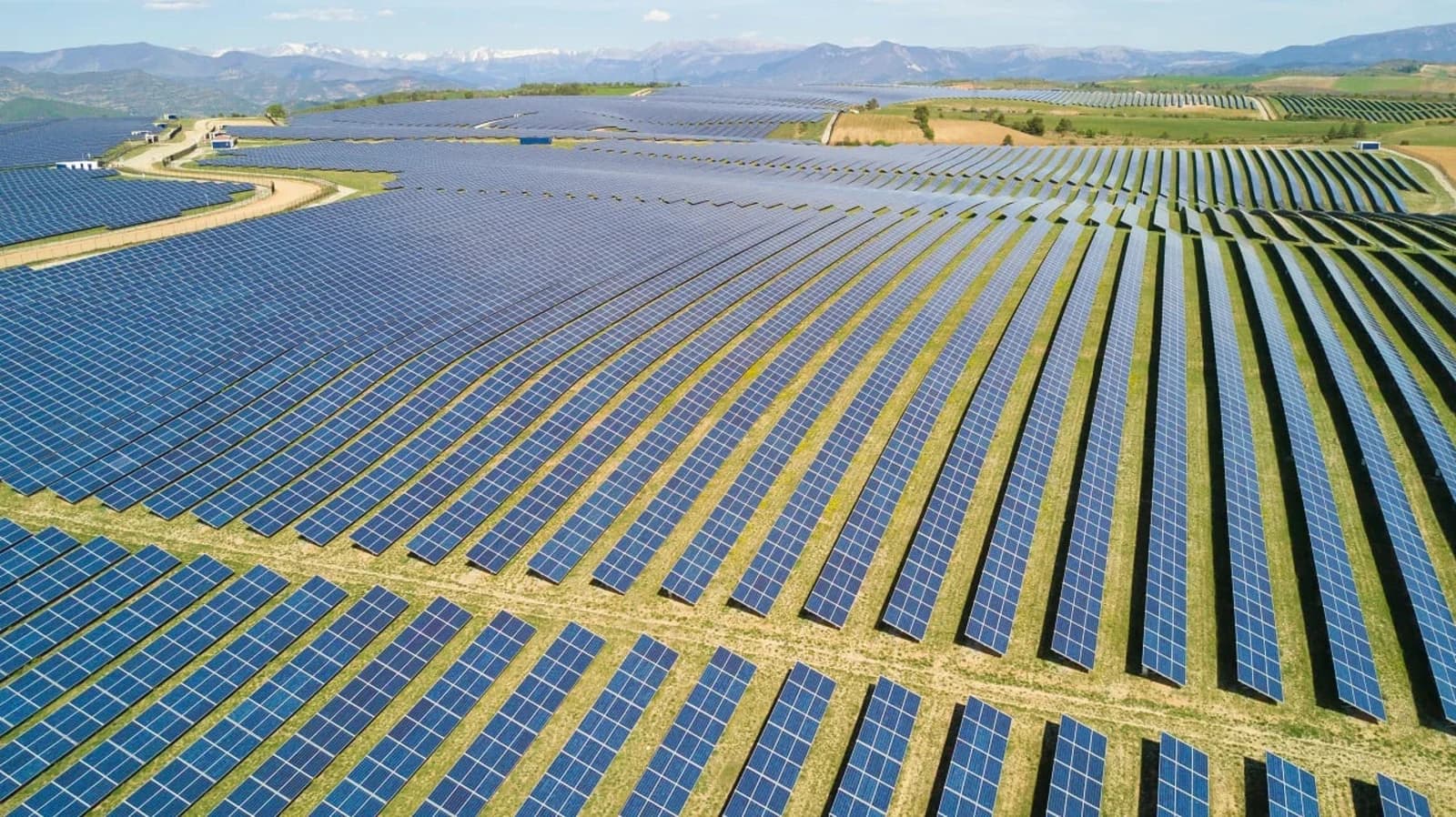
India, the world's third-largest solar generator, poured around of 4.2% of its photovoltaic production during July and August , despite going through a period of record electricity demand and maintaining a strong expansion of new capacity.
According to the Centre for Research on Energy and Clean Air (CREA), the country recorded 1462 million units of solar generation fed into the grid in those two months, within a total of 1835 million renewable units that could not be absorbed by the system.
This figure contrasts with the strong growth in the technology sector. Solar generation increased 39% year-on-year during the second quarter of fiscal year 2026-27 and accounted for approximately 58% of the increase in renewable energy production for the period.
Furthermore, on September 30, India reached a new daily record for solar power generation, with 705 million units .

But the increase in production was not matched at the same pace by the infrastructure needed to integrate it.
The country's photovoltaic capacity reached 168 GW in August 2026 , around 30% of the 555 GW of total installed electricity capacity. Only coal and lignite, with 231 GW, maintained a larger share.
At the same time, peak electricity demand reached 270 GW on July 16 , compared to 230 GW in the same quarter of the previous year.
The pressure on the system was no less: during 62 of the 92 days of the quarter , the daily peak demand occurred precisely during solar generation hours.
Even so, some of that production had to be dumped.
The explanation points mainly to operational restrictions, transmission limitations, and a lack of sufficient storage capacity to shift surpluses to the evening and nighttime hours.
Only 9.1 GWh of BESS are operational compared to 151 GWh tendered.
The storage gap appears to be one of the main bottlenecks.
India had approximately 9.1 GWh of operational BESS systems , while another 3 GWh were planned to come online by December 2026.
The contrast with the auctioned portfolio is considerable.
By August, the country had awarded approximately 290 GWh of storage projects , of which 151 GWh corresponded to batteries and another 142 GWh to pumped hydro storage.
In other words, the BESS capacity already contracted far exceeds the capacity that is actually available today to operate the system.
During nighttime peaks, storage contributed up to 5.5 GW , compared to 4.1 GW in the previous quarter, although it still only covered between 1% and 2% of national demand at those times.
CREA warns that this difference between renewable generation, grid and flexibility should also be considered when defining new thermal capacity.
“ Solar power is increasingly meeting daytime electricity demand, while storage helps cover evening and nighttime peak demand ,” said Manoj Kumar, an analyst at CREA in India.
The specialist added that coordinated planning between future demand, renewables and storage would prevent new capacity from becoming underutilized.
The tension is already becoming visible in the operation.
While solar power reached record highs and renewable generation, excluding large hydroelectric power, exceeded 100 BU for the first time, reaching 101 BU, the available infrastructure is still unable to absorb all of that production.
With 168 GW of solar installed, 39% year-on-year growth and a 4.2% curtailment in July and August , India now faces one of the central challenges of its next energy stage: ensuring that the expansion of renewables is accompanied by sufficient transmission and storage to prevent a growing portion of that electricity from being wasted.