


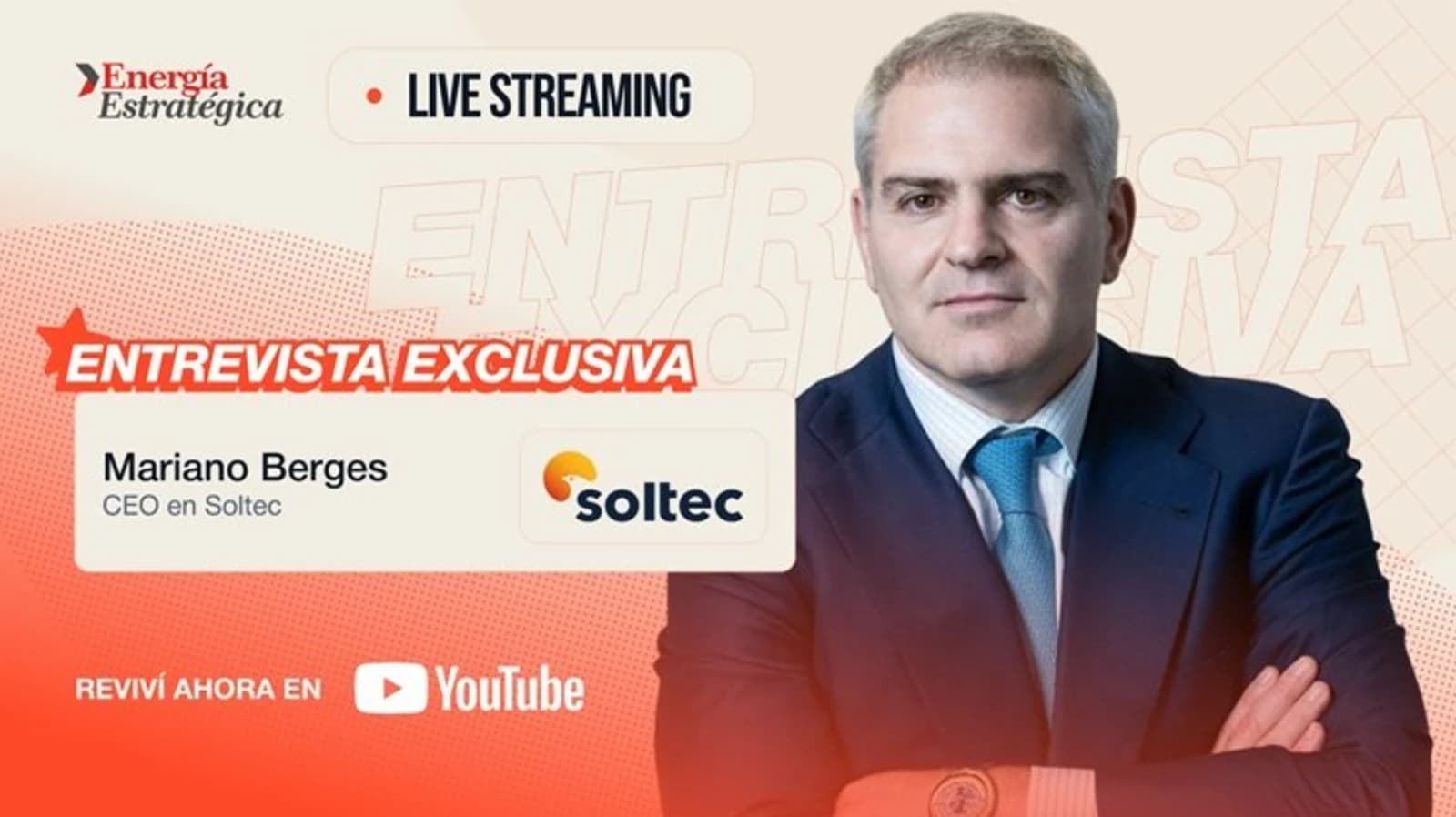
As an introduction, it's worth recalling that Soltec entered a deep financial crisis in mid-2024, facing one of the most challenging financial periods in its history. Just when things looked bleak, however, a year later it obtained court approval for its proposed debt restructuring plan, thus avoiding bankruptcy proceedings. As a result of this process, the company established a new medium-term payment schedule and strengthened its financial capacity with new lines of credit guarantees that will allow it to bid on projects again.
In parallel, the agreement with DVC Partners for a €45 million cash injection marks the beginning of a new phase for Soltec, characterized by greater financial stability and a strengthened capital structure. Watch the full interview with Soltec's CEO: https://www.youtube.com/watch?v=Z7qIMz3sAss https://www.youtube.com/watch?v=Z7qIMz3sAss - To begin⬦ How did renewables come into your life? I'm an industrial engineer, and I started out with the Indra Group, a Spanish technology company, but I didn't like it. I had done a master's degree in renewable energy because I was particularly interested in wind farms at that time (2002-2003). - And did you know anyone in the sector? I had a friend who owned a company that was developing projects; they were building a wind farm in Castile and León. I went to see it and fell in love with the sector.
It was love at first sight. - And Soltec? After stints at a subsidiary of what is now Naturgy (formerly Unión Fenosa - from 2004 to 2006), Fotowatio (2006 - 2020), and CPP Investments (2020 - 2023), the founder of Soltec, Raúl Morales, called me to join the project. - Did you already know Raúl Morales? Yes, we knew each other because the company where I worked was a Soltec client, which provided trackers, and we had done some transactions with them.
And I joined Soltec with the goal of becoming CEO, but I started as Chief Operating Officer. - Why? Because Raúl wanted me to join as soon as possible, since the CEO appointment could only happen at the shareholders' meeting held in the summer. - When exactly? I joined at the beginning of 2024, but with the goal of being appointed CEO in June of that year.

It was a plan that was in place from the beginning. - You took over the company during a crisis. How was it to face the restructuring of Soltec? There have been several key and intense moments during the last 18 months.
A difficult first moment on a personal level was when Raúl Morales had to step down as chairman of the board (mid-2024), and in October 2024 I was left without any board members, so I had no body to make certain decisions. - That must have been very difficult... Another critical moment is that, during the restructuring phases, certain deadlines are set.
We got two extensions and the judge told us he wouldn't give us any more, so there was tension about closing the process by a certain date.
Otherwise, the company would have gone into receivership. - Looking back, why would you say they managed to pull through? The company was bankrupt 18 months ago.
There's a lot of talk about the loneliness of being a CEO, but that loneliness should be minimized as much as possible by surrounding yourself with a good team. The most important thing is the team, and never being alone.
One of the greatest successes in bringing Soltec to fruition was surrounding ourselves with a group of good people committed to the project, who ensured the company didn't disappear. - And what's next? In the new Soltec, we'll focus on the tracker, on being a technology company, and we'll retain two adjacent businesses to support the tracker business: on the one hand, operation and maintenance of our trackers, and on the other, project development. - And what about the independent power producer (IPP) aspect? We won't be doing that anymore.
We will focus solely on developing projects that are less capital-intensive and help nurture our following, because all projects will utilize our technology, and we want to strengthen Soltec as a technology provider. We have been in the sector for over 20 years, and our vision is to remain for another 20, 30, or 40 years. What we want is to have a customer base that continues to work with us, continues to buy our products, and for us to help them grow their businesses. - Which markets will you focus on? We are very focused on the markets where we already have a presence: Europe, the Middle East, and Africa (EMEA), and all of the Americas, with a special focus on the United States, where we aim to generate 50% of our revenue within two years. - What particularly appeals to you about the United States? The demand for energy in that country is unstoppable, especially with data centers.
And the only way to meet that demand when needed is with renewables, and especially with solar energy. - And Latin America? What's the ranking of the countries that interest you most today? Where do you start and what are your next steps? The company's core market has always been Brazil, but currently, due to grid availability and disruptions, the development and execution of projects is on hold until there's a bit more clarity.
But for us, it will be the main market in the long term. - Just Brazil? No, there are many opportunities in Chile; we also participate in Colombia and Peru, and we always have Argentina on our radar, but we need them to have a policy that favors investment in renewables and provides some security. Meanwhile, in Mexico, it has also been stagnant for quite a few years, but right now they are holding auctions, awarding projects, and therefore, starting to pick up again.
Although for everything to be financeable and feasible, investors need a certain level of assurance that they will be paid accordingly for the energy produced. Soltec was once number one in Latin America, holding a dominant position there, and I would like to gradually regain that. - You're coming off a restructuring but with the drive to regain your market presence. What do you tell a client today when you go public? Why should they hire Soltec? From a mechanical and structural standpoint, we have the most robust tracker on the market in all versions (1P and 2P).
We have been in the sector for over 20 years.
The first tracker Soltec installed was a dual-axis model in 2006 or 2007. The first 1P tracker was installed in Italy in 2009, and the first 2P tracker, where Soltec has been a pioneer, was installed in Chile in 2013. Few companies in the market have that track record. - Looking ahead, what innovations are on the horizon? We're investing heavily in technology, software, and product improvements, which will result in a better product for the customer, improved production, a higher LCOE, and a better return on investment. We already have our own electronics, so we're investing a lot of money in them to provide enhanced applications for our customers. - On another note, given the strong development of battery systems, is that a business you're already considering? We're monitoring it very closely because it won't just be photovoltaic parks being built anymore, or there will be few occasions for that; instead, there will be solar projects with batteries. Therefore, we need to see how we integrate with the battery and what added value we can offer. - What options are you evaluating? We're starting to analyze them because right now we want to focus on getting the tracker business off the ground. We've spent 18 months executing all the projects without abandoning a single one, and now we need to get the machinery running. - The rebirth of Soltec... I prefer to take things one step at a time, so first we're launching the trackers, but it's true that we need to have some role within the storage sector, regarding how we integrate with the tracker.
We need to analyze where we can add value, because the battery market is already quite saturated, and therefore we won't be able to compete or do anything new, but we can see how we can adapt by integrating with the tracker. - Before we wrap up, I'd like to get to know the person behind the executive. What do you do outside of your role as CEO of the company? I have four children, and in my free time I enjoy playing sports.
And what I enjoy most is playing rugby, so I try to play a friendly match now and then. - What position do you play in rugby? I used to play 2 and 7, and now with age I'm moving more towards 9 or 11. - The role people have in sports generally coincides with the role they assume in different facets of life. Does that coincide in your case? I was captain, so you can imagine there might be a bit of synergy.