In July, Spain reached an unusual point in its energy transition: electricity demand reached its highest monthly level in 18 years, and at the same time, renewables produced more electricity than ever before .
It's not just about two simultaneous records. The system's performance during the month is beginning to show why energy storage is gaining ground in new renewable energy developments that are moving forward administratively.
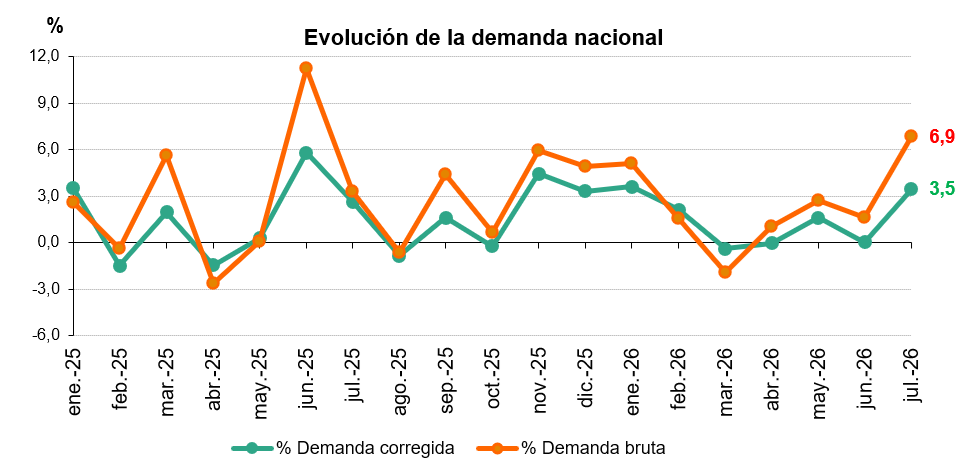
National demand reached 25,144 GWh , 6.9% higher than in July 2025. Even after correcting for temperature and working day effects, the increase remained at 3.5%.
It was the highest monthly amount of electricity demanded since January 2008.

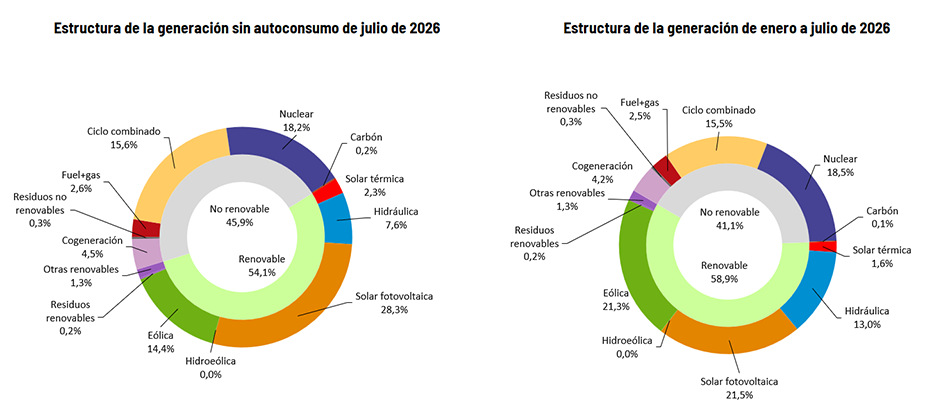
Renewables responded with 14,699 GWh , 5.8% more year-on-year and their highest monthly figure to date, representing 54.1% of all generation.
But the internal distribution of that growth matters.
Photovoltaics generated 7,696 GWh and contributed 28.3% of the electricity , becoming the country's leading technology for the fourth consecutive month. Its production grew by 22.2% year-on-year and alone accounted for more than half of all renewable energy generation in July.
On July 8, it also reached a daily record of 278.6 GWh.
Solar expansion thus allowed for the absorption of a significant portion of the increased energy consumption during peak hours. The problem arises when production and demand no longer coincide in time.
The second largest contributor to the energy mix was not another renewable source, but combined cycle gas turbines, which accounted for 20.1% of national generation . Nuclear power represented 18.2%, wind power 14.4%, and hydropower 7.6%.
The photograph reveals an increasingly visible paradox: Spain has more solar generation than ever before, but still needs a significant amount of manageable power to get through the hours when the resource decreases while consumption remains high.
That's where storage begins to take on another dimension.
During July, batteries and pumped storage plants absorbed 906 GWh of electricity and subsequently delivered 510 GWh to the grid , according to Red Eléctrica.
The amount absorbed is equivalent, for scale, to almost 12% of all photovoltaic production recorded during the month. This does not imply that the electricity came exclusively from solar plants, but it does allow us to understand how much volume is temporarily shifting within the system.
Self-consumption adds another piece. REE estimates that it produced around 1,654 GWh in July , equivalent to approximately 6.6% of monthly electricity demand.
When that generation is incorporated, the renewable share increases from 54.1% to 55.7%.
Therefore, the system is not only adding large power plants: a growing fraction of electricity is produced behind the meter and modifies the curve that the operator must manage.
The problems from July are already appearing in upcoming projects.
The evolution of the BOE during the same month allows us to see how the market begins to respond to this operational change.
The Strategic Energy survey identified 55 energy files published during July, and storage appeared in 23 , about 42% of the total.
A month earlier, the batteries participated in 18 of 63 performances.
Continue reading
Therefore, its presence in the pipeline went from 28.6% in June to 41.8% in July , a jump of more than 13 percentage points in just one month.
Even more revealing is how they are being incorporated.
Of the 23 projects involving batteries, 17 combine storage and photovoltaics . In other words, practically three out of every four BESS projects identified during July are directly associated with solar development.
It does not seem coincidental in a system where photovoltaics has just become the primary source of generation.
Some projects also show that the battery is no longer seen as a marginal complement.
In Alcalá de Guadaíra, six facilities that obtained prior administrative and construction authorization have a combined capacity of 278.4 MW photovoltaic and 237.6 MW of storage .
The BESS power is equivalent to 85% of the associated solar power, although the comparison in MW does not by itself allow us to determine how many hours of energy the systems will be able to store.
The trend is repeated in other initiatives.
La Atalaya combines 96.88 MW of photovoltaics with 83.71 MW of batteries ; while Azor Solar 1 and 2 incorporate 68.51 MW BESS along with a 64.02 MW plant.
OPDE Miramundo presents another configuration, with 49.99 MW of solar and 24.04 MW of storage.
They are different proportions and will respond to different operating models, but they share one signal: the battery is starting to be part of the initial sizing of the renewable plant and not just of a future expansion .
This transformation also coincides with an electricity park that, at the beginning of August, already had 109.5 GW of installed renewable power , equivalent to 72% of the entire national generation capacity.
This data helps to explain the change in priorities.
When the renewable energy expansion started from a limited base, the main challenge was installing megawatts. With more than seven out of every ten MW of the total capacity now coming from renewable technologies, the discussion is shifting towards when these assets produce electricity, where they can inject it into the grid, and what happens to the electricity when supply and demand don't match .
The administrative map for July also shows where that transformation is concentrated.
Andalusia accounted for 20 of the 55 cases , more than a third of the national total, and is home to the Alcalá de Guadaíra cluster.
Catalonia recorded eight actions, while Extremadura, Castilla-La Mancha, Comunitat Valenciana and Castilla y León each recorded five.
The career, however, is not linear.
During the same month, seven withdrawals were registered for more than 405 MW , including four Acciona facilities in the Valencian Community, two Statkraft wind farms in Andalusia and the 100 MW BESS Visenta in Huesca.
The data introduces a second interpretation to the volume of projects in process: more files and more storage do not automatically mean more connected capacity .
Julio thus shows two speeds of the same transformation.
In this operation, Spain managed to get through the month with the highest demand since 2008, achieving record renewable energy production and making solar the leading technology. However, it needed to maintain a 20.1% contribution from combined cycle plants and mobilize hundreds of GWh through storage and pumped storage.
Meanwhile, in the pipeline, batteries already appear in four out of ten projects and are mainly integrated alongside new photovoltaic capacity.
 By Emilia Lardizabal



 By Ailén Pedrotti

 By Florencia Guglielmetti