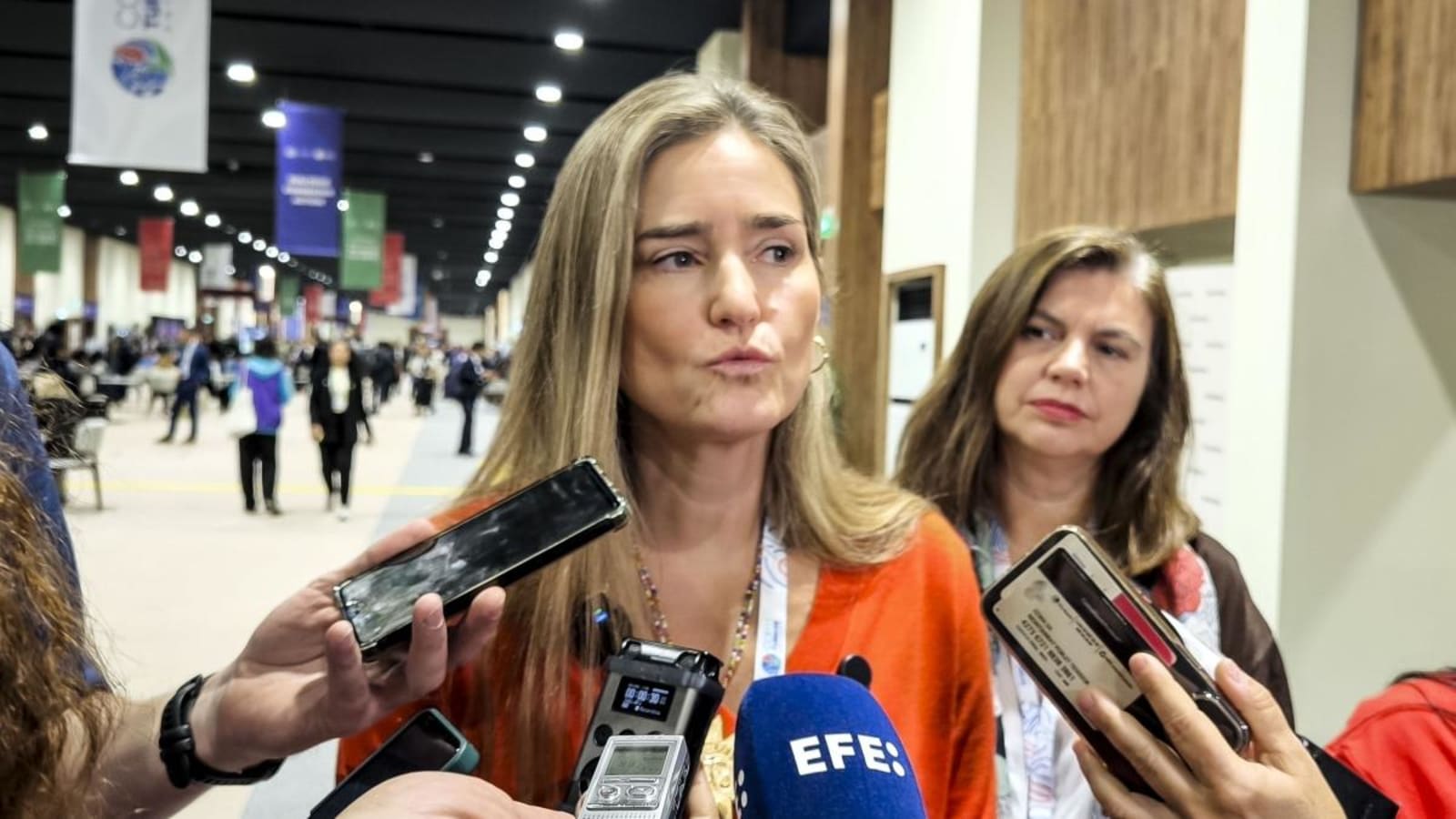
Spain raised its demands during COP31 in Antalya, Turkey , and called for the summit's final agreement to establish a concrete roadmap for progressively abandoning fossil fuels, accelerating the deployment of renewable energies, and expanding the electrification of the economy.
The position was defended by the third vice president and minister for the Ecological Transition, Sara Aagesen , who confirmed that the Government is working on a national strategy to move away from oil, gas and coal.
The announcement coincides with Spain's adherence to the 35 by 35 commitment , promoted by Turkey and Australia, which proposes to increase the share of electricity in global final energy consumption from 23% to 35% by 2035. However, Madrid proposes a higher timeframe for its own territory: to reach that proportion in 2030, five years ahead of the international target.
“Spain supports electrification that goes hand in hand with renewables; we believe it is important to electrify, but only if we manage to decarbonize,” Aagesen said, insisting that technological change must translate into an effective reduction in emissions.

The warning is particularly relevant given the current composition of the global energy mix. According to the International Energy Agency (IEA) , renewable sources accounted for 34% of global electricity generation in 2025, up from 32% in 2024.
Despite the progress, coal still contributed another 34% and natural gas 21%, which shows that greater use of electricity does not automatically imply abandoning hydrocarbons.
Now, the Spanish position seeks to translate into implementation the agreements reached during COP28 in 2023, when participating countries recognized the need to move towards a transition away from fossil fuels in energy systems.
That declaration also established the international commitment to triple installed renewable capacity and double the pace of improvement in energy efficiency by 2030 , two objectives that Spain considers fundamental to sustaining the transformation of the sector.
“It is something very important, which was already achieved in Dubai and is now more important than ever,” the minister told the press, questioning the lack of sufficient progress in translating that consensus into operational measures.
Aagesen linked this urgency to the economic consequences of the conflicts in Ukraine and the Middle East. In his view, dependence on fossil fuel imports increases countries' vulnerability to international crises, drives up energy costs, and compromises their strategic autonomy.
In that context, he confirmed the development of a Spanish strategy for abandoning hydrocarbons, although he did not yet specify the measures it will include or its presentation schedule.
The minister also endorsed Brazil's initiative to offer governments voluntary tools to facilitate the design of their own transition strategies, taking into account the economic and energy differences of each territory.
“It is a toolbox where different countries have made proposals and it allows us to help other countries join and present their roadmaps,” he explained.
The proposal is being developed as delegations negotiate the first draft of the Antalya agreement, presented on November 16. The document proposes accelerating the phase-out of fossil fuels and links increased clean electrification to investments in modern grids, energy storage, and system flexibility .
However, the text remains open to modifications and does not establish individual compliance obligations for countries, so the effective scope of its provisions will depend on the consensus reached before the close of the conference.
Brussels raises the stakes, and Spain seeks to increase its renewable energy generation from 56.6% to 81%.
Madrid's position finds support in the European Commission's strategy. During her speech at COP31, the President of the European Commission, Ursula von der Leyen , expressly supported the international commitment to electrification and defended its contribution to security of supply, emissions reduction, and competitiveness.
“The world has entered the age of electricity,” the leader said, noting that more than 70% of the European Union’s electricity production already comes from clean sources, including renewables and nuclear power.
The European Union aims to double the share of electricity in final energy consumption to 46% by 2040. This objective is combined with its goal of reducing net emissions by 90% compared to 1990 levels by the same year and achieving climate neutrality by 2050.
The data shows significant progress, although also differences between countries. According to Eurostat, renewables accounted for 47.3% of electricity generated in the EU in 2025 , slightly above the 47.2% of 2024. Solar energy registered the largest year-on-year growth, with an increase of 24.6%, while hydroelectric production fell by 11.8%.
In Spain, renewable energy penetration reached 56.6% of electricity generation in 2025 , including self-consumption, according to Red Eléctrica. During that year, approximately 10 GW of new wind and solar photovoltaic capacity was added, a figure that rises to 11.6 GW when self-consumption installations are included.
This growth allowed the country to reach nearly 50 GW of installed solar capacity and consolidated its position among the leading European photovoltaic markets. In addition, pumping systems and batteries contributed 9,213 GWh of electricity, 6.2% more than the previous year.
However, expansion must be maintained to meet the Integrated National Energy and Climate Plan (PNIEC) 2023-2030 , which establishes an 81% share of renewables in electricity production and 48% in final energy consumption by the end of the decade.
The gap between current penetration and national goals places expanding evacuation capacity, modernizing networks, and developing storage among the priorities to take advantage of the new generation and meet growing demand.
Europe is accelerating renewables, but gas continues to condition its transition
The scale of the international challenge was reflected during the opening of COP31, when the presidency of the United Nations General Assembly warned that tripling global renewable capacity by 2030 requires adding approximately 1,200 GW annually , a pace that demands a significant acceleration of investments.
In Europe, progress coexists with contradictory signals. According to Ember's European Electricity Review 2026 report, solar and wind power together generated 30.1% of the EU's electricity in 2025, compared to 29% from fossil fuels , surpassing them for the first time.
However, generation conditions forced a return to natural gas, whose electricity production increased by 8% during the year. As a result, imports of this fuel for the electricity sector reached €32 billion .
The contrast reinforces one of the arguments put forward by Spain in Antalya: renewable expansion must translate into less dependence on hydrocarbons, through greater integration of clean generation and resources capable of guaranteeing supply.

 By Emilia Lardizabal
 By Matías Medinilla
 By Ailén Pedrotti
 By Florencia Guglielmetti