

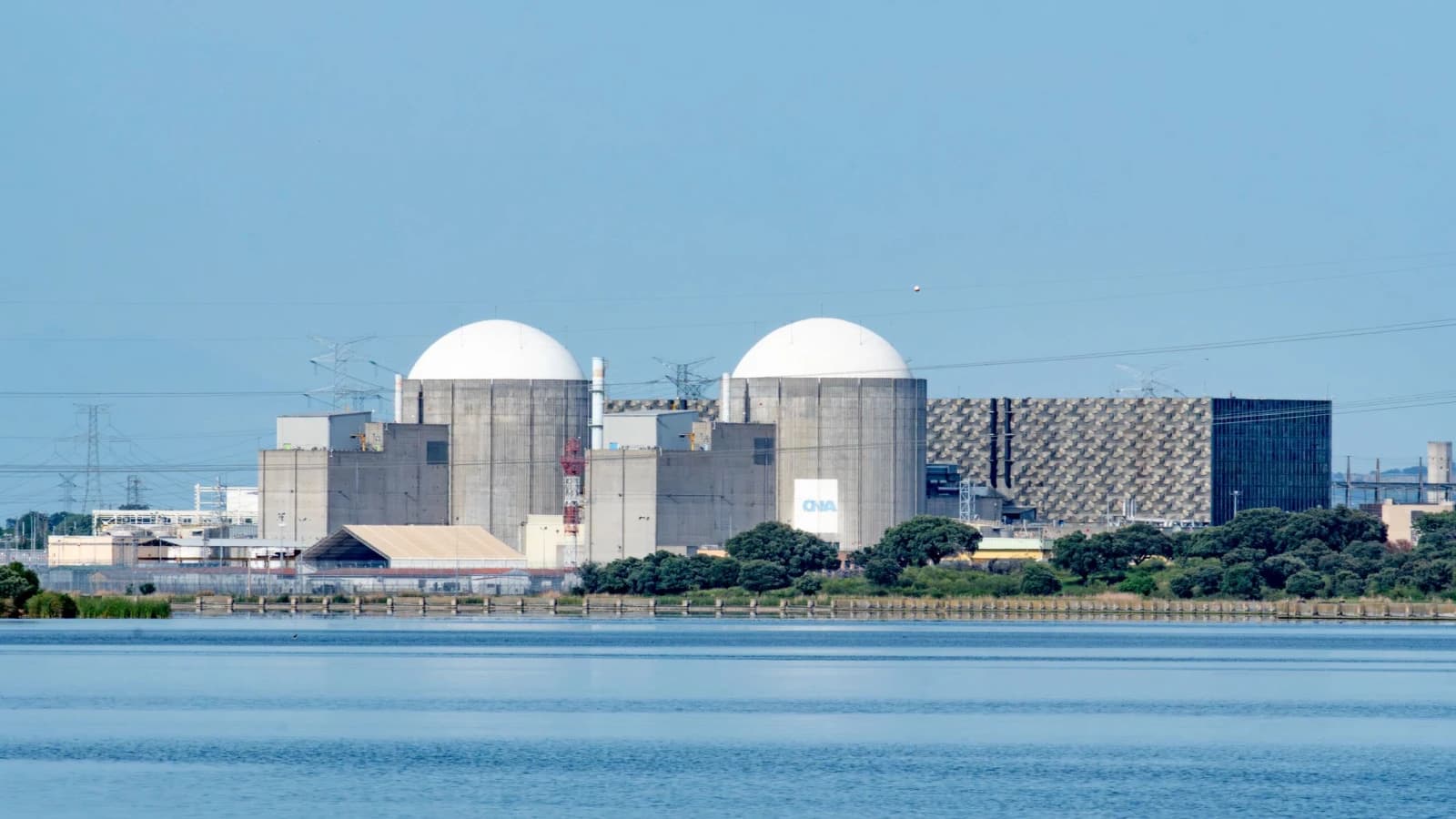
The Official State Gazette (BOE) published this Friday the ministerial order granting the renewal of the operating license for the Almaraz nuclear power plant in Extremadura, for its units I and II.
The extension will be limited: one of the units will continue operating for 31 months and the other for 19 months, with June 8, 2030, as the deadline. The decision does not change the planned schedule for closing all of Spain's nuclear power plants in 2035.
The Ministry for Ecological Transition justified the measure by citing the current uncertainty in international energy markets, marked by the conflict in the Middle East and the war in Ukraine. According to the government, the extension could help reduce Spanish consumers' exposure to potential price spikes.
However, from the perspective of the electricity system, the decision also poses challenges for the integration of new renewable generation.
“From a purely technical point of view, the expansion of the Almaraz nuclear power plant will reduce gas consumption and the cost for consumers, but at the same time it has an impact on the integration of renewable energies and the incorporation of new projects,” says Alejandro Zerain, Head of Advisory at Aurora Energy Research.
The plant is located in Extremadura, one of the regions in Spain with the strictest restrictions on injecting electricity into the grid. According to Aurora's analysis, Almaraz will compete with solar power for available capacity in an infrastructure that has not grown at the same rate as renewable energy generation.
In this scenario, the consultancy predicts that the expansion of Almaraz will contribute to maintaining grid congestion and increasing renewable electricity inflows over the next few years.
Aurora estimates that the curtailment of wind and solar generation, including photovoltaic and solar thermal, will be 40% higher in 2030 compared to the scenario in which the operation of the plant is not extended.
Continue reading
Extremadura, under greater pressure
The impact would be especially significant in Extremadura and, within the autonomous community, in Cáceres. According to Zerain, the main consumption center is Madrid, while the lines that transport the electricity generated in Cáceres to the center of the country pass through Badajoz, where restrictions are already in place.
“In this context, there will be an overproduction of electricity in Extremadura,” the specialist warns.
The problem takes on greater significance in the context of growing curtailment in Spain. According to data provided by Aurora Energy Research, uncompensated technical curtailments have reached 4.5 TWh so far this year, compared to 3.6 TWh recorded throughout 2025.
In Extremadura, the restrictions are even higher. During June, non-integrated electricity rates of around 60% were recorded at some nodes of the electricity grid.
According to Zerain, this situation affects not only the profitability of renewable energy projects that are already operational, but also developments that are still in the planning or construction phase.
“Electricity spills, that is, electricity not integrated into the system, have become one of the most limiting issues for renewable energies,” he argues.
In this context, the temporary extension of Almaraz adds pressure on a network that already has restrictions in evacuating the growing renewable generation of Extremadura to the main consumption centers.
The government, meanwhile, emphasizes that the Almaraz renewal comes as measures to promote renewable energy and storage continue, considered structural solutions to reduce the exposure and vulnerability resulting from dependence on imported fossil fuels.