Europe needs to incorporate an additional 25 to 30 GW of electrolysis capacity to meet the regulatory demand for renewable hydrogen projected for 2030 , a deployment that requires investments of between 50 and 60 billion euros in the next 12 to 24 months.
This is the warning issued by Hydrogen Europe in its Clean Hydrogen Monitor 2026 report, which identifies a significant gap between the decarbonization targets set by the European Union and the actual pace of development of green hydrogen production projects.
According to the survey, the operational capacity for water electrolysis reached 677 MW in July 2026 , compared to 571 MW a year earlier. This represents a year-on-year increase of 19%, although it remains insufficient to meet market needs.


Currently, the continent has an additional 3.7 GW of electrolyzers under construction , while approximately 1.6 GW are scheduled to come online during 2026, according to the timelines announced by the developers.
The gap between existing facilities and the volumes needed to meet European obligations is one of the main challenges for the sector.
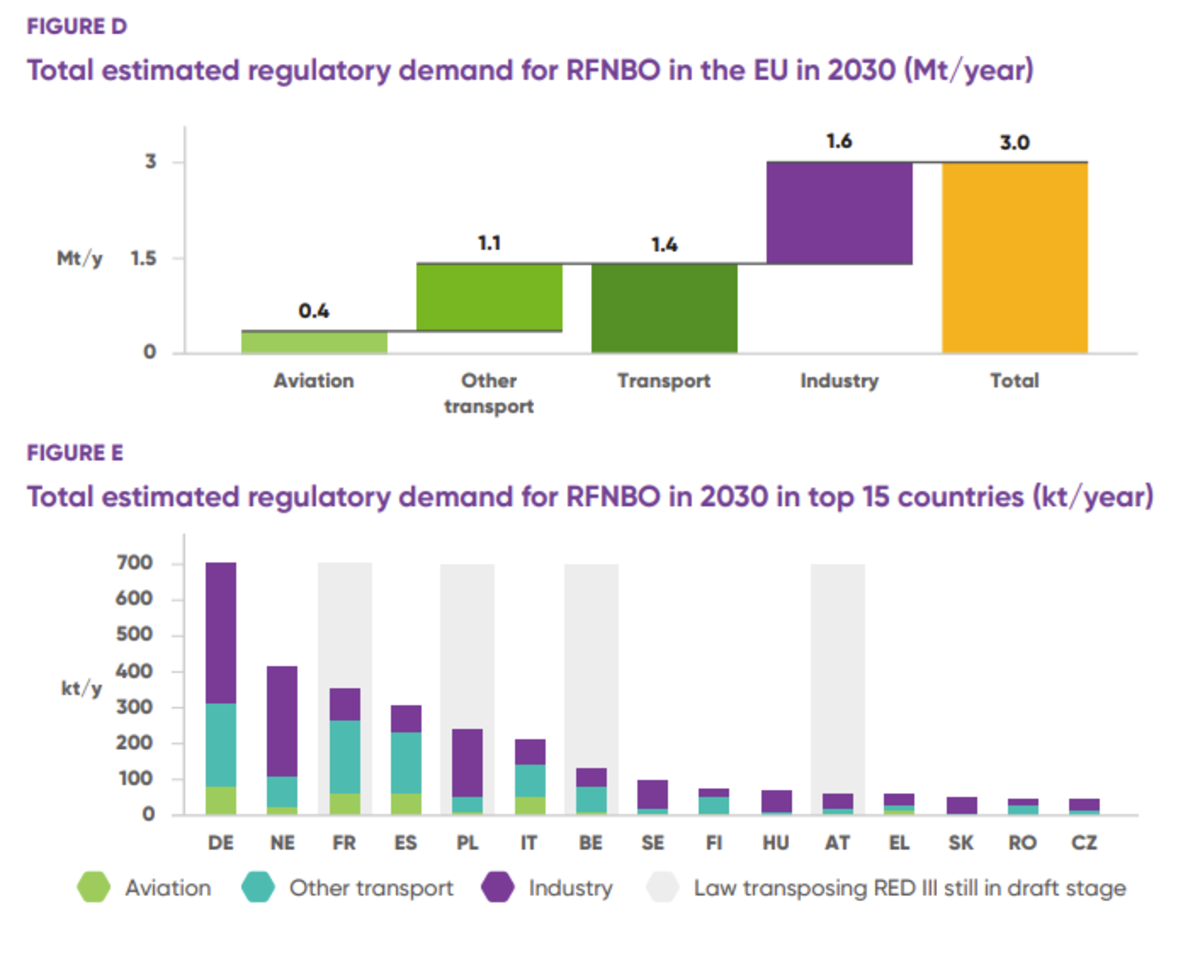
According to Hydrogen Europe, the regulatory demand for renewable non-biological fuels (RNBFs) could reach 3 million tons of hydrogen per year by 2030 .
Of that volume, around 1.4 million tons would correspond to transport and 1.6 million to industrial applications , driven by the provisions of the RED III Renewable Energy Directive and the RefuelEU Aviation regulation.
However, the report warns that this demand could remain largely in the realm of regulatory obligations if member states do not establish implementation mechanisms, economic incentives, and conditions that allow for the conclusion of long-term supply contracts.
The contrast is also evident in the current market structure. During 2025, Europe consumed approximately 7.9 million tons of hydrogen , compared to 7.8 million the previous year.
Despite that volume, water electrolysis represented only 1% of the total hydrogen production capacity at the end of 2025. Conventional technologies based on fossil fuels and their byproducts continued to dominate supply.
The operational electrolysis capacity identified in July 2026 would allow for the production of approximately 75,000 tons per year. If certain brine electrolysis facilities certified as renewable are incorporated, the potential rises to around 100,000 tons per year.
Meanwhile, the electrolysis projects currently under construction could contribute another 400,000 tons of hydrogen annually , once they reach their planned operation.
Projects are progressing, but investment and costs continue to shape the market
The growth of electrolysis varies significantly between countries. According to the document, 78% of the capacity under construction is concentrated in five markets , with Germany and Sweden as the main players.
Germany leads with approximately 1.3 GW under construction , followed by Sweden with 800 MW. These two markets account for more than half of the projects that have already passed the final investment decision stage.
Spain is also among the countries with the highest activity. During the first half of 2026, approximately 400 MW of electrolysis projects reached final investment approval , primarily to replace fossil-based hydrogen in refineries.
Among the highlighted initiatives is Onuba, promoted by Moeve , with 300 MW corresponding to the first phase of the Andalusian Green Hydrogen Valley, whose entry into operation is planned for 2029.
Also included is the Basque Hydrogen Corridor , linked to the Repsol refinery in Muskiz, with a capacity of 100 MW and an announced operating horizon for 2029.
Meanwhile, the Stegra project in Sweden envisions 740 MW of electrolysis associated with steel production, while initiatives such as Holland Hydrogen 1, Normand'Hy and Grey2Green aim at industrial supply and refinery decarbonization.

54% of the electrolysis capacity under construction is destined for the refining sector , while the steel industry accounts for another 31%.
Refining accounts for a significant portion of investments due to the potential to replace conventional hydrogen in existing industrial facilities and its role in fulfilling transport obligations. In contrast, projects related to ammonia and fertilizers face increasing competition from international producers, particularly from China, India, and Saudi Arabia, making it difficult to secure new European investments.
In addition to these differences, there is the economic factor. The report indicates that the production cost of renewable hydrogen decreased during 2025 , driven by lower electrolyzer prices and more competitive conditions for renewable electricity generation.
In the most favorable European locations, the estimated production cost reached approximately 3.9 euros per kilogram , although this value is not representative of all projects.
Hydrogen Europe estimates that the capital costs of electrolyzers registered an average reduction of close to 6% between 2024 and 2025 .
However, the economic difference compared to hydrogen produced with natural gas continues to be an obstacle to industrial procurement.
The increase in gas prices reduced that gap in some regions, bringing it to about one euro per kilogram on average during the period analyzed.
Competitiveness is also affected by the charges for access to and use of electricity networks, which vary significantly between Member States.
According to the survey, the costs associated with the network can represent around 0.15 euros per kilogram of hydrogen in France and exceed five euros per kilogram in Poland .
Continue reading
For a typical grid-connected European project, these charges represent approximately a quarter of the cost of renewable hydrogen production.
The document argues that tariff systems should recognize the flexibility that electrolyzers can provide to the electricity system, especially when they use renewable electricity that would otherwise have to be limited or wasted.
In this sense, the deployment of green hydrogen could also contribute to integrating larger volumes of wind and solar power generation, as well as reducing certain electrical congestion management needs.
However, to realize that potential, the plants need connection conditions, tariff structures, and operating schemes compatible with their flexible operation.
Regulatory uncertainty threatens planned investments for 2030
In addition to costs and commercial difficulties, Hydrogen Europe identifies regulatory stability as a central condition for accelerating investment decisions .
The report considers that the 25 to 30 GW of additional capacity needed to meet regulatory demand represents an investment opportunity of between 50 and 60 billion euros in electrolysis alone .
The figure does not include additional expenditures on renewable generation, facilities for the synthesis of derived fuels, storage, transport, port infrastructure and supply stations.
To achieve the 2030 goals, the organization warns that these investments will need to receive a final investment decision within the next 12 to 24 months.
The scenario gains relevance in light of discussions about the future of mandatory renewable hydrogen consumption targets after 2030.
The initiative arose after a draft impact assessment was released that raised the possibility of replacing the mandatory objectives of the future European regulations with an indicative Community target.
“ Weakening renewable hydrogen targets now would mean changing the rules mid-game ,” warns Jorgo Chatzimarkakis , executive director of Hydrogen Europe.
The sector's approach is linked to the need to guarantee predictable conditions for industrial projects whose capital recovery periods can extend over several years.
Along the same lines, François Paquet , CEO of the Renewable Hydrogen Coalition, summarizes the business position: “ Europe needs investment. Investment needs certainty. Certainty requires binding NBO targets .”
Currently, RED III establishes that renewable fuels of non-biological origin must represent at least 42% of the hydrogen used in industry by 2030 , a percentage that increases to 60% in 2035, subject to the flexibilities provided for by the regulations.
In transport, the directive incorporates a minimum quota of 1% for renewable fuels of non-biological origin by 2030, while RefuelEU Aviation establishes specific obligations for synthetic fuels intended for aviation.
However, the incorporation of these provisions into national legislation presents significant differences .
Hydrogen Europe highlights the progress made by Germany and Spain, which established frameworks with regulatory horizons up to 2040 and mechanisms designed to encourage compliance with obligations.
Conversely, countries such as France, Poland, and Belgium had not yet completed the transposition of the transport provisions at the time of the survey in July 2026.
In the industrial sector, the situation presents additional difficulties, given that several countries still do not have sufficiently defined implementation instruments to achieve the committed quotas.
The problem is not limited to demand generation. The organization warns that China accounts for approximately 60% of the world's electrolyzer manufacturing capacity , compared to a European share of around 20%.
Although European manufacturers maintain a predominant presence in installed and under-construction projects within the continent, the expansion of Chinese production increases competitive pressure on the local industry.
The report also links the advancement of renewable hydrogen to energy security. According to its estimates, failing to meet regulatory demand by 2030 would mean maintaining a dependence equivalent to approximately 14 billion cubic meters of natural gas per year , in addition to missing out on potential emissions reductions of around 32 million tons of carbon dioxide per year.
These figures represent scenarios estimated by Hydrogen Europe, not guaranteed results from the development of new projects.
Consequently, the organization proposes combining the continuity of regulatory objectives with specific instruments to support industrial consumers, financing for producers, acceleration of infrastructure, and improved access to renewable electricity.
The document also points to the need to strengthen coordination between European countries and establish protection mechanisms for investments made under existing regulatory rules.
Thus, the evolution of the European green hydrogen market will depend both on the execution of currently committed projects and on the ability to convert regulatory objectives into contracts, financing and new operational facilities .
With only 677 MW of operational electrolysis registered as of July 2026 and an estimated regulatory demand of three million tons per year by 2030, the sector faces a decisive period to define the pace of its industrial expansion.