


Latin America is beginning to play an increasingly important role in the European Union's energy strategy. The escalation of the conflict in the Middle East has reignited uncertainty about global oil and gas supplies and accelerated the search for partners capable of reducing the bloc's exposure to the volatility of fossil fuels. In this context, the region emerges as an ally with advantages that are difficult to replicate: a largely renewable electricity mix, abundant energy resources, and a growing potential to support the transformation of the European energy system.
The new crisis finds Brussels in the midst of redefining its energy policy. The Russian invasion of Ukraine marked a turning point for the bloc, which accelerated the diversification of suppliers, the deployment of renewable energy, and the electrification of its economy to reduce geopolitical vulnerabilities. Tensions over the Strait of Hormuz , through which nearly 20% of the world's traded oil passes, confirm that security of supply remains one of Europe's main challenges.
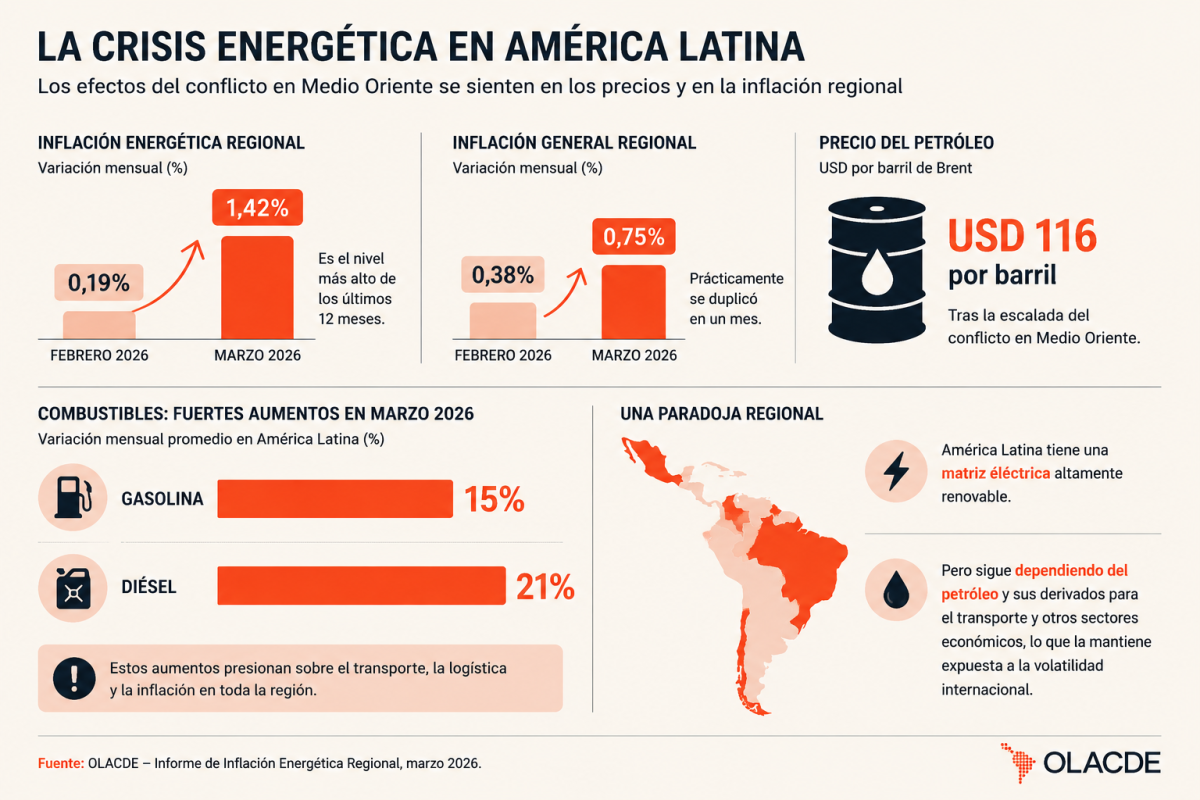
The consequences are also reaching Latin America. The latest OLACDE report shows that regional energy inflation rose from 0.19% in February to 1.42% in March 2026 , the highest figure in the last twelve months, while overall inflation increased from 0.38% to 0.75% . This surge coincided with the rise in oil prices, which reached USD 116 per barrel , reflecting how geopolitical conflicts continue to impact the region's economies.

The relationship between Europe and Latin America is no longer driven solely by decarbonization goals. Without abandoning its climate targets, the European Union has incorporated a new priority: building a more resilient energy system with diversified supply chains and less dependence on markets exposed to international conflicts.
Sources within the European Commission, consulted by Energía Estratégica during the EU Climate Dialogues 2 (EUCDs2), indicate that this vision now permeates a significant portion of the bloc's energy decisions. Diversifying supply and strengthening alliances with reliable regions have become structural components of the EU strategy.
In this process, Latin America offers attributes that acquire renewed value . The region has one of the cleanest electricity mixes in the world, possesses the resources to continue expanding that capacity, and maintains ample room to deepen energy cooperation with Europe.
This interest also stems from an economic logic. The greater the share of renewable energy sources and the diversification of partners, the lower Europe's exposure will be to episodes of volatility like those seen in recent years.
The escalation between Iran and Israel has once again placed the Strait of Hormuz at the center of international attention. Any disruption to this maritime route has an immediate impact on the global energy market due to the volume of crude oil that passes through this strategic corridor daily.
Although the European Union has significantly reduced its dependence on Russian gas, it remains a net importer of fossil fuels. Therefore, increased geopolitical tensions are quickly translating into higher energy costs for households, industries, and supply chains.
Continue reading
The impact is not unnoticed in Latin America either: OLACDE also warns that, although Latin America has a highly renewable electricity matrix, it maintains a strong dependence on oil and its derivatives for transport and other economic sectors , which explains why it continues to be vulnerable to fluctuations in the international hydrocarbon market.
The stabilization mechanisms implemented by several countries cushioned some of the impact on consumers, but did not prevent the increase in energy costs from eventually spreading to the rest of the regional economy.
Ukraine changed Europe's priorities
The speed with which Brussels reacted to the new crisis can be explained in 2022.
The Russian invasion forced the European Union to revise its energy policy in record time. The loss of one of its main gas suppliers accelerated investments in renewable energy, strengthened electricity interconnections, spurred the addition of new liquefied natural gas terminals, and diversified supply sources.
The change was much more profound than a short-term response. The energy transition ceased to be understood solely as a tool for reducing emissions and became an essential component of competitiveness, strategic autonomy, and security of supply.
This diagnosis was present in much of the discussion during the EUCDs2 , where the resilience of the European energy system emerged as a key theme. Conversations with EU officials reflected a growing consensus: the energy transition can no longer be separated from geopolitics.
The crisis in the Middle East further reinforced this perception. While the war in Ukraine forced Europe to rethink its energy model, the tension over one of the main global hydrocarbon trade routes demonstrates that the risks associated with fossil fuels continue to influence the bloc's decisions.

An opportunity that also presents challenges
The convergence of both crises redefines the relationship between Europe and Latin America.
For the European Union, the region represents a potential ally that can contribute to a strategy based on diversifying supply and expanding renewable energy. For Latin America, the situation presents an opportunity to consolidate its international standing, but also exposes an internal challenge: reducing dependence on oil in sectors where the transition is still progressing more slowly.
OLACDE data shows that geopolitical volatility continues to impact Latin American economies through fuel prices. This reality reinforces a conclusion shared on both sides of the Atlantic: strengthening renewable energy is no longer solely about fulfilling climate commitments. It is also a tool for reducing vulnerabilities, improving competitiveness, and building more resilient energy systems in the face of an increasingly uncertain international context.