
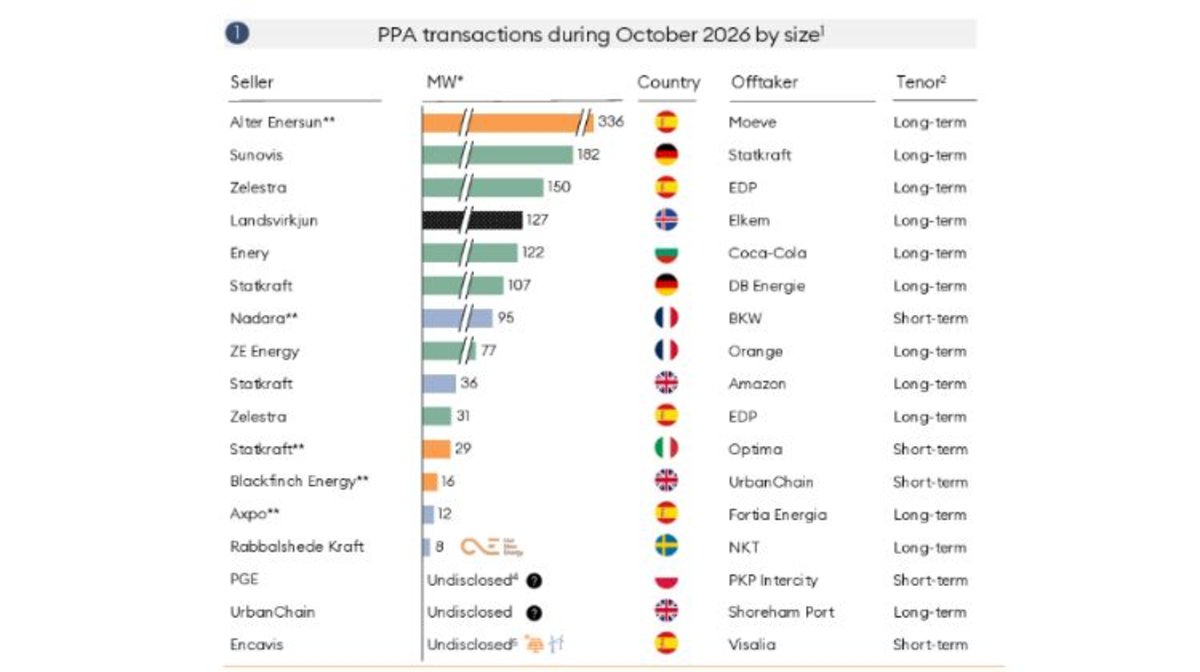
The European power purchase agreement (PPA) market recorded 1,328 MW of contracted capacity in October 2026 , according to the latest ONE Insights – PPA Market Update report by the consultancy Our New Energy (ONE). Of the reported volume, approximately 50% corresponds to hybrid generation capacity with battery storage systems (BESS) , reflecting the growing presence of this technology in the sector's commercial transactions.
During the tenth month of the year, three agreements were also recorded, the capacities of which were not disclosed. Regarding storage, the survey identifies 226 MW of power and 993 MWh of energy capacity , with an average reported duration of 3.9 hours for the projects that specified both figures.
The contracts involve developers, electricity producers, retailers, and large industrial consumers. Among the main sellers are Alter Enersun, Sunovis, Zelestra, Landsvirkjun, Enery, and Statkraft , while Moeve, EDP, Elkem, Coca-Cola, DB Energie, Orange, and Amazon appear among the offtakers linked to the analyzed transactions.
Geographically, Spain led October's contracting with at least 528.5 MW , followed by Germany with 288.9 MW, and France with 172.1 MW. These three markets account for approximately 74.5% of the capacity disclosed in the report.

Next came Iceland, with 127 MW; Bulgaria, with 122 MW; and the United Kingdom, with at least 51.7 MW. This distribution reflects the participation of different European markets, both within and outside the European Union, and a diversity of technologies and consumption profiles.

Which energy companies and offtakers were the main players in the October deals?
The largest single transaction identified by ONE is between Alter Enersun and Moeve, with an estimated capacity of 336 MW in Spain . The supply will be destined for the Onuba project, the first phase of the Andalusian Green Hydrogen Valley, which Moeve is developing in Palos de la Frontera, Huelva.
The energy company has mobilized an investment of over 250 million euros to develop the photovoltaic infrastructure linked to a proposal to supply approximately 500 GWh of renewable electricity annually.
The plan includes a firm agreement for 265 GWh annually from the La Luz plant , which is currently operational, and a preliminary agreement for an additional 235 GWh annually from Puerto Sostenible, a project under development. This latter volume is contingent upon the completion of the facility and the signing of the final contracts.
The electricity will partially supply the needs of the Onuba complex, which initially includes 300 MW of electrolysis capacity and an estimated annual production of 45,000 tons of renewable hydrogen. In this way, the PPA links new photovoltaic generation with the energy supply of an industrial facility designed to produce lower-carbon fuels and derivatives.
For its part, Germany concentrated another of the main operations through the agreement between Sunovis and Statkraft, which comprises 181.9 MWp photovoltaics and 61 MW of batteries with 244 MWh of storage .
The contract includes the ABS project, located in Saxony-Anhalt, and the Harnekop project, located in Brandenburg. Both facilities are being developed without public subsidies and are scheduled to become operational between the end of 2026 and October 2027.
The commercial structure incorporates an initial stage of marketing at market prices, with profit sharing during 2027. Subsequently, a significant portion of production will be covered by a fixed price scheme until the end of 2037 , while the remaining volumes will maintain mechanisms for participation in the income obtained.
This model combines revenue predictability for the developer with partial exposure to electricity market opportunities. In addition, Statkraft handles the marketing and optimization of hybrid assets.
In Spain, Zelestra and EDP signed two new PPAs to incorporate 115.45 MW of batteries and approximately 462 MWh of storage into photovoltaic plants that are already in operation.
The agreements cover the Pedroso plant in Seville and the Valkyria plant in Castilla-La Mancha. The former combines 31 MWdc of solar power with a 25 MW, 100 MWh battery storage system, while the latter has 150 MWdc of photovoltaic capacity and will add 90.45 MW of battery storage with 362 MWh . Both systems will have a four-hour operating time, allowing some of the solar generation to be shifted to periods after its production.
The commercial relationship between the two companies encompasses four hybrid projects in Spain, with 1022 MWh of contracted storage . This figure includes previous agreements and therefore does not correspond exclusively to the October transactions.
Another relevant operation in the German market involves Statkraft and DB Energie , a subsidiary of Deutsche Bahn, through a ten-year hybrid PPA associated with the Harnekop plant.
The project has 107 MW of photovoltaic capacity and a 35 MW storage system with a duration of four hours , equivalent to approximately 140 MWh.
Starting in January 2028, Statkraft will supply approximately 114 GWh of renewable electricity annually to DB Energie, along with the corresponding guarantees of origin. The contract includes a storage management scheme that allows some of the solar electricity to be shifted to periods required by the buyer.
Outside of the Iberian and German markets, Landsvirkjun and Elkem signed an agreement in Iceland for 127 MW , intended to guarantee the electricity supply of the ferrosilicon plant that the industrial company operates in the country.
The contract will be valid until 2039 and will be structured under the take-or-pay modality, which establishes payment obligations for the contracted volume.
In Bulgaria, Enery and Coca-Cola HBC Bulgaria agreed to supply renewable electricity from the Knizhovnik hybrid plant , located in the south of the country.
The complex combines 122 MWp of photovoltaic generation with two storage systems of 70 MWh and 130 MWh , respectively. The estimated annual production of the facility reaches 200 GWh, although this volume corresponds to the entire project and not exclusively to the supply destined for Coca-Cola.
In France, Nadara and BKW agreed to the purchase and sale of approximately 200 GWh of wind energy annually , a transaction that ONE is including in its monitoring with an estimated capacity of 95 MW. Unlike the main hybrid contracts of the month, this agreement pertains to wind power generation.
Continue reading
The registry also includes a 36 MW wind power deal between Statkraft and Amazon in Scotland . The agreement pertains to the Mossy Hill wind farm and furthers the tech giant's position as a buyer of renewable electricity in Europe.
Other actors identified by ONE during the period include ZE Energy, Blackfinch Energy, Axpo, Rabbalshede Kraft, PGE, UrbanChain and Encavis, in transactions involving offtakers such as Orange, UrbanChain, Fortia Energía, NKT, PKP Intercity, Shoreham Port and Visalia.
The registry also includes smaller capacity contracts and others whose volumes were not publicly disclosed. In some cases, such as the 77 MW agreement between ZE Energy and Orange, these are transactions announced before October 2026, although included in the consultancy's monthly monitoring.
Technologies and corporate demand: how is the PPA market evolving?
Beyond the contracted capacities, the agreements show different remuneration structures and distribution of commercial risk , especially in projects that combine renewable generation with storage.
In the case of Sunovis and Statkraft, the model combines fixed income with a share of market results. At Landsvirkjun and Elkem, remuneration includes a reference to the price of ferrosilicon, while Statkraft's agreement with DB Energie incorporates flexibility services related to energy storage.
These differences show that the economic conditions of a PPA depend not only on the price of electricity, but also on the delivery schedule, the contract duration, the allocation of risks and the associated services.
In Spain, the approval of the capacity market through Order TED/966/2026 introduces a new revenue stream for BES S projects, with firm capacity auctions and remuneration contracts of up to 15 years for new investments. However, as Energía Estratégica analyzed, its impact on financing will depend on factors such as firmness coefficients, financial guarantees, and penalties for non-compliance. Furthermore, capacity revenue can coexist with PPAs and battery tolling agreements , provided their obligations are compatible, thus opening up revenue diversification opportunities for hybrid project developers.
From a technological point of view, the expansion of hybrid agreements coincides with a reduction in the share of independent photovoltaic solar PPAs in the total number of European transactions .
According to ONE Insights, this technology accounted for 34% of contracts registered in 2026 , compared to 51% in 2025, 58% in 2024 and 60% in 2023.
This represents a decrease of 17 percentage points compared to the previous year. However, this indicator reflects the number of agreements and does not, on its own, allow us to conclude that contracted solar capacity has decreased by the same proportion.
Meanwhile, the corporate segment continues to account for the majority of transactions. 78% of PPAs registered in 2026 correspond to corporate contracts , a proportion close to the 79% recorded in 2025.
Buyers range from technology companies and data center operators to energy-intensive industries, beverage groups, railway companies, and electricity retailers.
Regarding volumes, the survey reflects a monthly average of 846 MW contracted in 2026 , compared to 1,197 MW in 2025 and 1,224 MW in 2024.
The comparison with the previous year implies an approximate reduction of 29.3%, although it should be considered that the 2026 data only includes the period up to October.
Likewise, the number of transactions amounts to 167 agreements during the first ten months of 2026 , while in 2025 242 were recorded and in 2024 268 operations were recorded during the respective full years.
Furthermore, the cumulative ranking of buyers for 2026 places Amazon as the main European offtaker, with 1,036 MW of disclosed contracted capacity , followed by Trafigura, with 434 MW, and Merlin Properties, with 426 MW.
Also noteworthy are a Fortune 500 company with 367 MW; Airbus with 300 MW; Statkraft with 286 MW; Nscale with 230 MW; Respect Energy with 219 MW; Google with 214 MW; and Axpo with 184 MW.
Among the sellers, Skyborn Renewables leads the cumulative list with 811 MW , followed by Nadara, with 529 MW; Solaria, with 426 MW; RWE, with 387 MW; and Capital Dynamics, with 367 MW.
Completing the top ten positions are Iberdrola, with 363 MW; TotalEnergies, with 350 MW; Alter Enersun, with 336 MW; Zelestra, with 328 MW; and Sonnedix, with 305 MW.
These rankings correspond to the volumes disclosed during 2026 and not exclusively to the October transactions.
In this context, the 1,328 MW identified during October exceed the monthly average recorded in the year , while the participation of projects with BESS shows the relevance that the contracting of assets capable of combining renewable production and storage is acquiring.
The agreements between developers, marketers and offtakers also reflect a diversification of supply schemes: from contracts intended for industrial hydrogen facilities to operations that incorporate time flexibility, surplus marketing and participation of multiple buyers on the same asset.
Thus, the European PPA market maintains a high share of corporate demand, but with a more diversified technological and contractual composition , in which the incorporation of batteries constitutes one of the main elements of the operations registered in October.


 By Emilia Lardizabal

 By Energía Estratégica

 By Matías Medinilla