


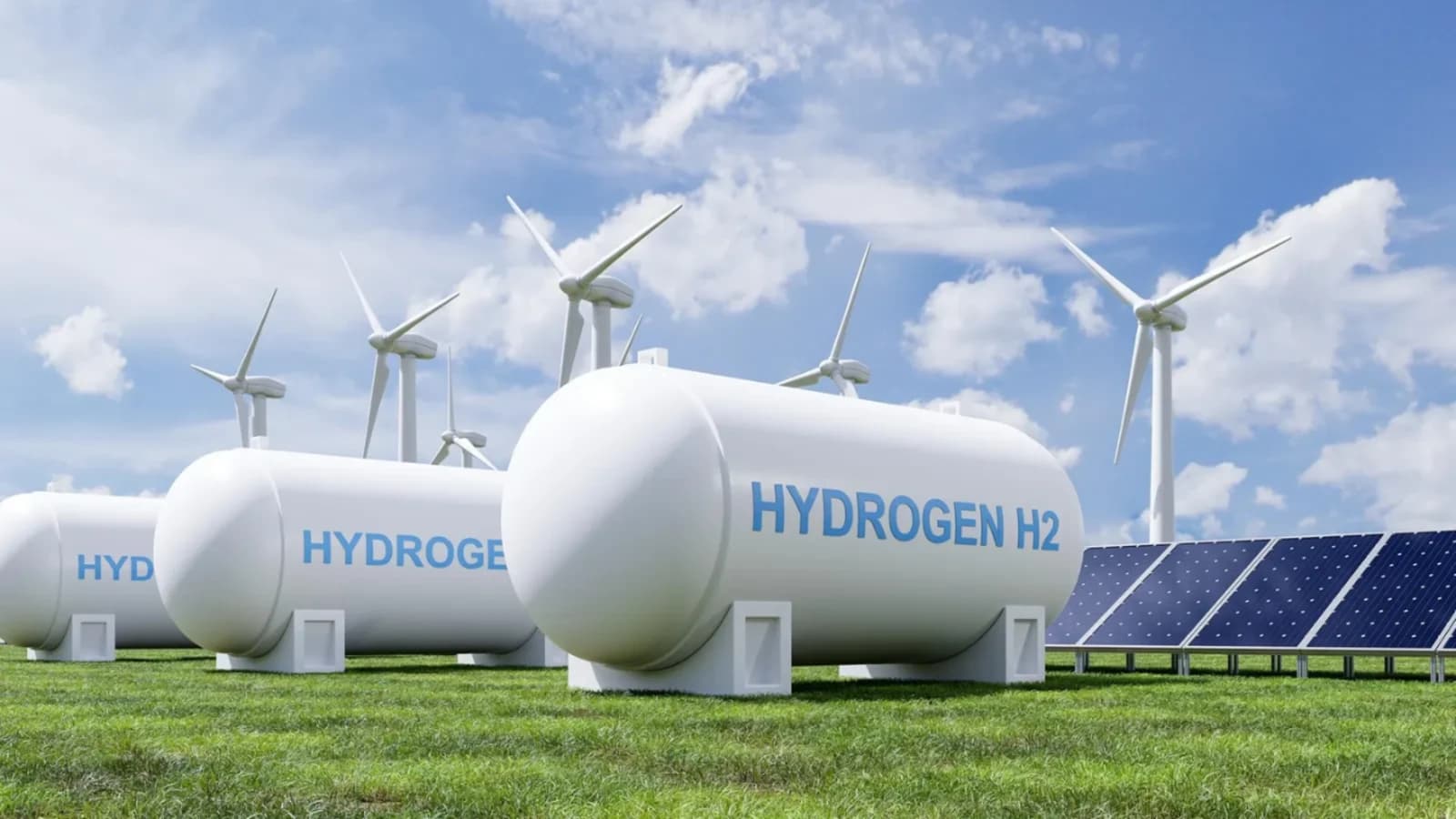
The European Union is preparing a new regulatory and financial architecture to accelerate renewable hydrogen projects , in a scenario marked by delays, cancellations and a slowdown in final investment decisions.
The European Commission presented the revised EU Emissions Trading System (EU ETS) along with the Electrification Action Plan. The package includes signals for electrolysis, synthetic fuels, industrial flexibility, and long-duration energy storage.
The initiative also establishes the legal basis for creating a €100 billion Industrial Decarbonization Bank , intended to cover commercial risks and facilitate the deployment of mature projects in energy-intensive sectors.
The announcement coincides with a significant market contraction. The International Energy Agency's (IEA) Global Hydrogen Review 2026 reduced its forecast of potential annual production from announced low-emission initiatives by 2030 from 37 to 27 million tons .

Although the IEA figure includes different production routes, about half of the reduction corresponds to large electrolysis developments oriented towards export , both in advanced economies and emerging markets.
Cancellations account for 30% of the decline , while postponements beyond 2030 represent another 25%, and temporarily paused projects, 15%. The Agency also excluded from its forecasts initiatives with no reported progress for more than three years.
Among the main causes are high technological costs, insufficient public support, difficulties in accessing electricity networks, regulatory uncertainty, and the absence of long-term purchase agreements .
The ETS shifts from granting rights to demanding investments
One of the main proposed changes is the introduction of a conditional allocation scheme . A portion of the free emission allowances will be tied to verifiable investments in clean industrial processes, instead of being granted without additional transformation commitments.
The design could improve the conditions for electrolysis projects to reach a final investment decision. Developers need to narrow the cost gap, secure buyers, and have stable regulations in place before committing capital.
“ This is a strong sign that Europe is moving from climate ambition to execution ,” said Jorgo Chatzimarkakis , CEO of Hydrogen Europe.
The executive added that the association " values the introduction of investment allocations ," considering that the instrument can accelerate the transition of decarbonization technologies from development to construction.
The new approach also extends to aviation and maritime transport. Brussels seeks to boost demand for sustainable aviation fuels, e-SAF, e-methanol, and other derivatives produced using renewable electricity .
Chatzimarkakis highlighted “ the new SMAP mechanism for the maritime sector ”, because it incorporates specific support from the European carbon market for sustainable fuels.
According to the executive, the tool “ reflects our long-term proposal to accelerate the adoption of sustainable marine fuels through targeted ETS support .”
The proposal also seeks to ensure that a larger proportion of the revenue raised through the carbon market finances the modernization of industrial facilities in the Member States.
“ The proposal also correctly reinforces the principle that ETS revenues should be reinvested in Europe’s industrial transformation ,” said the CEO of Hydrogen Europe.
According to Chatzimarkakis, this reinvestment will allow the bloc to maintain competitiveness, strengthen industrial resilience, and preserve quality jobs .
Hydrogen Europe, however, questioned the reduction in the overall ambition of the ETS through the proposed changes to its linear reduction factor. The organization warned that a consistent carbon price remains necessary for the replacement of conventional processes to be financially viable.
The regulatory debate arises while global investment sends mixed signals. Installed electrolysis capacity doubled during 2025, exceeding 4 GW , although China accounted for almost three-quarters of the new additions and around two-thirds of the total installed capacity.
Meanwhile, the volume of projects that reached a final investment decision fell by approximately 30% compared to 2024. The slowdown affected China, Europe, and India, despite the growth in plants that began operations.
By 2026, the IEA identified more than 2.5 GW of electrolyzers under construction with expected commissioning during the year. Nearly 90% of that capacity is located in China and Europe.
The EU market could lead the way in new additions, with almost 2 GW under construction , quadrupling its capacity. The European Union is expected to reach around 2.4 GW of installed capacity by the end of 2026 .
Continue reading
That volume would amount to barely 6% of the former European target of 40 GW by 2030. The Agency calculated that EU capacity would need to be multiplied by 70 to meet the ambition set out in the 2020 strategy.
€100 billion, electrification and flexible demand
The future Industrial Decarbonization Bank seeks to address one of the main obstacles in the market: numerous projects have reached technological maturity, but still do not meet sufficient commercial conditions to begin construction .
The tool will target energy-intensive industries and will cover risks associated with market entry, not just technological development. This criterion could prioritize initiatives with advanced permits, defined engineering, access to electricity, and identified buyers.
The approach aligns with the recommendations of the IEA, which proposed directing support towards ready-to-build projects , with solid purchase agreements, access to infrastructure and realistic plans to close the cost gap.
Initiatives that already have committed investments could contribute around 4.3 Mt of low-emission hydrogen annually by 2030. This figure would exceed 6 Mt if the most likely projects reach final investment decisions during 2026 or 2027.
Even under that scenario, the market remains far from meeting public targets. Achieving government goals would require average annual growth of nearly 100% until 2030 , compared to the 40% projected based on the committed capital portfolio.
The Electrification Action Plan complements the financial front. The Commission proposed that electricity account for 46% of final energy consumption by 2040 , subject to an impact assessment within the Energy Union package.
Increased solar and wind power penetration will require more storage, grids, and demand-responsive capacity. Within this framework, electrolyzers could consume electricity during periods of renewable abundance and reduce their activity when the system is under greater strain.
“ Moving away from dependence on fossil fuels is the path to competitiveness, security of supply and lower energy prices ,” said Daniel Fraile , Chief Market & Regulation Officer of Hydrogen Europe.
The executive emphasized that “ hydrogen and Power-to-X are part of that story, not an afterthought .”
Fraile also defined electrolysis as an asset with a dual function within the system. “ Electrolysis connected to the grid is both an electricity consumer and a facilitator of electrification ,” he explained.
The representative from Hydrogen Europe attributed that role to its ability to provide “ flexibility and long-term energy storage ,” two needs that will grow as variable renewable generation increases.
The Commission plans to review the European Hydrogen Strategy between 2026 and 2027 to incorporate this systemic function. The Electrification Plan also includes a modification of the rules on network tariffs, a key component for the operating costs of electrolyzers.
The price of electricity remains one of the main constraints on the competitiveness of renewable energy. In Europe, the IEA also identified a lack of clarity regarding the integration of non-biological renewable fuels into industry and delays in the transposition of EU legislation.
Creating demand will be as important as supporting supply. Purchase agreements for approximately 1.7 million tons per year were signed in 2025, a similar volume to the previous year and 800,000 tons lower than the peak recorded in 2023.
Only one-fifth of these new agreements have firm contractual commitments. The binding transactions represent approximately 360,000 tons annually and are concentrated in power generation, industry, and refining.
For renewable energy projects, the difference between preliminary agreements and firm contracts can determine their bankability. Since 2020, around 800,000 tons per year included in initial understandings have ended up being canceled , according to the Agency.
Infrastructure also presents a considerable gap. The announced gas pipelines total more than 40,000 kilometers by 2035 , but only 9% have reached an investment decision, begun construction, or entered service.
In electrolysis, the global pipeline for 2030 has been reduced by approximately 30%, to around 320 GW . Approximately 240 GW of this pipeline has a low or uncertain probability of becoming operational before the end of the decade.
More than 100 GW corresponding to projects between 100 MW and 1 GW could lose all possibility of becoming operational before 2030 if they do not reach a final investment decision during 2026 or 2027.
The timeframe is narrow because an electrolysis plant typically needs between one and four years from investment approval to commissioning. The timeframe depends on the size, technology, permits, and availability of an electrical connection.
Europe is attempting to respond with a combination of carbon pricing, financing, electrification targets, and sectoral demand. The proposal will be negotiated between the European Parliament and the Council during 2026 and 2027, with implementation planned from 2028.
The outcome will depend on whether the €100 billion translates into contracts, infrastructure, and operational plants , rather than simply expanding the list of announcements. Faced with a pipeline that lost 10 million tons in a single year, the challenge lies in guiding renewable energy projects to their final investment decision.