


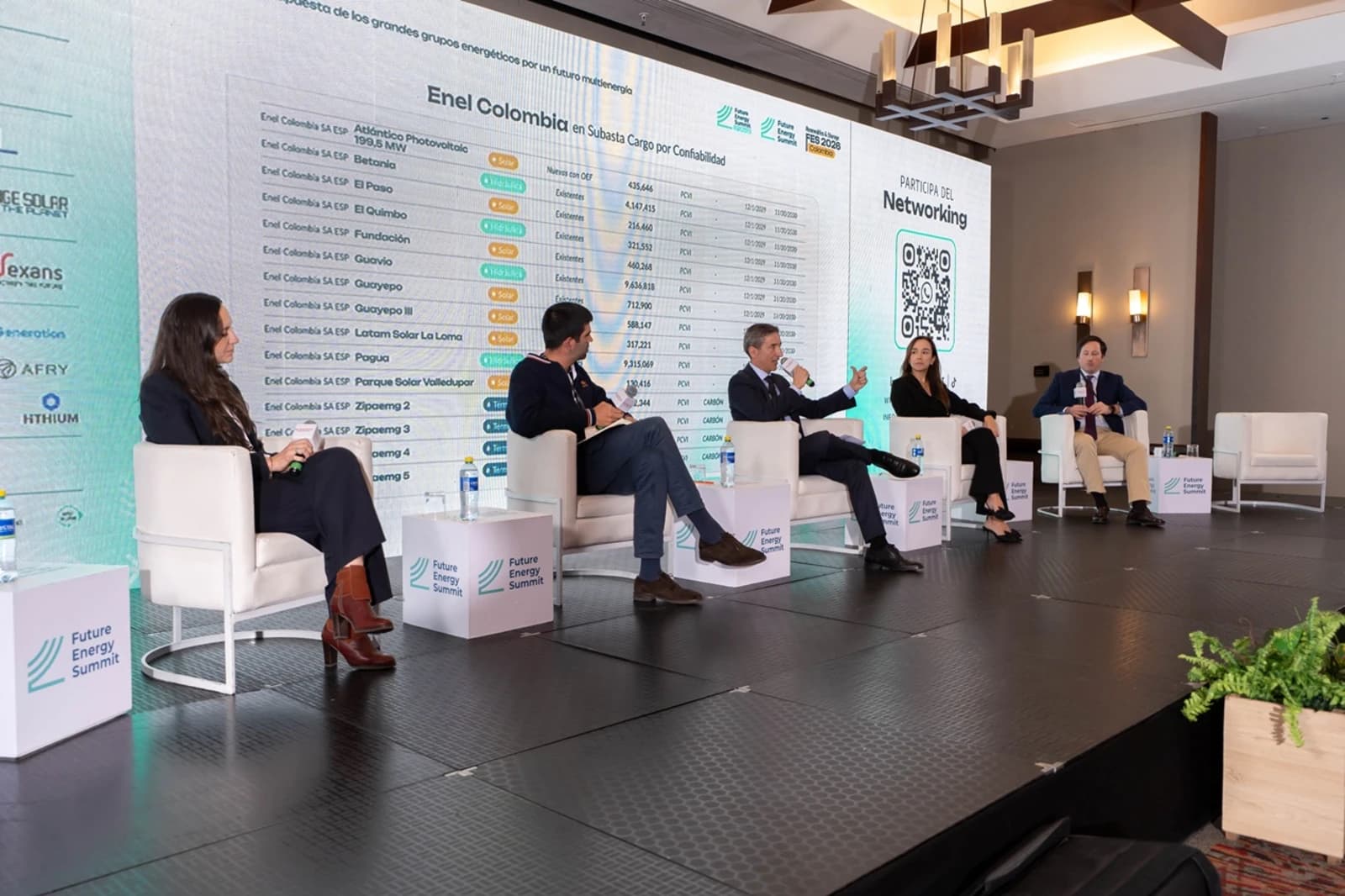
A new wave of energy investment is beginning to take shape in Colombia, with solar power generation, energy storage, and grid expansion taking center stage. This was evident at the Future Energy Summit (FES) Colombia 2026 , where some of the market's leading companies outlined figures, timelines, and objectives for their upcoming projects.
Isagen described a portfolio of about 820 MW of solar power in different stages and another 600 MW of its own development; Krelo-Promigas projected up to 800 MW operational in Colombia by 2030; Celsia set itself the goal of reaching 1 GWh of storage in five years; Terpel is preparing a large-scale BESS and Enel has new developments in the pipeline.
This deployment must be accompanied by the necessary infrastructure. ISA Energía anticipated that it could double the number of transmission projects it currently has underway in the short term.
Along those lines, Esteban Arroyave , Vice President of Generation Projects at Isagen, detailed a pipeline of approximately 820 MW of solar power in various stages and another 600 MW of its own development , which should reach Ready to Build status by the end of 2027 or the beginning of 2028. The company's goal is to add 1 GW of new capacity by 2027 and reach an additional 3 GW by 2035 .

“I tell the team that every solar project has to include batteries,” Arroyave stated. Based on that premise, hybridizing the portfolio the company is analyzing could represent approximately 4 GWh of storage .
A prime example is Bosque Solares de los Llanos 8 , a 170 MW AC solar project. The design includes up to 120 MW of power and approximately 480 MWh of storage , with an initial phase of around 125 MWh . Isagen is finalizing the acquisition of the project and anticipates beginning construction this year.
Celsia also set a specific target for batteries. After being awarded 75 MWh of solar plus storage capacity in the latest auction, it will seek to complete the originally planned 200 MWh through bilateral sales of the remaining 125 MWh.
In addition, there is another 200 MW associated with another solar project that is starting construction and a growing strategy in the commercial and industrial segment.
“Our goal is to close with at least 1 GWh of installed energy storage in the next five years,” said Simón Pérez , Investment Platforms Leader at Celsia.
The company also has a B2B portfolio of close to 200 MWp and sees opportunities to combine solar generation and batteries for industrial customers as a hedge against grid tariffs and market volatility.
For her part, Chiara Gasparrini , Vice President of Development for Latin America at Krelo-Promigas , commented: “Our goal is to have 3.5 GW in operation in the region by 2030, of which Colombia will represent approximately 700-800 MW.”
The company is preparing a project of approximately 100 MW in northern Colombia , whose construction should begin soon, and maintains a pipeline of 600 MW of greenfield solar projects in the country. These developments are evaluated from the outset with the possibility of adding energy storage.
The commitment to BESS also extends to Enel Green Power Colombia , which attempted to participate in the last auction with a large-scale system.
“We wanted to go with a truly industrial-scale battery and we couldn’t,” said Antonio Crisol , Head of the company in Colombia.
According to the explanation, the proposal for product 4 was equivalent to approximately five times the total energy offered in that segment and was limited by the competition rules of the process. Enel also has generation projects under development, including Valledupar , whose construction Crisol hopes will begin soon, and maintains investments of close to COP 1 trillion annually in generation, distribution, and marketing.
Terpel is preparing another significant move. “We should soon announce one of the largest energy storage projects in this country,” anticipated its president, Oscar Bravo .
The company has not yet revealed the power or capacity of the project, which will be incorporated into a strategy that already includes nearly 100 photovoltaic projects through Sonex for clients in various industries.
The network will need to grow at the same rate.
The planned new capacity will have to find space in the electrical system. Claudia Marcela Uribe Arroyave , Business Development Manager at ISA Energía , posed the question directly: “What do we need to ensure that these auctions translate into megawatts actually in operation?”
The company has 35 projects underway , with approximately 484 kilometers of lines , expansions and four new substations , and estimates that it could double that number of initiatives in the short term .
Among the developments, ISA highlighted the La Loma–Sogamoso, Pasacaballos and Magangué projects, currently under construction, in addition to Cuestecitas–Copey–Fundación , whose execution was completed last year.
Uribe identified three critical areas: allocation of connection points, updating the planning, and physical network constraints . Currently, congestion and capacity limitations hinder the deployment of new generation capacity in certain areas.
From the generators' side, Crisol reached the same conclusion: "Without transmission, we generators have nothing to do."
ISA operates around 77% of the National Transmission System , so the speed of expansion and modernization of the network will be crucial to supporting new projects.
There is demand: what's missing for the projects to close?
The latest auction signaled strong market interest. Pérez indicated that for product 3, which combines solar and storage, demand reached nearly 10 GWh per day, approximately ten times the available supply . A similar ratio of more than ten times demand was recorded for the peak nighttime demand product.
“This is not a question of whether it will arrive or not, but of how we design the appropriate mechanisms for the ends to meet,” said the Celsia executive.
Their proposal is that long-term auctions, bilateral PPAs, B2B agreements, and reliability charges should operate in a complementary manner. Gasparrini added the need for predictable auction schedules and standardized contracts to facilitate financing.
For storage, the main question is about remuneration.
“Today there is regulation, yes we can connect the batteries, but we still need to figure out how to remunerate them,” warned Arroyave, who mentioned arbitrage, power charges and auxiliary services among the pending alternatives.
Crisol agreed: “What we are looking for is for the regulator to provide a price signal so we can invest in storage.” Enel believes that auctions can contribute to that signal, but they must be complemented by ancillary services and other mechanisms.
The analysis gains weight in light of the expected composition of the new supply. Arroyave believes that, given the development timelines of other technologies, solar will be the main source of new capacity in the coming years , while the system will need reliability during peak hours.
In addition to the positive economic indicators, there is also regulatory stability. “When we invest in projects, we are thinking 30 or 35 years ahead,” the Isagen executive noted.
Enel also demanded greater clarity in licensing, consultations, and connections, as well as planning with longer time horizons. “Decisions made with a four-year timeframe, for investment returns that extend far beyond that period, are useless,” Crisol stated.
Environmental licensing completes the agenda. ISA highlighted the greater agility it observes in markets like Brazil, while Enel requested predictability regarding obligations once authorizations are obtained.
In this way, FES Colombia outlined the next stage of the market: new solar projects, a growing portfolio of BESS and more transmission infrastructure , supported by a demand that is already beginning to appear in the auctions.
The challenge will be to translate those plans into operational capacity. For companies, the path forward lies primarily in monetizing the flexibility of storage, expanding the network, and providing predictability for investments planned for several decades .