


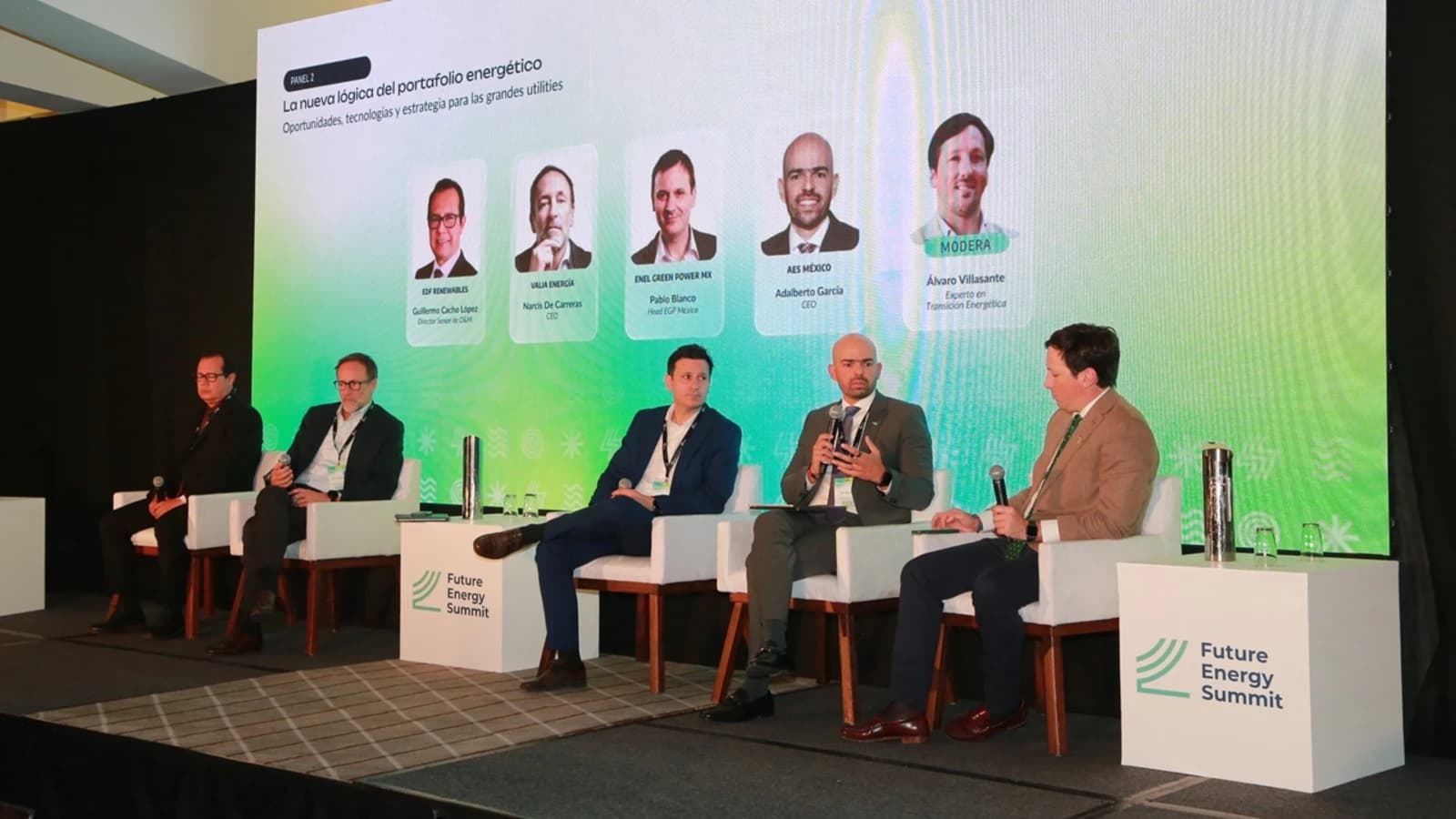
The third edition of Future Energy Summit (FES) Mexico brought together major energy companies such as EDF Renewables, Valia Energía, Enel Green Power and AES Mexico to analyze the new logic of the energy portfolio.
Storage, hybrid schemes, and the search for greater reliability appear as common axes in companies with historically different origins, but which now converge on the same strategy.
“While we have a portfolio of seven natural gas-fired power plants, our ambition is to complement the firm energy vision and diversify the portfolio with renewables, although we do not envision renewable energy without it being reliable with batteries,” stated Narcis De Carreras, CEO of Valia Energía .
“Our portfolio in Mexico has been operating for over a decade, and there is an evolution that must take place. One of these is incorporating new available technologies, such as storage and grid forming,” said Guillermo Cacho López , O&M director of EDF Renewables .

The move also responds to concrete market signals, as Mexico plans to add 32 GW of new electricity capacity by 2030 , mainly renewable, along with more than 6 GW of storage .
Meanwhile, the new scheme promoted by the Government has already resulted in 56 projects driven by 40 companies advancing in the call for generation with mixed investment together with the Federal Electricity Commission (CFE) to add 7500 MW before the end of the decade.
For Enel Green Power, the strategy involves strengthening assets capable of responding to a more demanding system, considering that demand is expected to grow approximately 3.8% until 2030, but is also already "more complex, sophisticated and demanding than before"; and therefore, better responses are required to provide stability to the system and support to large customers.
“We are focusing heavily on improving our portfolios (...). Of course, batteries are essential, and since wind and solar are the most competitive and quickest to install, they are capable of providing grid stability. Obviously, we need to complement them with batteries, but Mexico has significant renewable potential and must improve its energy mix to become more independent,” emphasized Pablo Blanco , Head of EGP Mexico at Enel Green Power.
Similarly, at AES Mexico , the focus is on hybrid portfolios that combine different technologies according to the needs of the system.
“We are very excited to participate in the calls launched by the government and we have several projects that we want to bring to fruition,” acknowledged Adalberto García, CEO of the company, before more than 400 leaders of the Mexican market.
“What does the portfolio look like in the future? Until we have technological development that allows for sustainable firm energy, the combination of renewables + batteries and combined cycle natural gas plants is what we must pursue as a country. And at AES, we are aiming for that combination,” he added.
The challenge is not just investing, but executing
Beyond corporate strategy, utilities also conveyed messages about the regulatory and operational context, as well as the speed of implementation, considering all the projects awarded and under evaluation in the latest initiatives of the Executive Branch.
And it is worth remembering that the Ministry of Energy reported that the portfolio currently under evaluation exceeds 10 GW of generation capacity and 3 GW in storage , with estimated investments of 270 billion Mexican pesos .
In addition, the first call for priority clean generation projects yielded 51 firm initiatives equivalent to 5336 MW of generation and 1158 MW of storage , while the new open round incorporates renewable developments, non-associated storage and strategic self-consumption.
“Beyond the specific plans, the big question is whether, given the scale of the challenge, the current deployment of mixed schemes and calls for proposals is sufficient. Because the challenge is to build 30 GW by 2030, and that has never been done in Mexico,” De Carreras warned.
“We see a significant risk in the implementation, as we are behind schedule in the investments. This implementation challenge is where we still need to make progress, and we will test the actual functionality of the mechanisms,” García stated.
Likewise, electric transport continues to condition growth, so part of the success that can be achieved with the evolution of the portfolios and incorporation of storage "must be capitalized with reinforcements to the national transmission network."
“We see a market niche in the Yucatán Peninsula. In Oaxaca, there is still capacity, but unfortunately, there are some transmission capacity constraints. Meanwhile, the northern region can also continue to grow in renewables. There is also a good opportunity to develop projects shared with the grid operator,” stated the O&M Director of EDF Renewables.
With a market that is once again opening up to private capital, growth in industrial demand, and new technical requirements, the major utilities have already sent a clear signal at the Future Energy Summit (FES) Mexico : the country's next energy portfolio will be more hybrid, more flexible, and with storage as a structural component of the business.