


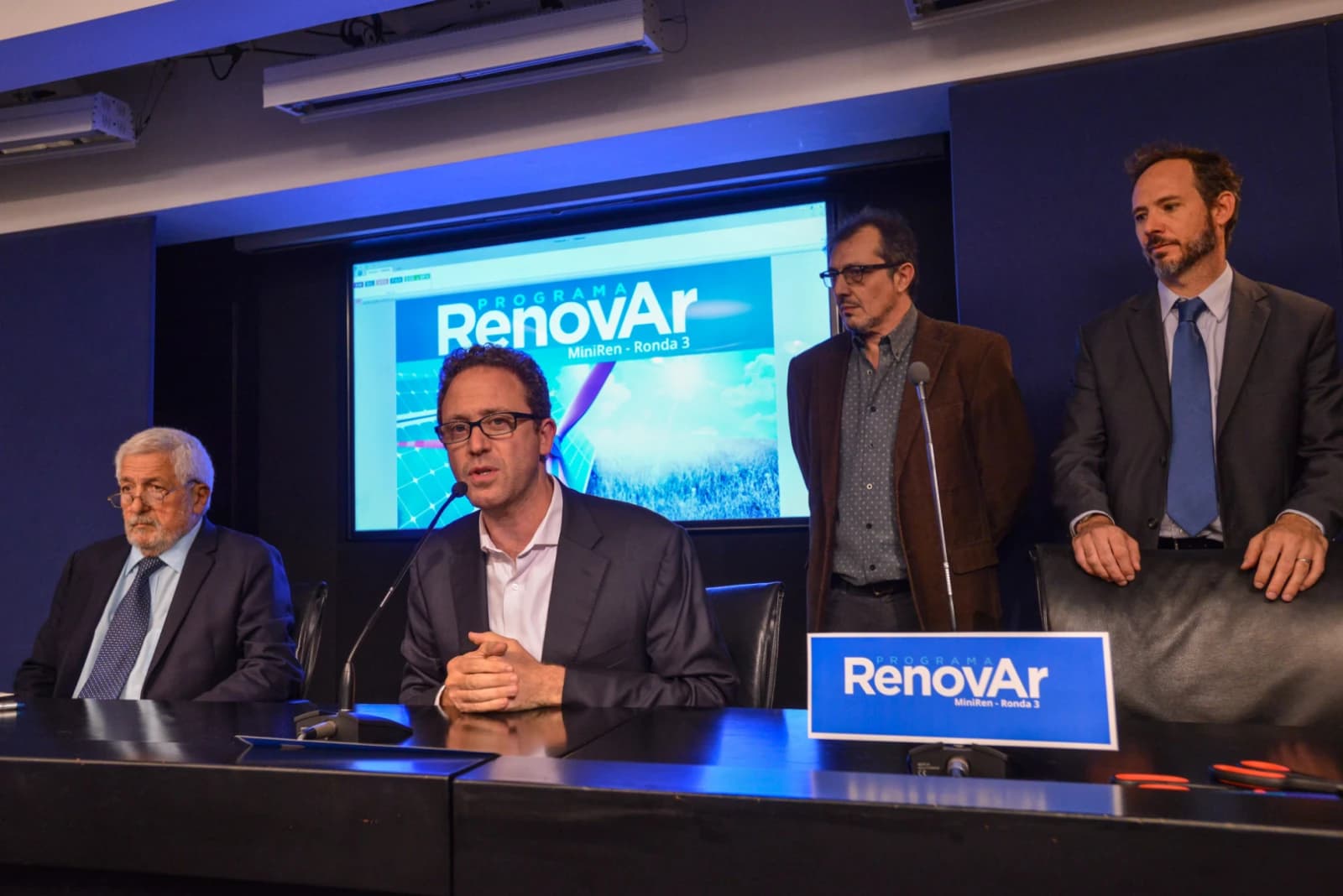
The Argentine government established a voluntary regime to terminate the contracts of public rounds 1, 1.5, 2 and 3 of the RenovAr Program and Resolution 202/2016 , whether or not they have achieved Commercial Authorization.
The key financial condition is specific: the policyholders must pay a one-time fee of 14% of the total amount of the Performance Bond . However, if there are ongoing legal proceedings, they will also be responsible for all costs incurred by both parties.
In return, the penalties applied and pending payment will be forgiven , while the amounts already disbursed will not be returned, compensated or reimbursed.
It will also be mandatory to waive claims against the National State, the Energy Secretariat and CAMMESA, in addition to rescinding the respective Agreement of Adhesion to the Fund for the Development of Renewable Energies (FODER).

For power plants that already have Commercial Authorization, the resolution adds another relevant alternative: after rescinding, they will be able to start marketing their generation in the Renewable Energy Term Market (MATER) from the following calendar month .
To do so, they will have to pay a quarterly charge of USD 500 per MW commercially enabled for two years.
In addition, the Dispatch Priority will be maintained for projects corresponding to Rounds 1, 1.5 and 2, those incorporated through Resolution 202/2016 and the MiniRen projects of Round 3 that received it at the time of signing their contracts.
This means that a 100 MW power plant that chooses to terminate and move to MATER would face USD 50,000 per quarter, USD 200,000 per year and USD 400,000 during the two years foreseen by the mechanism.
The measure is part of a broader contractual framework. The various public tenders held between 2016 and 2023, including the RenovAr and RenMDI rounds and other schemes, awarded 5,929 MW through 283 power purchase agreements .
Currently, CAMMESA identifies 123 active contracts with an average cost for the Wholesale Electricity Market (MEM) of USD 73.5/MWh , considering the final value of the energy, the incentive and update factors and the corresponding market recognitions.
Resolution 257/2026 is part of the process of normalizing the Wholesale Electricity Market (MEM) and restoring CAMMESA's original role as the technical dispatch administrator , with increased contracting between private entities and less centralization of electricity purchases. The Secretariat also aims to reduce costs and litigation within the system.
To terminate the contract, the 14% payment will not be sufficient. The company must submit a waiver of all rights, actions, or administrative, judicial, extrajudicial, or arbitral claims , both domestically and internationally, against the National State, the Secretariat of Energy, and CAMMESA.
It will also have to commit to holding the State harmless against any actions initiated by shareholders, controlling companies, controlled companies or related companies .
Another requirement will be to waive, through a sworn statement , the promotional tax benefits granted and not yet enjoyed under laws 26.190 and 27.191 and Decree 814/2017.
For those businesses that never obtained Commercial Authorization, the Implementing Authority will also proceed to invalidate the Certificate of Inclusion in the Promotion Regime , where applicable.
The funds collected through the termination fee will be allocated to FODER , while the holders must also terminate the Adhesion Agreements they maintain with that fund.
The resolution also addresses one of the issues that has hindered contract closings for years: legal proceedings related to the enforcement of performance bonds . CAMMESA must move forward with negotiated agreements to resolve pending litigation under conditions that are beneficial to the State.
This is not the first attempt to clean up the portfolio awarded since 2016. During the last few years , different mechanisms were used to resolve contracts for power plants that did not reach commissioning , while in 2023 a scheme was created that allowed penalties to be compensated through new renewable investments.
Specifically, Resolution 257/2026 repeals Resolution 883/2023 . According to the Energy Secretariat, that mechanism never began to be implemented and did not result in any formal agreements or contracts.
But this time the regulation is not limited to abandoned projects. It also includes power plants currently in operation and offers them the possibility of terminating their contractual relationship to compete for private demand in the MATER market .
For those who prefer to continue under their existing agreements, the Government has simultaneously enabled various options for contract renewal .
Power plants from Rounds 1, 1.5 and 2 and those incorporated through Resolution 202/2016 may eliminate the Committed Energy and Minimum Committed Energy commitments from June 1, 2026 , in exchange for reducing the Supply Period by two years.
A four-year Production Recovery Period is also established to cover energy not supplied due to deficiencies, and an alternative to resolve outstanding penalties through a proportional reduction of the contractual period based on the volume that was not delivered.
The mechanisms are voluntary, complementary and non-exclusive , so the same holder may take advantage of more than one alternative as long as they meet the corresponding requirements.
In all cases, the contractual regularization is again linked to a common condition: waiving claims arising from events prior to the signing of each addendum .
RenMDI also gets more time, but at an increasing cost.
The regulatory restructuring also extends to the RenMDI Call for Proposals. For those awarded contracts under lines 1 and 2 who still need time to obtain their Commercial License, the Secretariat is allowing an additional 365 calendar days beyond the originally planned maximum extension .
During the first 365 days of the extension, holders must pay USD 5000 per MW of contracted power per quarter , without altering the Supply Period.
If they need to use the additional term, the cost will increase to USD 7000/MW per quarter and a contractual discount will begin to operate: for each additional day actually used until Commercial Activation, two days will be deducted from the Supply Period .
Resolution 257/2026 thus establishes a new contractual menu for renewable generation awarded through public tenders : terminate by paying a portion of the guarantee and, for operating assets, then compete in the MATER; remain under the original agreement but modify obligations; or, in the case of RenMDI, buy more time to reach commercial operation.
For RenovAr, the question now lies with the generators' response. The 14% Performance Guarantee becomes the concrete price for closing the contract early , while for the authorized power plants, the decision will have to be compared with the commercial conditions they can obtain outside the centralized purchasing scheme.