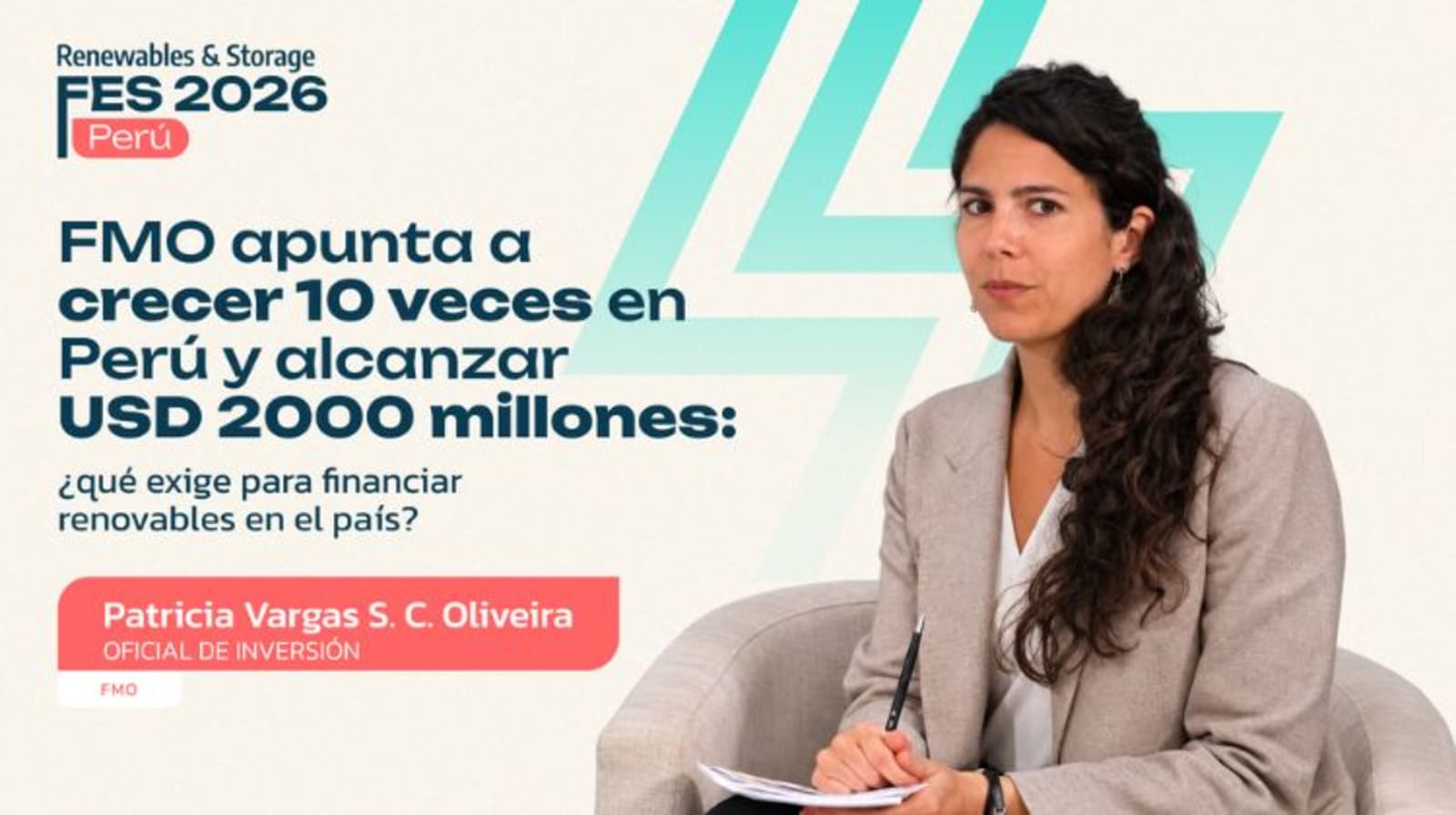
Dutch development bank FMO identifies the capacity to multiply its financial exposure in Peru and potentially reach USD 2 billion , with investment opportunities in renewable generation, transmission infrastructure and projects that incorporate energy storage.
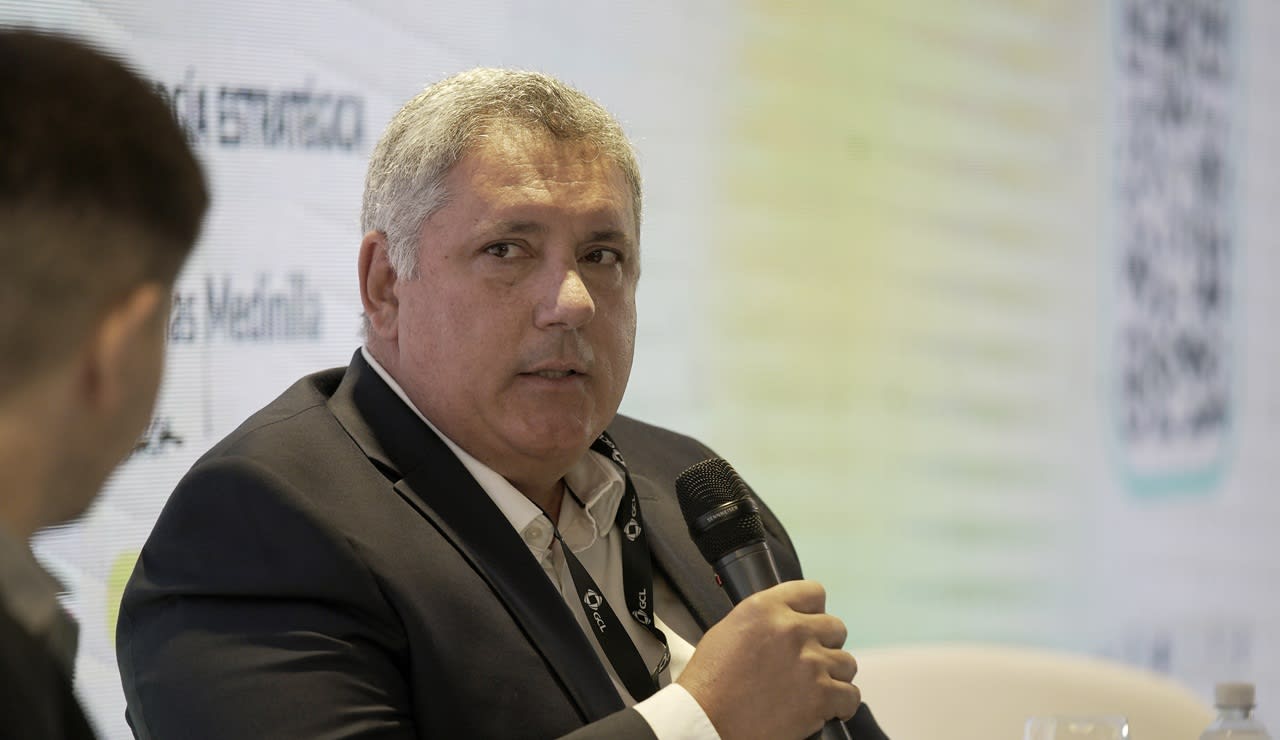
“We have concrete opportunities, but we believe there is room for further development. We have $200 million in exposure, but we can increase it up to ten times more. We have the capacity to do so, as Peru is a macroeconomically stable country with a good credit rating,” revealed Patricia Vargas SC Oliveira, Investment Officer at FMO , in an exclusive interview during the Future Energy Summit (FES) Peru 2026 .
Vargas Oliveira believes that this growth could begin to materialize as early as 2027, provided that initiatives that meet its bankability requirements are implemented.
The bank already has a track record of financing wind, solar, hydroelectric projects and transmission lines , segments in which it seeks to expand its participation through debt schemes adapted to the characteristics of each investment.

Among the completed transactions, the financing of USD 100 million for the 296.4 MW Punta Lomitas wind farm , developed by ENGIE Energía Perú, stands out. FMO also has participation in electricity transmission infrastructure projects, where concession terms allow for structuring longer-term loans.
The entity's interest coincides with a portfolio of 22,701 MW of solar and wind projects with Pre-Operational Studies (EPO) approved by the Economic Operation Committee of the System (COES), according to a survey by Energía Estratégica .
Of that universe, 19 initiatives totaling 3,714.5 MW have definitive concessions , while 14 projects totaling 2,772.4 MW have an estimated entry horizon between 2026 and 2027, according to their respective studies.
Among the developers that make up this portfolio are Continua Energías Positivas, Grupo Enhol, Orygen, Zelestra, ACCIONA and ENGIE, among other players that are advancing with renewable projects of different scales in the country.
In that sense, Vargas Oliveira explains that Peru's macroeconomic stability and the presence of commercial banks influence FMO's strategy, which seeks to complement the existing financial offering through long-term solutions, rather than competing with traditional lenders.
What does FMO require to finance new renewable energy projects in Peru?
The developer's experience and the strength of the contractual structure are the first aspects that FMO evaluates before committing financing for a new renewable energy plant.
“I believe that a good sponsor is the first thing one wants,” said Vargas Oliveira, who explained that the bank prioritizes companies with knowledge of the Peruvian market or, failing that, international developers associated with local partners who have verifiable experience.
Another determining factor is the track record of the EPC contractor , responsible for engineering, equipment procurement, and construction of the facilities. The entity specifically analyzes its capacity to execute solar or wind projects and its history of meeting deadlines.
Once these elements have been evaluated, the analysis focuses on the bankability of the power purchase agreement (PPA) , particularly its duration, termination clauses, and conditions that allow for projecting sufficient income to meet financial obligations.
During her participation in the FES Peru 2026 panel, the executive also identified regulatory stability and dispatch conditions as relevant elements, which affect risk assessment and revenue predictability.
Consequently, the contract term is crucial for structuring financing under the project finance modality, where debt repayment depends primarily on the cash flows generated by the asset itself.
“If the auction results in longer-term bankable contracts, I think there will also be more room for project finance,” the FMO representative noted.
The Peruvian market is awaiting regulatory definitions that could facilitate the financial closing of new renewable energy projects . The Ministry of Energy and Mines (MINEM) expects to approve the pending regulations for electricity and ancillary services tenders before the end of 2026, as recently announced by Minister Guillermo Shinno.
In particular, the bidding regulations, linked to Law No. 32249 , seek to establish new conditions for energy procurement, including long-term agreements and mechanisms that allow for greater participation of solar and wind technologies in the regulated market.
The draft regulations contemplate contracts of ten to fifteen years , while various companies in the sector requested modifications to facilitate the bankability of new investments.
Continue reading
Among these proposals, ACCIONA suggests extending contracts to 20 years and increasing the proportion of contracted demand on a long-term basis. ENGIE, for its part, requests greater clarity in the participation requirements and the possibility of submitting indivisible bids that cover different time blocks.
The observations also extend to the conditions of competition . While EDF Perú and Ignis Energy propose prioritizing new projects in long-term tenders, Kallpa, Statkraft, ENGIE, and Fenix Power , among other companies, argue that existing power plants should also be able to participate in the bidding processes.
However, FMO maintains that new tenders are not essential to secure financing in the Peruvian market , as it has alternatives adapted to current contractual conditions.
“We can do corporate finance, pooling projects into a portfolio to finance the portfolio as well,” explains Vargas Oliveira.
The entity also contemplates operations with free clients and industries that demand shorter supply contracts, even of five years , through corporate financing structures adjusted to the duration of the agreements.
Likewise, during the FES Peru panel , the executive acknowledged the possibility of financing projects with a merchant revenue proportion , directly exposed to the conditions of the electricity market and without long-term contracts.
In these cases, FMO considers more stringent debt coverage criteria to mitigate the business risks associated with revenue volatility.
Another alternative identified by the executive is the mini-perm , a shorter-term loan used primarily during construction, which can later be refinanced with other banking entities or through bond issuances.
However, FMO seeks to differentiate itself from commercial banking by offering longer-term solutions , capable of supporting projects both during their construction phase and during operation, with repayment schemes linked to the income generated.
“We want to offer perhaps a long-term solution, not only during construction because we can take construction risk, but also until the end of the project, with repayment through project cash flows to avoid the risk of not finding financing,” the bank representative stated.
This flexibility allows projects to be evaluated under different contractual structures, without limiting financing opportunities exclusively to developments that have 15 or 20 year power purchase agreements.
Storage: the potential of 2 GW of solar power and the pending conditions
On the other hand, hybrid projects that incorporate battery storage systems are also among the opportunities analyzed by FMO , although their financial viability will depend on the definition of regulatory mechanisms that allow remuneration for the services provided by these technologies.
“Hybrid is always being discussed, and all developers are waiting for the regulation,” the executive stated, referring to the still pending regulations for complementary services.
The ancillary services regulation , whose approval is also planned before the end of 2026, could provide greater clarity on the participation and remuneration of battery systems in the Peruvian electricity market.
During her participation in the FES Peru 2026 panel, the FMO representative also put forward an estimate of the photovoltaic growth that the Peruvian market could register during the next few years, with up to 2 GW of solar accompanied by storage .
“A guess estimate for a couple of years could be 2 GW of solar accompanied by about 20% battery,” says Oliveira, when assessing the potential for incorporating both technologies into the electrical system.
Regarding stand-alone storage projects , Vargas Oliveira acknowledges that FMO has not yet identified sufficiently advanced initiatives to begin concrete discussions about their financing. This estimate does not constitute a committed financing target for FMO, but rather an approximation of the volume of renewable energy development that could materialize under favorable conditions.
In this way, the bank keeps open various alternatives to expand its exposure in Peru, both in conventional renewable projects and in transmission infrastructure and hybrid developments.
“There are quite a few companies developing projects here that are recognized efforts, that know how to work, that know the market, and that we would love to support with financing,” Vargas Oliveira emphasized.
Thus, the possibility of FMO multiplying its exposure tenfold and potentially reaching USD 2 billion will depend on the realization of projects with technical backing, experienced developers and bankable financial structures , regardless of whether the new tenders materialize in the short term.

 By Emilia Lardizabal

 By Energía Estratégica
 By Ailén Pedrotti