


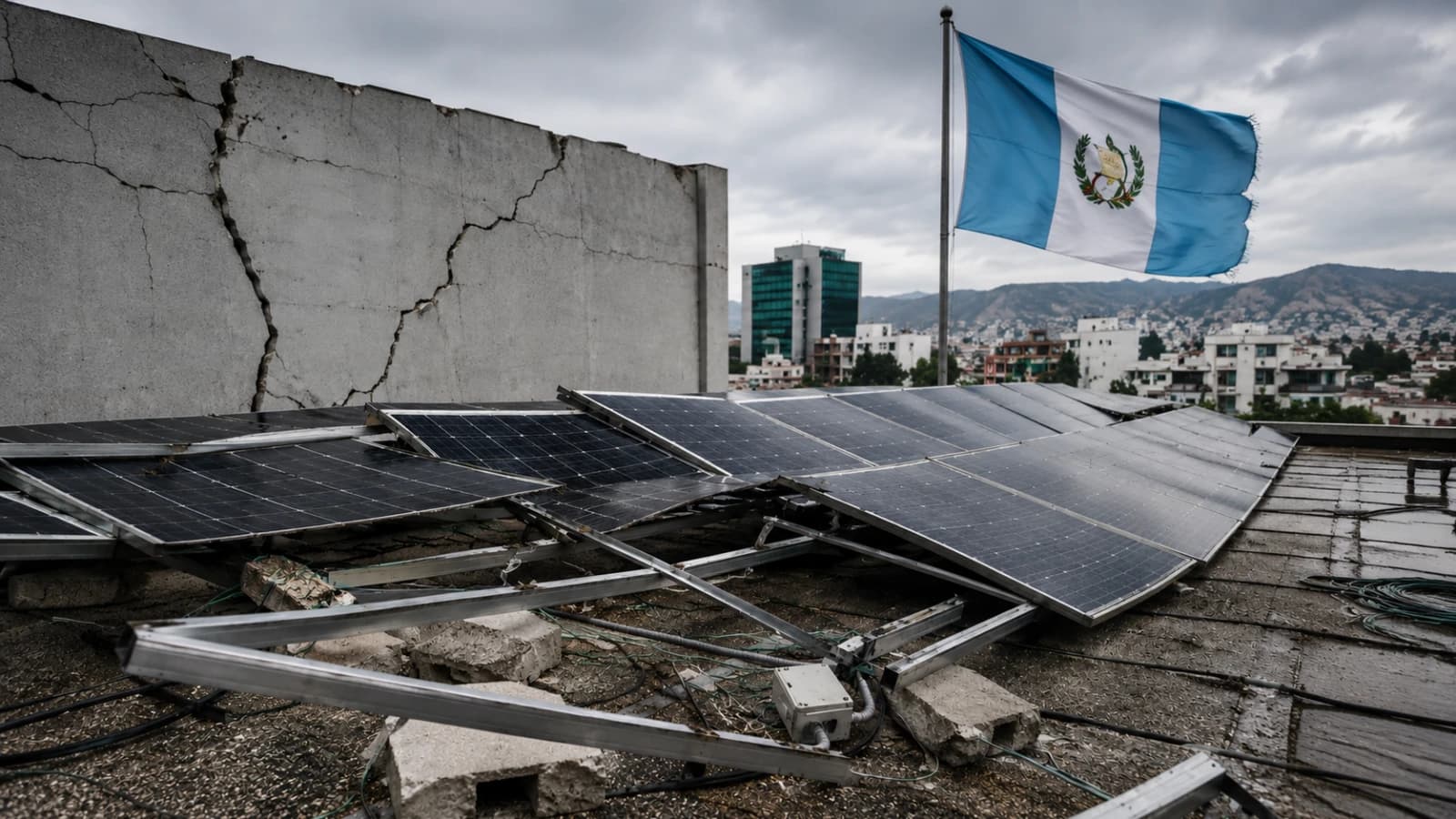
The powerful earthquake that struck on Friday, July 17 , exposed deficiencies in Guatemala's photovoltaic installations . The Guatemalan Association of Self-Producers of Renewable Energy (AAERG) received reports of detached panels, structural failures, and situations that could compromise the safety of homes and families.
The main earthquake reached a magnitude of 7.4 and shook the southwest of the country. During the following 24 hours, 131 seismic events were recorded, 33 of which were felt by the population, according to the report released by Guatemalan authorities.
In that scenario, Ottoniel Isaías Alfaro , president of AAERG and founder of Infinite Power, warned that the reported problems do not call into question the capacity of photovoltaic technology, but rather reflect the consequences of using inadequate materials or executing projects without professional criteria.
“ Solar energy is a great solution for Guatemala, but only when it is installed correctly ,” Alfaro stated.

The expansion of solar self-consumption requires technical standards, trained personnel, and structures adapted to the country's seismic conditions . The price or power of the modules should not be the only criteria when choosing a system.
The earthquake's epicenter was in the Pacific Ocean, near the border between Guatemala and Mexico, and it was also felt in El Salvador and southern Mexico. Authorities activated preventative protocols and evacuated buildings due to the intensity of the tremor.
Guatemalan agencies responded to 58 emergencies in various regions , while preliminary inspections revealed damage to roads, schools, and public offices. Authorities maintained an alert in the most vulnerable areas.
Professional installation and seismic resistance
The incident demonstrated that a photovoltaic installation cannot be evaluated solely based on its electricity production or projected economic return . Anchors, structures, and fixing points must respond safely to lateral movement and vibrations.
“ Professional installation is not a luxury, it is a safety obligation ,” said the president of the AAERG.
Alfaro emphasized that projects must be designed and installed by technicians capable of interpreting local regulations, seismic loads, and best practices for anchoring and fixing . This requirement is especially important for systems installed on residential, commercial, or industrial roofs.
A faulty assembly can affect both the modules and the covering that supports them. In addition to disrupting power generation, the detachment of panels, profiles, or other components poses a danger to people, vehicles, and nearby buildings .
The reports submitted to the Association include improperly installed photovoltaic systems, detachments, and structural failures. According to the organization, these situations could have been avoided with proper planning and the intervention of trained professionals.
“ The right materials make all the difference ,” Alfaro emphasized.
The founder of Infinite Power recommended using lightweight but strong structures, certified seismic-resistant fixings, quality modules, and assembly solutions tested in conditions similar to those in Guatemala.
“ Lightweight yet strong structures, certified anti-seismic fixings, quality modules and assembly systems tested in conditions similar to ours prevent detachments and guarantee the long-term durability of the system ,” the executive explained.
The warning also extends to procurement based solely on the lowest price. Using inexpensive components of uncertain origin can reduce the asset's lifespan and increase structural risks , even if the modules continue to generate electricity after the relocation.
Continue reading
The Association deemed it necessary to strengthen the traceability of materials and the training of installers. Increased adoption of the technology without adequate controls could lead to more incidents and undermine user confidence.
AAERG calls for immediate reviews
Given the continued seismic activity, the agency requested that owners of solar systems conduct an immediate inspection of the modules and their support structures .
The inspection should include the condition of the anchors, the integrity of the profiles, the panel fixings, and the tightness of the components. It is also necessary to detect any deformations, movement, loose parts, or damage to the surfaces where the installation is mounted.
“ Prevention saves lives, investment, and time ,” Alfaro said.
Poor execution leads to economic losses, can endanger people and damage the image of the renewable energy sector , precisely when Guatemala needs to expand the adoption of clean generation solutions.
For this reason, the AAERG advised paying special attention to systems implemented without technical supervision or using materials of dubious origin.
“ Conduct an immediate review of your photovoltaic systems ,” the president of the Association requested.
The inspection should not be limited to verifying whether the system remains operational. The continuity of electricity production does not guarantee that the structure will retain its original stability and safety conditions after an event of this magnitude.
Alfaro asked to verify “ the condition of the anchors, the integrity of the mounting structures and the correct tightening of all components .”
If you notice any movement, deformation, or loose parts, it is recommended that you stop any work on the roof and call in qualified personnel. Climbing onto a roof or handling electrical components without technical knowledge could increase the risk of accidents.
“ If your system was installed without professional supervision or with inexpensive materials of dubious origin, contact an AAERG-certified installer as soon as possible ,” the executive said.
The organization facilitates contact with professionals who apply technical standards and offers guidance to homeowners who need to have their installations inspected. The goal is to prevent initial savings on materials or labor from later resulting in repairs, asset loss, or damage to homes.
This incident also serves as a warning to developers, distributors, insurers, and public institutions. The growth of self-consumption requires clear protocols for design, installation, maintenance, and inspection following extreme events .
The seismic sequence recorded after the main earthquake reinforces the need for preventative action. The 131 events recorded during the first 24 hours kept communities in the south and west of the country on alert.
“The energy transition must be safe, reliable and responsible ,” Alfaro concluded.
The earthquake sent a message to the Guatemalan market: the quality of a photovoltaic system also depends on its ability to withstand the real conditions of the territory without putting people or their property at risk .