


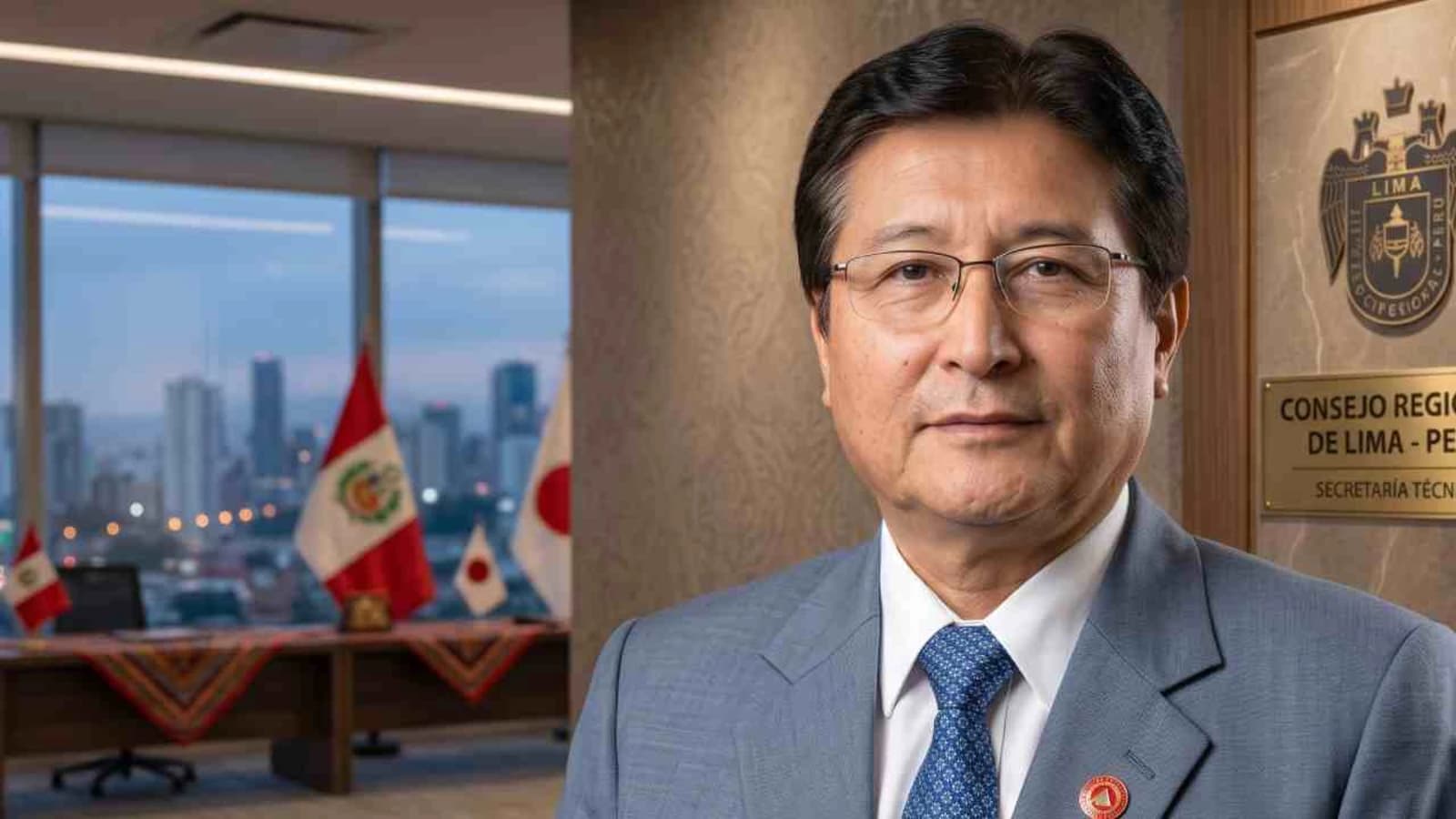
Keiko Fujimori assumed the presidency of Peru for the period 2026-2031 and appointed engineer Guillermo Shinno Huamaní to lead the Ministry of Energy and Mines (MINEM).
The appointment clears up the uncertainty surrounding the Ministry in the days leading up to the change of government. Rafael Belaúnde Llosa had been mentioned as a possible head of the energy sector , but was ultimately assigned to the Ministry of Defense, while Shinno remained in charge of the agency that regulates mining, electricity, and hydrocarbons.
The appointment places at the center of the agenda an executive with extensive mining experience and a background in electrical and regulatory institutions. Shinno was Vice Minister of Mines, Director General of Mining, and Manager of Mining Oversight at the Supervisory Agency for Investment in Energy and Mining (Osinergmin).
He also held positions at the Central North Electric Transmission Company and the Arequipa Electric Generation Company. In the private sector, he headed the Institute of Mining Engineers of Peru and the Apumayo Mining Company.

His arrival at the Ministry of Energy and Mines (Minem) comes at a crucial time. The sector expects the new administration to finalize the regulations for Law 32249 and define when the bidding processes will begin, allowing renewable energy technologies to compete for supply to regulated users.
Legal certainty and fewer permits: Fujimori's signs
During his first address to the nation, Fujimori presented institutional stability, legal security, and the predictability of public decisions as conditions for recovering national and foreign investment .
The president called on the business community to invest in Peru and stated that the State must offer clear rules and institutional protection. This approach is crucial for an electricity industry that needs long-term horizons, bankable contracts, and predictable administrative procedures to finance new power plants and networks.
Fujimori swore that “I will uphold and enforce the Political Constitution and the laws of Peru” when he formally assumed the Presidency on July 28, 2026.
The speech also foreshadowed a process of deregulation and the elimination of administrative burdens deemed unnecessary . The goal will be to reduce obstacles that delay investment and modernize state procedures through a new digital institutional framework.
The creation of a National Digital Authority and the implementation of a digital identity would be part of that transformation. For renewable energy developers, the impact will depend on whether these measures extend to procedures related to concessions, environmental permits, easements, connection studies, and sector-specific authorizations.
In international affairs, the new administration will seek to strengthen relations with the Pacific Alliance and the Andean Community, as well as attract capital from the economies that make up the Asia-Pacific Economic Cooperation Forum and from Middle Eastern countries.
Continue reading
The goal is to position Peru as a logistics and production hub , a strategy that will require greater electricity coverage, robust transmission networks, and competitive energy availability to support new industrial activities.
The Ministry of Energy and Mines (MINEM), through Shinno, will have to lead an agenda that includes the regulation of Law 32249 , the incorporation of 3.6 GW of solar and wind projects and the possible reactivation of renewable investments estimated at USD 12 billion .
The market already has a large renewable energy portfolio under development. According to Osinergmin data analyzed during the interview, there are 105 projects with approved pre-operational studies , totaling approximately 22 GW . Of that total, 13,778 MW correspond to photovoltaic solar power plants and 8,243 MW to wind farms .
The new administration aims to increase the share of non-conventional renewable energy to 20% of the electricity mix by 2031. According to the figures provided, these technologies already represent approximately 14%.
Fujimori's program also aims to achieve 100% national electricity coverage , with special attention to rural communities, Amazonian areas, and territories where there are still limitations to accessing the supply.
The proposal also seeks to reduce dependence on imported derivatives from approximately 75% to 50% , through a combination of new renewable capacity, domestic hydrocarbon production and natural gas expansion.
Regarding clean energy sources, the incoming government plans to develop a National Green Hydrogen Agenda with the participation of public agencies, private companies, and international cooperation organizations. The development of this industry will require establishing regulations for the production, certification, transportation, and use of this energy carrier. It will also demand electrical infrastructure, competitive access to renewable energy generation, and financing mechanisms.
One of the main outstanding issues is the implementation of Law 32249 , aimed at improving efficiency and competition within the Peruvian electricity market. The lack of operational regulations limits contract structuring and hinders projects from reaching financial closure. The next minister will also have to address the consequences of institutional instability. Peru has experienced more than eight presidencies in recent years, along with numerous changes in ministers and deputy ministers that have affected the continuity of sector policies.
The presidential address also acknowledged climate change and El Niño as threats capable of destroying infrastructure and impacting the economy . The government will seek to shift from a post-disaster response approach to a policy of timely prevention.
This approach will have implications for the electrical system. Networks, substations, and power plants will need to incorporate resilience criteria to address floods, droughts, extreme temperatures, and other events that can affect both supply and demand.
Shinno's arrival puts an end to the debate about who will lead the Ministry, but opens a more demanding phase. The market is waiting to learn when Law 32249 will be implemented, what products will be put out to tender, how renewable energy will participate, and what network expansion will accompany the awards.
The initial decisions will allow us to gauge whether the presidential promises of legal certainty, simplification, and attracting capital translate into concrete projects. In this process, the electricity tenders will be one of the first tests for the Fujimori administration's energy policy.