


The 296.8 GW distributed among 6091 BESS projects registered with the Energy Research Company (EPE) for Brazil 's auctions would undergo a strong vetting process before the processes scheduled for December (2nd and 4th of that month)
“I think that between 30 and 50 GW will be a feasible participation value. All the players that exist in Brazil are there, both in the generation and transmission sectors, so there are really very powerful and very serious companies, ” calculated José Manuel Perales , CEO of Grupo SIMM, during “It Had to Be Said and It Was Said ,” the streaming event hosted by Energía Estratégica .
Watch the full stream: https://www.youtube.com/watch?v=z1pQH8jcfyg
The range represents approximately 10% to 17% of the total power initially recorded . However, the reduction will depend on factors such as the homologation of the developments, the power availability at each substation, and the provision of guarantees .

The difference will be even greater with respect to the awards, since the market estimates contracts of 2 to 5 GW for BESS projects with a duration of four hours, which would represent between 8 and 20 GWh of storage capacity.
With up to 50 GW potentially available compared to only a few GW of contracted capacity, the supply-to-demand ratio anticipates intense competition . Furthermore, interest is not limited to specialized developers.
Local content will be another variable in the process, so there are already concrete moves to set up manufacturing in the country or commercial alliances with local companies like WEG or Moura.
The specialist even estimates that between five and seven companies have already confirmed production in Brazil, giving priority to the call with a minimum national requirement (to be made on December 2), over the one that will not have limitations (4/12).
The process also finds Brazil with very little installed storage , while EPC contractors, manufacturers and integrators begin to position themselves in relation to the volume that could be activated after the regulatory definition.
Grupo SIMM seeks to leverage its previous experience. Its engineering and construction teams have already worked with this technology, and the company completed a 240 MWh BESS project in six months .
“We are one of the few companies whose engineering department has already worked with BESS, whose construction area has already worked with BESS, and who have installed a 240 MWh BESS in six months. It is know-how that we can add and that many of our clients are recognizing us for,” Perales highlighted.
“Today, according to the timeframes requested in other processes, we should have BESS within 6-8 months from the signing of the contract ,” he warned, alluding to the fact that Grupo SIMM is already facing those timeframes in Argentina with AlmaSADI projects and expects a similar dynamic with future Brazilian awards.
Brazil could reach between 15 and 20 GW of BESS.
The December tenders would only be the beginning of a considerably larger rollout, given the need to reduce renewable curtailment (in 2025 it was around 20% solar and wind curtailment) and the fact that the sector has already suggested maintaining annual calls for tenders.
“I believe that BESS will reach 15-20 GW in 3 to 5 years. I don't see it as absurd because the market needs it; in fact, it's quite feasible. Although the rules will have to be established,” stated the CEO of Grupo SIMM.
“Once the rules are defined here in Brazil for how the BESS will operate, and even if several auctions can be planned or proposed, the figures of 20 GWh that Chile would have at the end of the year would be very small compared to what could happen with Brazil,” he added.
The growth in new loads is also beginning to modify the system. Data centers are emerging as one of the main drivers , both because of the electrical infrastructure needed to supply them and because of the firm demand for generation.
The SIMM Group works on both ends of the spectrum. On one hand, it develops direct power supply infrastructure for data centers . On the other, it participates in the construction of renewable energy assets designed to meet that demand.
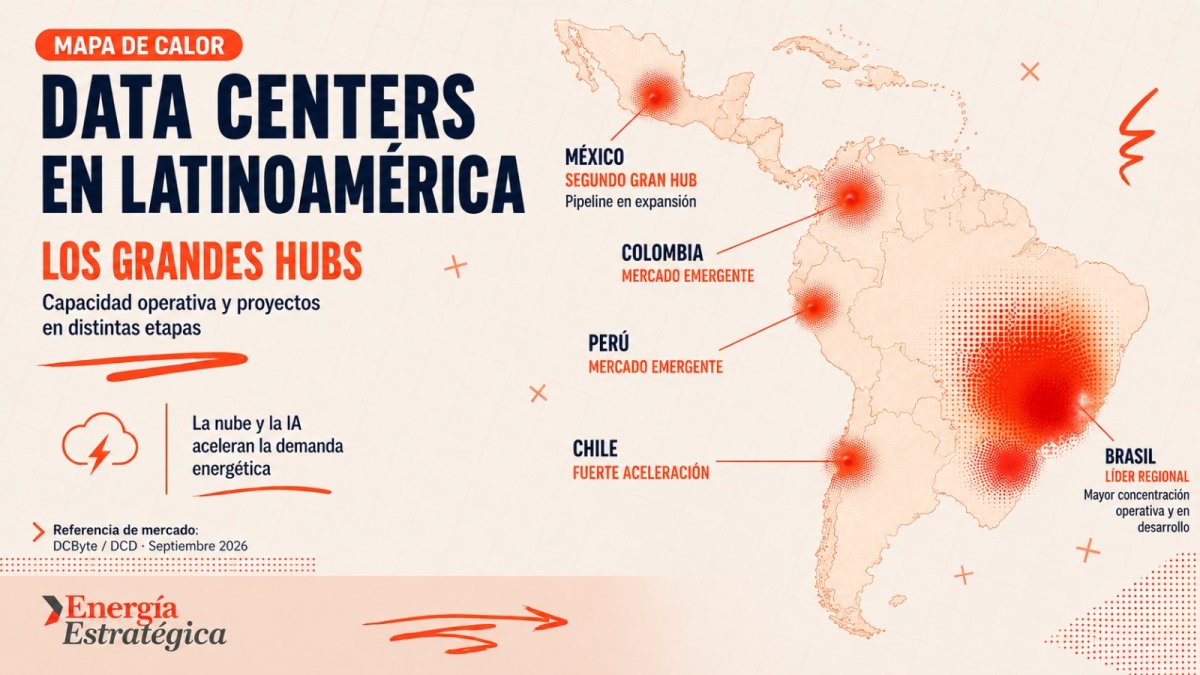
In Brazil, its main client is Casa dos Ventos , for whom it works as an EPC contractor on wind and solar power plants. Simultaneously, it is developing mining data centers ranging from 10 to 50 MW , in some cases located at the source of generation.
This scheme allows for the incorporation of constant and intensive consumption near renewable assets and, at the same time, offers an alternative to mitigate some of the curtailment problems.
“The growth drivers and the new players entering the energy and electricity markets are really creating distortions. There needs to be a new model,” Perales stated.
For Grupo SIMM, both BESS and smaller-scale data centers can capture specific opportunities within this transformation. The company understands that generators will need to incorporate these alternatives as constraints increase and the composition of demand changes.
The movement also finds Latin American EPC companies competing with European, American, and Asian players. In particular, Chinese companies are no longer just entering the market as suppliers of batteries, photovoltaic modules, or wind turbines, but also with engineering and construction capabilities.
“Today, Latin American companies, originating and created in Latin America, have a very good opportunity to compete on equal footing with companies from Europe or the United States in EPC,” Perales concludes.
Likewise, the ability to meet deadlines will be especially relevant. Large wind farms that two or three years ago required between 24 and 26 months to complete now must be finished in 12-14 months .
The schedules even require overlapping phases. In certain contracts, the engineering work progresses directly on-site and simultaneously with the client , instead of being completed before construction begins.