


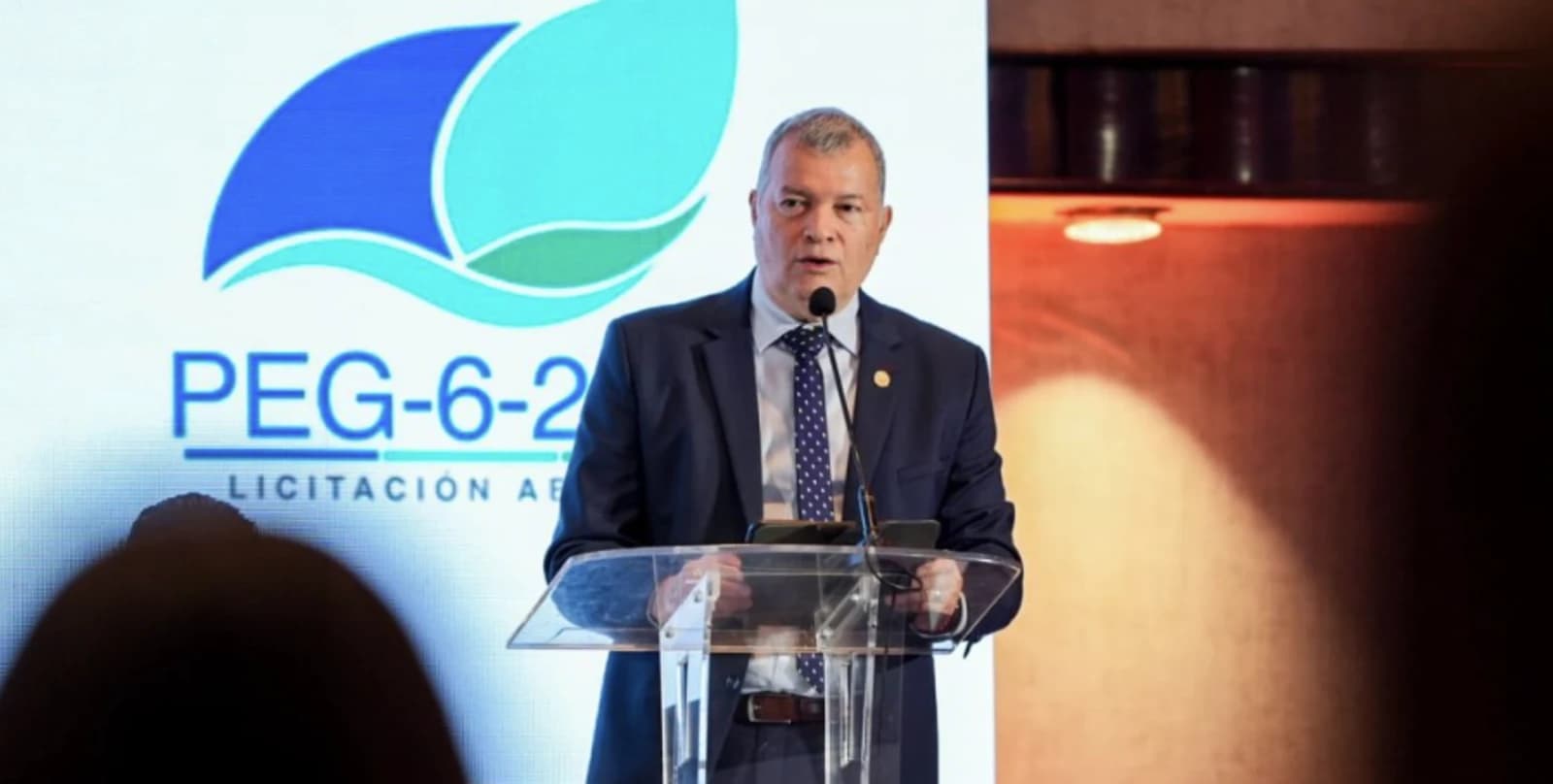
The President of the Republic, Bernardo Arévalo, and the Minister of Energy and Mines, Erwin Barrios, participated in the official launch of the Open Tender PEG-6-2026, a strategic process aimed at incorporating new electricity generation and strengthening the security, reliability and continuity of the country's energy supply.
The PEG-6-2026 plan includes the contracting of 600 MW of power and electricity, distributed in two blocks: 450 MW for new plants and 150 MW for existing plants, through contracts of up to 15 years. Supply is scheduled to begin on May 1, 2032.
The tender is being promoted by EEGSA, DEORSA and DEOCSA, with the support of the National Electric Energy Commission (CNEE), and stems from Resolution CNEE-323-2026, through which the Terms of Reference that served to develop the basis of the process were approved.
During his speech, Minister Barrios emphasized that the Ministry of Energy and Mines is working on the formulation of energy policy and the planning of the sector with a long-term vision, with the purpose of guaranteeing a safe, reliable, competitive and sustainable supply.

In that regard, he explained that the sustained growth in electricity demand is forcing the country to anticipate the generation capacity it will need in the coming years. According to the information presented during the launch, in 2026 the peak demand of the National Interconnected System (SNI) reached 2,301 MW, 8.6% higher than in 2025.
“Guatemala needs investment in firm generation and energy security to continue growing,” highlighted the head of the MEM, who stressed that the country must continue advancing in the diversification of its energy matrix and in the use of renewable sources.
Continue reading
The Minister pointed out that renewable energies constitute an essential part of Guatemala's energy future and that their expansion must be accompanied by firm power, necessary to strengthen the reliability and responsiveness of the system to variations in the availability of generation sources and changes in climatic conditions.
He also emphasized the importance of having a resilient electrical system in the face of increasingly variable climate scenarios, which can affect the availability of certain energy resources. In this context, planning and diversifying the energy mix are fundamental to guaranteeing continuity of service.
Barrios emphasized that PEG-6-2026 not only seeks to incorporate more generation, but also to ensure a firm foundation that allows for the growth of demand, supports the expansion of renewable energies and guarantees a reliable supply for homes, commerce and national industry.
Minister Barrios reaffirmed the MEM's commitment to technical, transparent, and long-term planning, as well as to generating conditions of legal certainty that favor new investments in the energy sector.
Finally, he invited national and international developers and investors to participate in the process and take advantage of the opportunities the country offers to expand and diversify its energy infrastructure.
“Come and invest in Guatemala, come and invest in energy,” the Minister said, emphasizing the importance of attracting investment that contributes to strengthening the national electricity system.
With PEG-6-2026, Guatemala is advancing in the planning of the generation capacity it will require during the next few years, with the goal of having a more robust, diversified, resilient and competitive electrical system, capable of supporting economic growth and reliably meeting the energy needs of the population.