


New electricity tenders, industrial growth, and the future electrification of transportation are reshaping the energy landscape of Central America and Mexico. In this context, Atera has identified three countries in the industrial corridor with the greatest potential to expand its energy efficiency and demand management business.
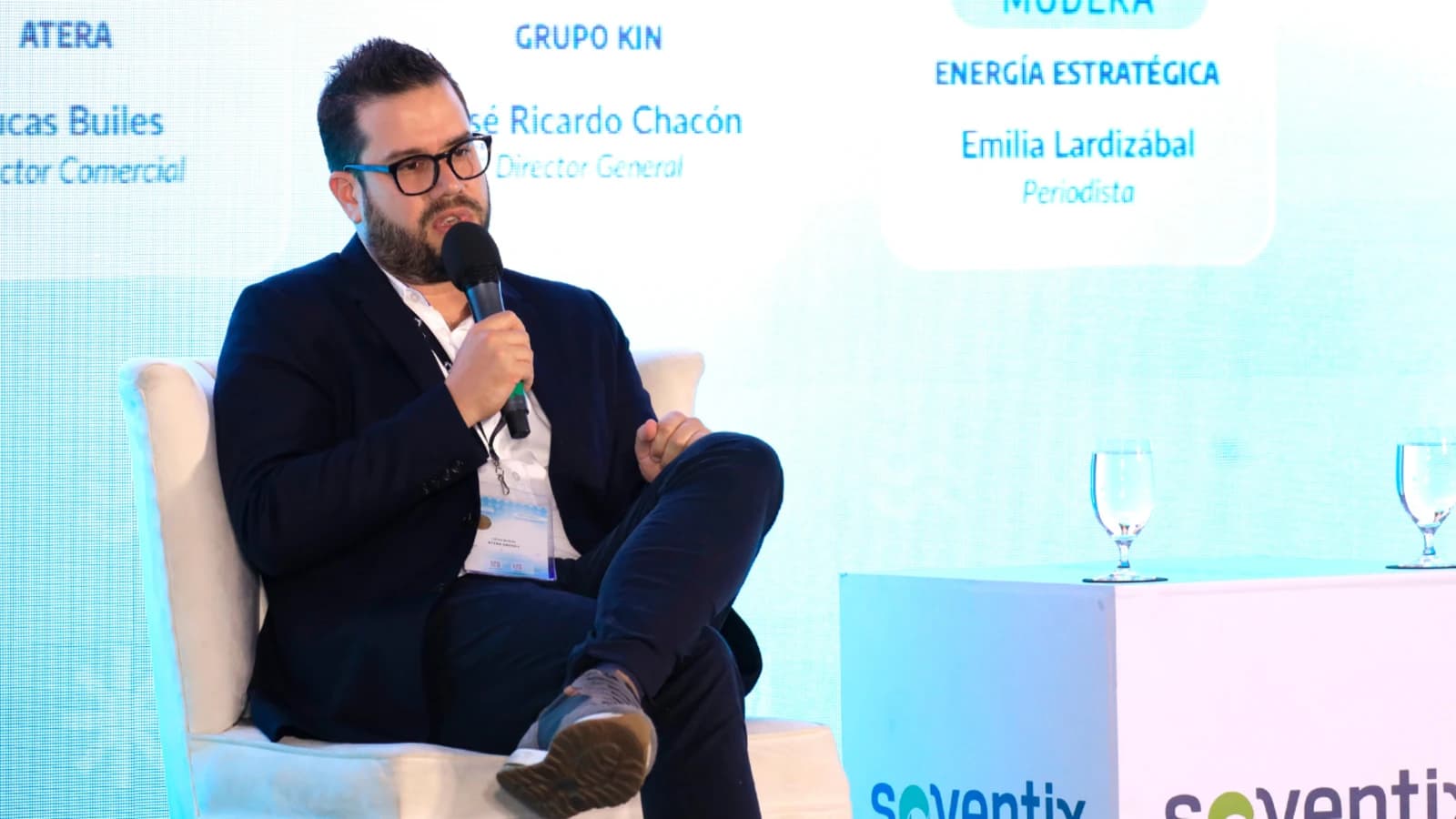
" Honduras, Guatemala and Mexico represent a huge opportunity for us because they are an energy hotspot in the region ," said Lucas Builes , Commercial Director of Atera, during his participation in the Future Energy Summit (FES) Guatemala.
The company's strategy aims to support this development through demand management. Its proposal involves first optimizing customers' energy processes and then defining the most suitable supply solution—an approach it considers unique in the face of the region's projected growth.
" The opportunity and industrial growth coming to this region are tremendous ," Builes said.

REVIVE FES GUATEMALA HERE: https://www.youtube.com/watch?v=-fQIrVqwZYk
Atera already operates in Panama and Honduras , recently inaugurated its first energy efficiency project in Mexico and seeks to consolidate its presence in the corridor that connects these markets with Guatemala.
" We have an operation in Panama and Honduras with a strong desire to continue growing northward and to consolidate that corridor towards Mexico, and of course, in Guatemala ," he added.
The regional scenario is beginning to show signs that support that strategy.
In Guatemala , the electricity market is entering a new phase following the awarding of PEG-5 , considered one of the most competitive tenders in recent years. The process added 1,258 MW , of which approximately 73% corresponds to renewable technologies . Meanwhile, the sector is already looking ahead to PET-4 and PEG-6 , tenders that will seek to expand transmission infrastructure and incorporate new firm capacity to support the system's growth.
At the same time, Honduras is preparing to launch the terms of its long-awaited 1500 MW tender , planned after the electricity reform promoted by the Government, which seeks to restore investor confidence through a new institutional structure and greater guarantees for project development.
In Mexico , meanwhile, the mixed scheme promoted together with the Federal Electricity Commission (CFE) awarded 7410 MW among 31 developers , while the country prepares to face a peak demand of close to 54 GW , driven by both industrial growth and electrification and the 2026 World Cup.
For Atera, all these movements point in the same direction: the growth in demand will force industries to manage their energy consumption more efficiently.
Demand, the real challenge
During FES Guatemala, one of the aspects that Builes highlighted most was the change that is beginning to occur in the energy debate.
" I would like to highlight something that I am seeing for the first time at an event of this kind, and that is the insistence with which the demand is being discussed ," he noted.
The executive explained that the company's focus is on understanding how its customers consume energy before defining any supply project.
Continue reading
" What Atera does first is optimize the energy processes of its clients and then think about how to supply the energy they need ," he said.
This challenge takes on a greater dimension when considering the current level of electrification in the region. In Guatemala, for example, electricity represents only between 8% and 10% of total energy consumption.
Based on that data, Builes suggested that the real challenge will come when activities that currently depend on fossil fuels, such as transportation, cooking, and various industrial thermal processes, begin to be electrified.
" The challenge tomorrow will be: what are we going to do when that other portion of energy starts to become electrified? " he warned.
In his view, the transformation has already begun and will require a different kind of planning than the current one.
" We have to think about that tomorrow that we still see as a great challenge, and I think we are not yet prepared for that ," he said.
Faced with this scenario, Atera's strategy relies on behind-the-meter solutions, combining energy efficiency, financing, operation and consumption management to accelerate the adoption of new technologies.
The company was born with a model designed to eliminate one of the main barriers that industries face when moving forward with this type of project.
" Atera was also born from a proposal to break the initial investment barrier ," Builes explained.
The executive stressed that the difference lies not only in providing financing, but in integrating technical knowledge, operation and maintenance with a detailed analysis of energy demand.
" It's not just about capital, it's about knowledge, operation, maintenance, and understanding demand ," he said.
Therefore, before installing any solution, the company analyzes the energy behavior of each client to identify specific optimization opportunities.
" It's not about installing a self-generation system just for the sake of it, but first understanding the demand and consumption processes within our clients' facilities ," he stated.
With that diagnosis, Atera develops schemes where customers do not have to make the initial investment, a modality that, according to the company, accelerates the incorporation of energy efficiency solutions.
" After doing that, and proposing schemes where customers don't have to invest, we believe we can greatly accelerate the adoption of these types of initiatives ," Builes concluded.
For the company, the true potential of the corridor formed by Honduras, Guatemala and Mexico will not only lie in the incorporation of new generation capacity, but also in the possibility of responding to a demand that will grow hand in hand with industrial development and the electrification of the economy.