


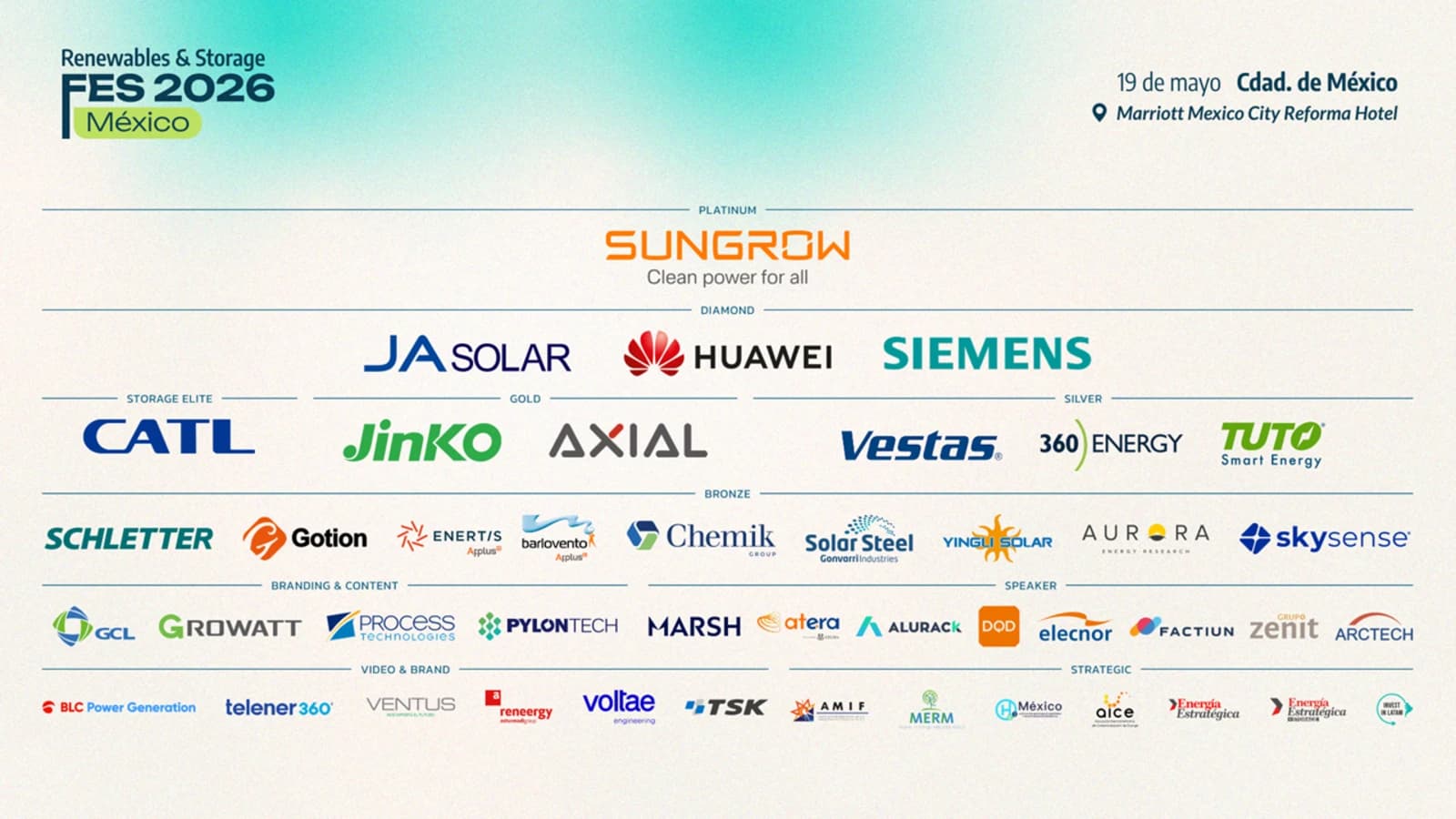
Future Energy Summit (FES) will hold its third edition of FES Mexico today, at one of the most active times for the national energy market in years.
The meeting will begin at 8 a.m. Mexico time (11 a.m. ARG - 4 p.m. ESP) at the Marriott Mexico City Reforma Hotel and will focus the strategic discussion of the sector on key points such as the new open calls to accelerate renewable projects and storage systems, official capacity expansion targets and a renewed public-private participation scheme.
The agenda focuses directly on the variables that currently influence investment decisions. Panels such as “Mexico Redefines the Game for Solar + BESS: Interconnection, Social Impact, and Reliability as Key Drivers of Development,” “The New Logic of the Energy Portfolio,” “Technological and Investment Criteria for New Project Types,” and “Mexico and Its Next Wind Wave” will shape the debate.
The business lineup foreshadows the high caliber of the event. Participating companies include Sungrow , JA Solar, Huawei , Siemens , CATL , Jinko , Axial, Vestas , 360Energy , Tuto Power , Schletter , Gotion , Enertis/Barlovento Applus+, Chemik , Solar Steel , Yingli Solar , Aurora Energy Research, and Skysense.

They are joined by other renowned entities such as GCL , Growatt , Process Technologies , Pylontech , Marsh , Atera , Alurack , DQD , Elecnor , Factiun , Grupo Zenit , Arctech, BLC Power Generation, Telener 360°, Ventus, Renergy, Voltae, TSK, AMIF, MRM, H2 México and AICE.
The timing of the event coincides with a concrete redefinition of the market, given that the government recently launched two new calls for renewables and storage, along with a specific mechanism for strategic self-consumption projects.
The numbers show that the movement has already begun. According to official information from the Ministry of Energy, the portfolio currently under evaluation exceeds 10 GW of generation and 3 GW of storage , with estimated investments of 270 billion Mexican pesos, equivalent to USD 15.73 billion .
Business interest is already reflected in the open bidding processes. In the mixed-investment generation call promoted by CFE, 56 projects from 40 companies advanced with the goal of adding 7,500 MW before 2030. In addition, the first call for priority clean energy generation projects closed with 51 initiatives equivalent to 5,336 MW of generation and 1,158 MW of storage , mobilizing more than 145 billion Mexican pesos .
The message to the market is clear: Mexico is once again opening up space for new infrastructure, albeit under more demanding rules and with a much more active state role.
The new Call for Proposals for Strategic Projects for Electric Power Generation and Storage enables the development of renewable power plants and non-associated BESS systems from 0.7 MW , while excluding distributed generation, self-consumption, cogeneration and projects previously linked to existing infrastructure.
One of the most important focuses is on energy storage. The Ministry of Energy has established an initial requirement of 935 MW with three hours of autonomy , prioritizing regions critical to the system's operation. Furthermore, projects that become operational before 2030 will be given preference. 
The registration period for expressing interest and requesting studies will be open from May 25 to August 25, 2026. Commercial operation is expected to begin between 2027 and the first half of 2030.
The development logic is also changing. Through the Single Window for Strategic Projects in the Energy Sector (VUPE) , developers will have to channel registrations, technical studies, financial guarantees, and administrative follow-up.
The new model also strengthens commitments: acceptance of interconnection works, mandatory financial backing, socio-environmental permits within defined deadlines, and risk of revocation in case of non-compliance.
Therefore, what will be discussed today at the third edition of FES Mexico is no longer a regulatory expectation but a transformation underway, allowing partnerships with CFE through joint investment, long-term contracts or other legal mechanisms.
For the private sector, this changes the development logic, since simply identifying available resources, technology, or nodes is no longer enough. Alignment with state priorities and the ability to structure projects under new partnership models will also be crucial.