


India is preparing a new push for agrivoltaics with a potential target of 5 GW in the next three or four years , while evaluating financial support mechanisms capable of closing the cost gap with conventional solar projects.
The Ministry of New and Renewable Energy (MNRE) is working with the Ministry of Finance to define the structure of the program, which could be integrated into the PM-KUSUM scheme or launched as an independent initiative.
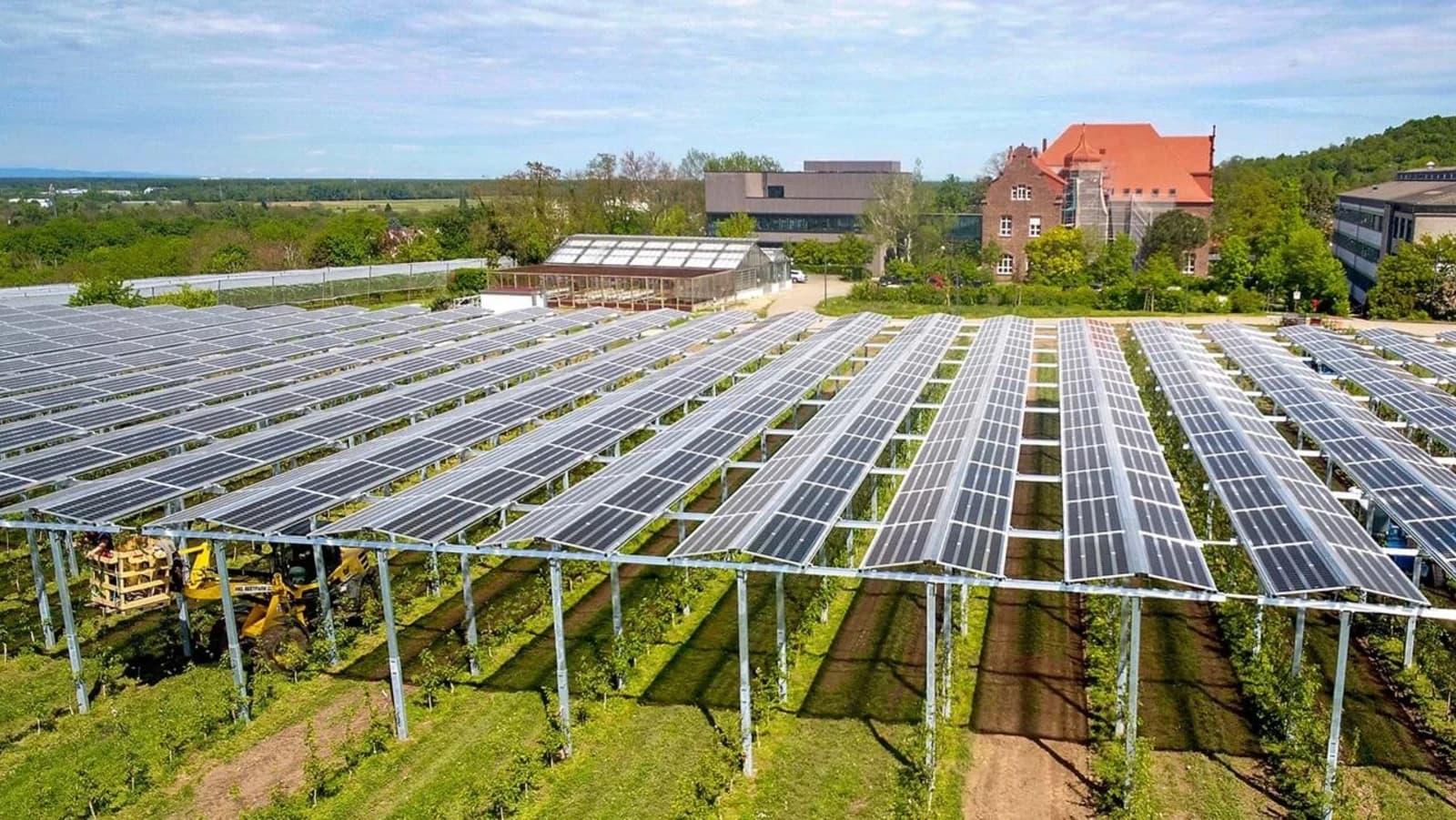
The main economic barrier is the cost, since according to the secretary of the MNRE, Santosh Kumar Sarangi , agrivoltaic projects require elevated structures that allow agricultural activity to continue below the panels, which makes the installations 25% to 30% more expensive compared to conventional solar plants on the ground.
“Our goal will be to cover this cost difference with AgriPV,” Sarangi explained.

The government hopes that this initial support will allow it to scale up, improve the competitiveness of projects, and expand its reach to states where the availability of non-agricultural land is lower.
Currently, around 85% of the country's solar expansion is concentrated in five states , so agrivoltaics appears as an alternative to better distribute the new capacity and reduce competition between electricity generation and agriculture.
The technical potential is also significant.
The ministry estimates that AgriPV's potential capacity in India is between 1 TW and 2 TW , although the immediate goal is well below that ceiling and will depend largely on the signals sent by state governments.
To reach the planned 5 GW, one of the determining factors will be the feed-in tariffs that each state can establish for this type of generation.
Continue reading
The estimated cost of agrivoltaic electricity is between 3.20 and 3.30 rupees/kWh , compared to a range of 2.80 to 3 rupees/kWh for decentralized solar installations under PM-KUSUM.
The difference reinforces the need for financial support during an initial stage.
Pilots, crops, and expansion into new states
The MNRE is already developing pilot projects together with the Indian Institute of Agricultural Research (IARI) to evaluate which types of crops perform best under elevated solar structures.
The trials showed encouraging results in fruits and leafy green vegetables , while crops such as rice and sugarcane presented greater adaptation difficulties.
Among the states identified with potential are Madhya Pradesh, Odisha, Chhattisgarh, West Bengal, and Uttar Pradesh .
The strategy aims to allow solar power to scale up without completely displacing other land uses.
In this sense, agrivoltaics allows combining agricultural production and electricity generation within the same area, an alternative that may gain more importance as competition for land suitable for renewable projects increases.
The ministry is also working with distributors to facilitate the purchase of energy generated by these projects and is preparing a specific regulatory document to guide their development.
The new scheme is not yet finalized, but the direction is clear: India wants to use incentives to offset the higher initial CAPEX and bring agrivoltaics to a multi-gigawatt commercial scale .
If it manages to reach the projected 5 GW in three or four years, the technology would move from a primarily pilot phase to becoming a new avenue for
