


Years ago, the record prices that solar photovoltaic energy is achieving in renewable energy auctions around the globe were unthinkable.
While it depends on many factors, the drop in module costs and recent innovations have led to photovoltaic technology becoming one of the favorites.
"It is the cheapest generation technology that can be obtained worldwide," said Ricardo Garro , head of sales in Central America, Colombia and the Caribbean for Jinko Solar during the webinar: Cost Optimization in the New Era of the Photovoltaic Industry . 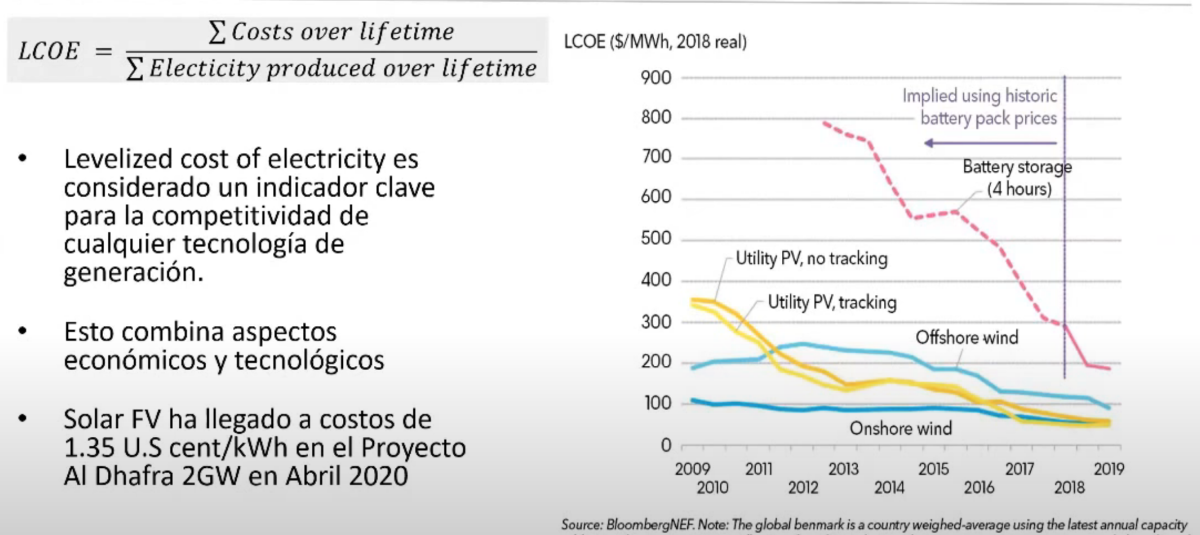
Evolution of solar energy costs Tiger-Pro
Just three months ago, Jinko Solar introduced the most powerful product line in the industry, and it is already attracting interest from various utility-scale projects around the world.

The Al Dhafra solar project (2 GW) managed to position itself with the lowest tariff in this technology, calculated at 1.35 US cents/kWh (AED 4.97 fils / kWh in local currency) according to announcements from the Abu Dhabi Energy Corporation.
It is not insignificant that this megaproject is now considering incorporating Jinko Solar's new technology that reaches up to 585 W.
Jinko Solar projects securing 7 GW in contracts during 2020 in Latin America
"It's a very important leap in power, achieved in less than a year by our company," said the head of sales in Central America, Colombia and the Caribbean for Jinko Solar.
In a quick comparison, while the maximum of its Tiger-Pro line reaches 585 W in 78 cells, recently inaugurated projects in the Latin American region, such as the Castilla solar park in Colombia (21 MWp), have 385 W panels mounted.
How do these panels achieve the lowest levelized cost of energy (LCOE)?
According to the head of sales in Central America, Colombia and the Caribbean for Jinko Solar, it ensures both a reduction in CAPEX and OPEX as well as an increase in generation. 
A comparison of a solar project in Taiwan shows that energy costs are decreasing and profitability is increasing. *Bifacial solar panels can achieve better results, but not all locations are suitable.
CAPEX and OPEX Reduction: Its high efficiency and power (585W and 540W) imply reductions in: balance of system (BOS), labor, civil works, execution time, land area and logistics cost.
Its lower open circuit voltage (VOC) improves, allowing for fewer longer strings, and therefore less balance of system (BOS).
It guarantees lower operating and maintenance costs because there are fewer modules and equipment to clean.
Increased generation: lower temperature coefficient, more cell technologies such as MultiBusBar, Tilling Ribbon, Circular Ribbon, Half Cell, Tedlar Dupont such as Blacksheet and Transparent Backsheet.
In all its versions, this type of Tiger-Pro module provides competitive advantages.
The three models highlighted by the company are: Tiger-Pro 78TR (max. 585 W), Tiger-Pro 72TR (max. 540 W), and Tiger-Pro 60TR (max. 450 W) . https://youtu.be/YI5ioIL9KUM
Technological vanguard
Jinko Solar is working hard on innovation.
During the webinar "Cost Optimization in the New Era of the Photovoltaic Industry", this manufacturer presented a new alternative that appeals to solar developers and integrators: N-Type technology.
Its differentiating qualities enhance the efficiency of projects, guaranteeing between 5 and 10 watts of additional power.
According to the company, although the cost of this technology is higher, its lower degradation combined with the warranty they offer makes it a viable alternative for certain applications.
"As manufacturers, our goal is to help generators and EPC contractors have more competitive projects," said Ricardo Garro, head of sales in Central America, Colombia and the Caribbean for Jinko Solar.