The Latin American wind energy market is undergoing a reconfiguration of its main investment hubs . While Brazil is experiencing a marked slowdown in the addition of new wind farms, Mexico projects adding 6,860 MW by 2030 , in a scenario that is altering the outlook for developers, wind turbine manufacturers, and technology providers.
Brazil's contraction is reflected in the figures from the National Electric Energy Agency (ANEEL): the country registered 4,260.57 MW of power corresponding to new power plants in 2024 , a volume that fell to 1,825.90 MW in 2025 and to 832.50 MW by October 2026. The reduction between 2024 and 2025 reached 57.1%, while the latest figure does not yet represent a full year.
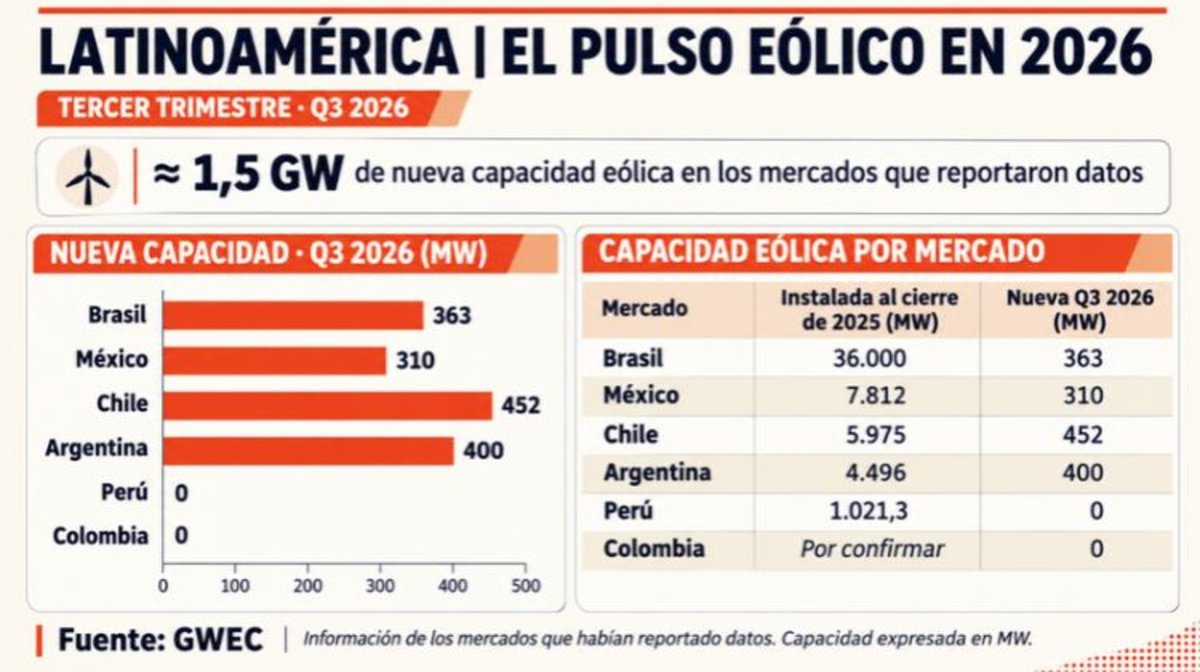
The contrast is also evident in the regional data presented by the Global Wind Energy Council (GWEC) . Through the third quarter of 2026, Chile added 452 MW, Argentina 400 MW, Brazil 363 MW, and Mexico 310 MW, according to information from markets that had reported results.

" We can say that we are in the midst of a wave that will surely rebound again from 2028 onwards," said Ramón Fiestas, president of GWEC for Latin America, in the streaming event " It had to be said and it was said ," organized by Energía Estratégica.
He warned that the situation stems from structural factors affecting the viability of new variable generation projects connected to the electricity grid. The main problem, he pointed out, is related to the combination of rapid expansion of distributed generation, transmission limitations, and difficulties in securing long-term electricity supply contracts.
According to Fiestas, more than 20% of the electricity that previously circulated through the Brazilian system became self-supplied , which reduced the commercial space available for large renewable projects connected to the grid.
The situation particularly affects wind farms of 50, 80, 100 MW or more, whose financing depends on contracts that guarantee income over extended periods. This is compounded by curtailment.
The slowdown also alters the business outlook for manufacturers who historically concentrated a large part of their regional operations in Brazil.
This is the case of Goldwind, which entered the Brazilian market more than a decade ago and has accumulated more than 2.7 GW in secured contracts , in addition to approximately 1.5 GW in projects under maintenance, according to data shared by the company.
In that context, Li Zhang, Goldwind's Latin America director , acknowledges the change in regional dynamics and highlights the opportunities that are beginning to concentrate in Mexico, driven by new calls for proposals and the growth of industrial demand.
"Mexico will indeed be a boost," said the executive, who believes that the development of this market can help sustain regional wind energy activity while Brazil is going through a period of less dynamism.
As part of this repositioning, Goldwind opened an office in Polanco, Mexico City, in early November , aiming to strengthen its presence in the country after several years of reduced business activity. The company also plans to relocate staff from other Latin American operations and expand its local service capabilities.
"I want to emphasize that Goldwind never left Mexico," said Zhang, who clarified that the firm maintained its presence during the years of less dynamism in the sector and now seeks to take advantage of the new stage of investments.
However, Brazil's recovery remains crucial for the future of the industry. Fiestas points out that the country was the main driver of Latin American wind energy expansion since the first specific tenders launched in 2008.
At that stage, Brazil received a portfolio of nearly 10,000 MW of projects interested in participating in the first calls , of which approximately 1,000 MW were initially awarded.
The competitive mechanism made it possible to reduce wind power generation prices and develop a supply chain that accompanied the market expansion in the following years.
For GWEC, the current challenge is to recover the conditions that made that growth possible, but under a different electricity scenario, marked by a greater penetration of distributed generation, network constraints and new consumption patterns.
Mexico projects $12 billion in investments and attracts new players: the new regional wind energy engine?
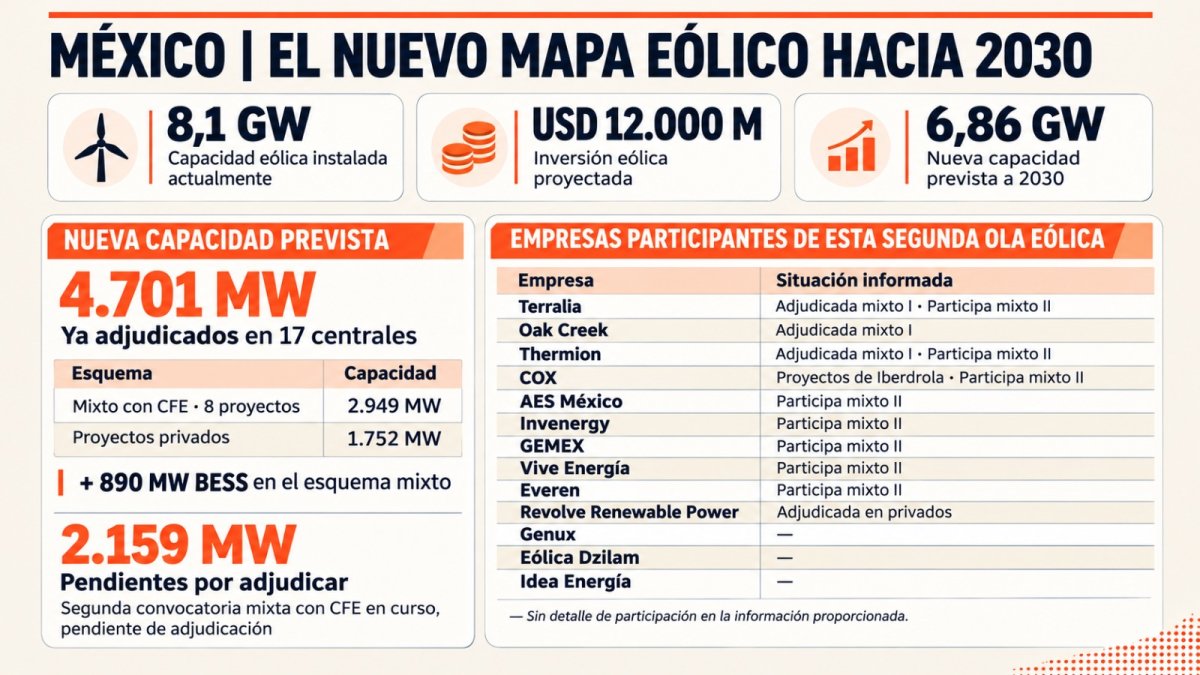
While Brazil faces a contraction in its wind power market, Mexico projects to mobilize $12 billion in investments linked to this technology , within the framework of an expansion that contemplates incorporating an additional 6,860 MW by 2030, according to data from the Ministry of Energy (SENER).
The country has approximately 8.1 GW of installed wind power capacity and aims to reach nearly 15 GW by the end of the decade. Of the new capacity planned, 4,701 MW have already been awarded across 17 power plants , while another 2,159 MW remain pending allocation.
One of the main tools to revive the market is the mixed development scheme with the Federal Electricity Commission (CFE) , which contemplates partnerships between the public sector and private companies to finance, build and operate new power plants.
Of the 4,701 MW awarded, 2,949 MW correspond to eight projects under the mixed scheme with CFE , while the remaining 1,752 MW come from private initiatives.
Under this arrangement, the state-owned company retains a minimum stake of 54% and the private partner can reach up to 46%, in a model that introduces new participation conditions for investors.
The second call for public-private partnerships is still underway and is the focus of much of the sector's expectations, due to the volume of power that still needs to be allocated to meet the objectives set for 2030.
In this context, Terralia, Oak Creek, and Thermion are among the companies with projects awarded in the first joint call for proposals . Terralia and Thermion are also participating in the second round of the program, according to information presented during the meeting.
Continue reading
The new phase also attracts international companies such as Cox, AES Mexico and Invenergy , which are participating in the second mixed call and are looking to expand their presence in the Mexican electricity market.
The interest was also reflected in the first mixed call, which received registrations for 38 GW of solar and wind projects , although this figure represents initiatives submitted and not capacity actually awarded.
For Fiestas, this response demonstrates the existence of a portfolio of projects that remained stagnant for years and is now finding new development alternatives.
"This is the first time a process of this type has been launched in Latin America, where public and private initiatives participate in a mixed way in companies that will develop and operate projects," he analyzed.
He noted that this could raise questions about corporate structuring, supply commitments, and the distribution of responsibilities between the State and private investors.
"This requires a harmonization of interests between the parties and above all, it requires a horizon of transparency and legal certainty that is extremely important," Fiestas warned.
According to their analysis, regulatory certainty is crucial for reducing financial costs , especially when investments must be recovered over periods of 10 or 15 years.
But Mexico's challenges are not limited to regulatory design. The territorial concentration of new wind farm developments poses infrastructure and logistical demands that could affect the construction schedules planned between 2028 and 2030.
Zhang identifies Tamaulipas, Nuevo León, and Yucatán among the states where a significant portion of the project portfolio is concentrated, which will increase the need for component transportation, port availability, and supplier coordination.
"We need to take a somewhat rational approach, because the infrastructure to handle so many projects is also a challenge," warned the regional director of Goldwind.
For the executive, the volume of new awards represents an opportunity, but realizing them will require anticipating the risks associated with the supply chain and the capacity to execute.
The firm, which has almost 3.5 GW of installed wind power in Latin America, believes that Mexico could acquire increasing importance within its regional operations, although it does not communicate a specific target for participation in the awards.
Zhang also notes that the Mexican market has demand fundamentals linked to industrial relocation, data centers, mining, and the development of artificial intelligence applications.
"The market now sees Mexico as a very stable, long-term market," the executive stated. This growth in industrial consumption introduces new demands for renewable energy generation, particularly due to the need to guarantee electricity 24 hours a day and reduce supply variability.
For his part, the president of GWEC points out that the first Mexican awards prioritize projects that can be connected with less infrastructure expansion requirements, but warns that this strategy will have limitations as installed capacity increases.
According to their analysis, optimizing existing networks could enable renewable integration increases of between 10% and 15% in certain scenarios , although subsequent expansion will require specific investments in new lines.
The global wind power industry is changing its key players: eight of the ten largest manufacturers are Chinese.
The reconfiguration of the Latin American market coincides with a change in the competitive structure of the global wind industry , characterized by the growth of Chinese manufacturers and a greater concentration of new installations among the main suppliers of wind turbines.
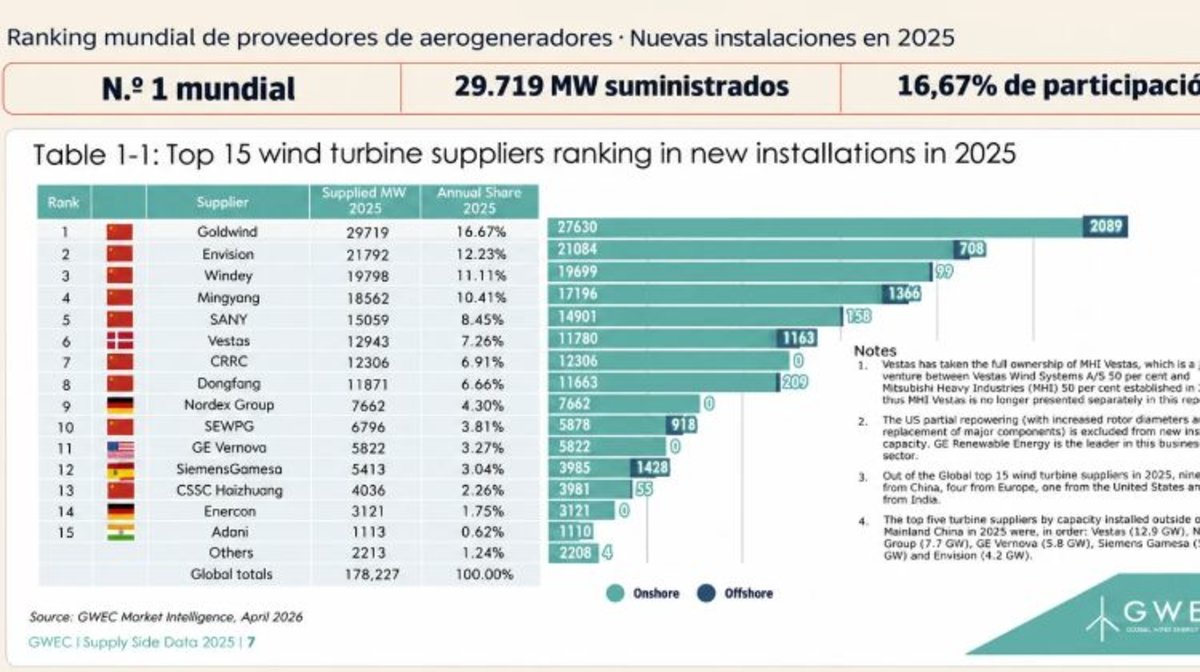
According to the Global Wind Energy Council's (GWEC) Supply Side Data 2025 report, eight of the world's ten largest wind turbine manufacturers by new installations are of Chinese origin , while the other two are European companies.
In that scenario, Goldwind topped the world ranking of new installations in 2025 with 29,719 MW supplied , equivalent to 16.67% of the global market considered in the report.
However, 87.14% of its supplies were concentrated in China , while Brazil accounted for 1.50%, reflecting the importance of the domestic market for its international positioning and the room for expansion that still exists in other regions.
Zhang attributes the growth of manufacturers to the technological evolution of wind turbines and the development of local structures capable of supporting the construction, operation and maintenance of wind farms.
In particular, he explains that Goldwind works with two technological platforms: direct drive permanent magnet wind turbines (PMDD) and medium speed generator equipment (MSPM) , developed from its experience in the Chinese market and subsequently introduced in other countries.
However, the changing needs of electrical systems are forcing suppliers to expand their technological offerings. The integration of energy storage, control systems, and increased grid stability requirements are beginning to play a central role in the design of new projects.
"Given the unstable winds, how are we going to provide consistent power? That's the big issue, both technical and regulatory, that we need to resolve," concluded the Goldwind regional director.
In this way, global competition among wind turbine manufacturers is beginning to incorporate new demands for technological integration, services and responsiveness to electrical grids , at a time when Latin America is redefining its main investment markets.
 By Ailén Pedrotti
 By Energía Estratégica
 By Matías Medinilla
 By Florencia Guglielmetti
 By Emilia Lardizabal