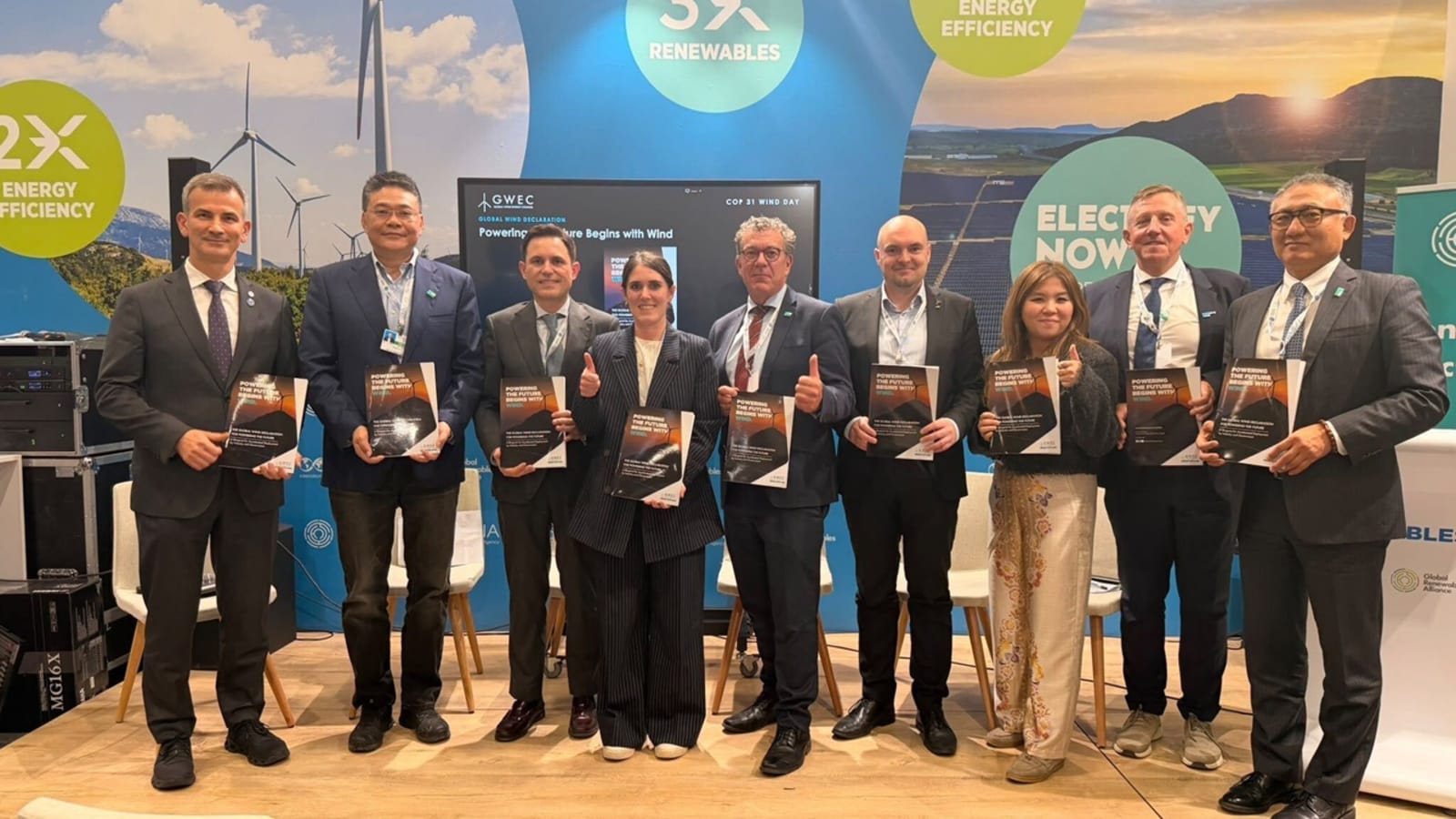
The global wind industry brought a new roadmap to COP31 in Turkey to accelerate project development over the next decade and respond to the challenge of more rapidly expanding installed renewable capacity.
The so-called Global Wind Energy Declaration to Power the Future , promoted by the Global Wind Energy Council (GWEC) together with the Turkish Wind Energy Association (TÜREB) , combines commitments from the private sector with recommendations aimed at governments to improve investment conditions.
The goal is to reduce the barriers that still slow down the development of new parks, especially in terms of permits, networks, financing and supply chains.
“The transition to a clean, secure, and affordable energy system begins with wind power. If, for example, it takes two years to build an offshore wind farm, it shouldn’t take eight to twelve years to obtain the necessary permits,” warned Ben Backwell , CEO of GWEC.

The statement suggests that global wind power capacity could triple or even quadruple over the next decade if governments and industry can coordinate investments and resolve major bottlenecks.
According to data released by GWEC, global wind power capacity reached 1299 GW at the end of 2025 , after multiplying more than twentyfold over the last two decades.
In 2025 alone , 165 GW of new capacity was added, 40% more than the previous year and enough, according to the agency, to supply another 118 million homes.
The projections included in the statement show that the sector is currently on track to reach 2 TW in 2029 and 3 TW in 2035 .
However, with greater public support to reduce risks, mobilize investment and remove barriers to development and manufacturing, GWEC believes that capacity could even exceed 4 TW by 2035 .
Permits, networks and funding at the heart of the debate
The need to accelerate deployment was also one of the central messages during COP31.
United Nations Secretary-General António Guterres called for an extraordinary acceleration of renewables, electricity grids, storage and clean electrification, with the goal of tripling renewable capacity by 2035 compared to 2025 levels.
In that context, the wind declaration establishes five principles to accelerate implementation.
These include providing greater regulatory certainty and investment opportunities, developing wind industries capable of sustaining regional economies, promoting innovation and sustainable supply chains, improving the integration of wind energy into electrical systems, and harnessing the potential of offshore wind.
“ We have built an industry that today generates almost 1.3 TW of capacity globally, and just last year we added a record 165 GW ,” said Michael Hannibal, president of GWEC .
The executive stated that the next challenge will be to transform that industrial scale into new projects and mobilize enough investment to exceed 4 TW over the next decade.
From TÜREB, its president İbrahim Erden stressed that to achieve further developments it will be necessary to combine predictable policies with efficient permitting, timely investments in networks and storage, and access to competitive financing.
The declaration also places special emphasis on the development of offshore wind power.
Rafael Munilla, business development director at Ocean Winds , stated that the sector is ready to invest, but needs "visibility and confidence" to transform potential projects into actually installed capacity.
As he explained, governments will play a central role in creating stable frameworks and viable project portfolios that allow investments to move forward.
Growth in demand is accelerating the pressure on projects
The document also links the need to accelerate renewable deployment with the growth of new sources of electricity demand.
The expansion of artificial intelligence and data centers is driving up consumption and increasing pressure on energy infrastructure and development times.
The challenge, according to the statement, is no longer just about determining how much clean capacity can be built, but how quickly it can be effectively put into operation .
To achieve this, GWEC proposes moving from a logic of isolated projects towards integrated planning of generation, storage and networks.
Along those lines, Kane Xu, senior vice president of Envision Energy , pointed out that the next leap forward for wind power will depend not only on better turbines, but also on the ability to integrate this technology with battery storage, smart grids, solar energy, and green hydrogen and ammonia.
The central message from the industry during COP31 is that the technological scale already exists.
The next stage will depend on ensuring that permits, connections, financing, and network planning advance at the same pace as the capacity to build new wind farms .
 By Emilia Lardizabal
 By Florencia Guglielmetti
 By Ailén Pedrotti