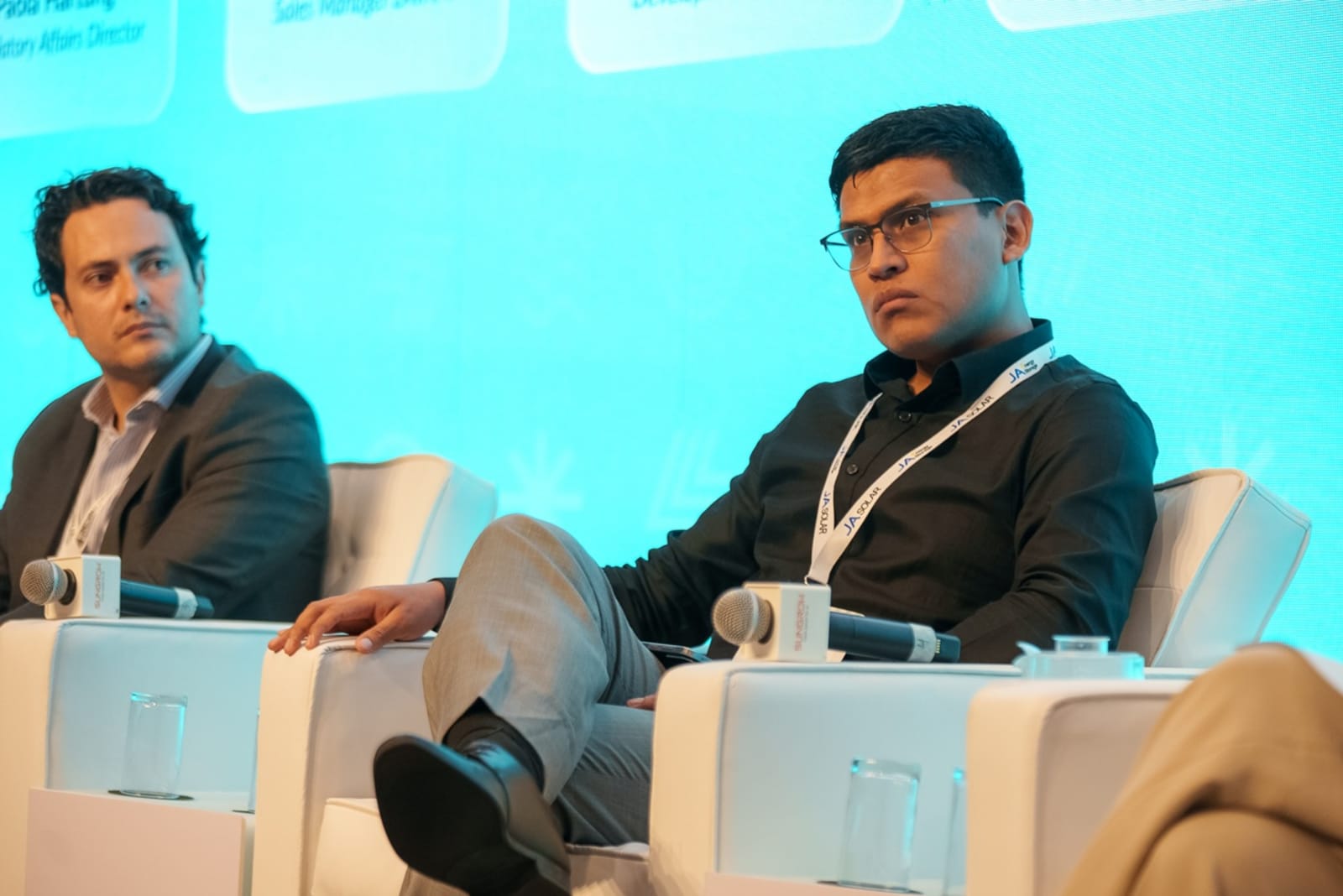
“The current timings are killing projects,” warned Erick Melo, Technical Manager for South LATAM (PV & BESS) at JA Solar , during the Future Energy Summit (FES) Chile 2026. The executive focused on how equipment delivery times, obtaining permits, and grid access conditions can impact the schedules and profitability of energy investments.
The warning comes amid strong regional expansion. According to the latest Technical Note No. 21 from the Latin American and Caribbean Energy Organization (OLACDE), battery energy storage capacity (BESS) reached 3,408 MW in operation in August 2026 , compared to 1,681 MW in 2025. This growth places greater demands on planning to integrate these new assets into electrical systems.
“Often the State and its regulations advance much more slowly; I'm not saying they don't advance, but they advance much more slowly than the technologist's know-how ,” Melo argued.
The difference in speeds can create mismatches between the availability of technological solutions and the conditions necessary for their implementation. For developers, this means coordinating investment decisions with connectivity studies, transport capacity, and the required permits in each market.

Meanwhile, the integration of batteries is transforming the design of renewable energy installations. “In less than a year, we’ve stopped thinking of a photovoltaic plant solely as the components that utilize photovoltaic technology. Today, when we talk about a park of this type, we’re also talking about a storage system,” he explained.
This change expands the responsibilities of technology providers, who must respond to performance and durability requirements in facilities designed to operate for extended periods.
“ Our role as manufacturers basically involves two things. First, making the product work. And second, making it reliable in the long term ,” said the JA Solar representative, referring to projects with operating horizons of at least 20 years.
Connection times, a challenge for storage
The difficulties of integration have concrete precedents in Chile, one of the most developed storage markets in Latin America.
In June 2026, a presentation to the National Electric Coordinator outlined the need to accelerate the expansion works of the Kimal substation to allow the connection of a 430 MW and 3010 MWh BESS project , with a duration of seven hours.
The development plan envisioned its interconnection during the third quarter of 2028. However, if the infrastructure is processed through the ordinary transmission planning process corresponding to 2026, the works could only become available in the fourth quarter of 2030.
The difference represented a potential delay of nearly two years , which is why the exceptional mechanism provided for in article 102 of the General Law of Electrical Services was requested.
The economic evaluation presented estimated that the expansion would generate systemic savings of approximately USD 40.3 million during the period 2026-2045, compared to an approximate investment of USD 2.98 million. The Coordinator subsequently initiated the procedure to evaluate the proposal as an urgent project.
Another precedent was recorded at the Parinacota substation, where a 50 MW and 200 MWh storage system required new connection positions.
According to the National Energy Commission (CNE), the infrastructure would have been available only during the second quarter of 2030 through conventional planning, even though the BESS project was scheduled to begin operations by the end of 2028.
In May 2026, the authority authorized the expansion through the urgent works mechanism, after verifying its necessity and the economic benefits associated with the incorporation of the battery system.
Both cases reflect the importance of aligning transmission expansion with energy development timelines. They also demonstrate the application of exceptional measures to address needs that cannot be met within standard planning timelines.
At the regional level, OLACDE identified the main challenges of storage as the definition of connection and operation rules, the recognition of flexibility services, and the creation of remuneration mechanisms that allow for the financing of new facilities.
From decarbonization to the quality of electricity supply
The debate on the integration of new technologies also responds to a change in the priorities of Latin American electrical systems, where the growing participation of renewables requires addressing operational aspects that go beyond the incorporation of installed capacity.
“ We have moved to a 2.0 transition which, of course, has these urgent environmental problems, but one of the most important problems is the quality of the electricity supply ,” Melo stated.
From this perspective, storage becomes relevant because of its ability to shift energy between different times of the day and, depending on the technology and configuration used, provide services that contribute to the stability and reliability of the networks.
The executive identified three conditions for the development of these markets: the existence of a specific energy need, the availability of appropriate technology to meet it, and an environment that allows its implementation.
“ We need both technology and the flexibility of the system, specifically in the State, to advance at the same rate or to the same extent ,” Melo stated.
With an expanding storage portfolio, the challenge for Latin America will be to convert the growth of installed capacity into resources effectively available to electrical systems, through planning that considers both infrastructure needs and the technical and economic conditions of operation.
 By Emilia Lardizabal


 By Energía Estratégica

 By Ailén Pedrotti