


The expansion of small solar farms in Colombia began to incorporate a new profitability variable: energy storage as a complement to small-scale photovoltaic projects. In a market that needed to accelerate the integration of generation capacity, Evolti and LONGi Solar advanced a joint strategy that combined the growth of their solar portfolio with the installation of their first battery storage system .
Evolti is a Colombian power generation company that integrates project development, investment, construction, and operation. The company has accumulated approximately 20 MW of installed capacity through self-generation and distributed generation , with another 30 MW under construction or about to begin construction .
By 2027, the company projects to reach between 50 and 55 MW operational , in addition to maintaining another 50 to 60 MW under development .
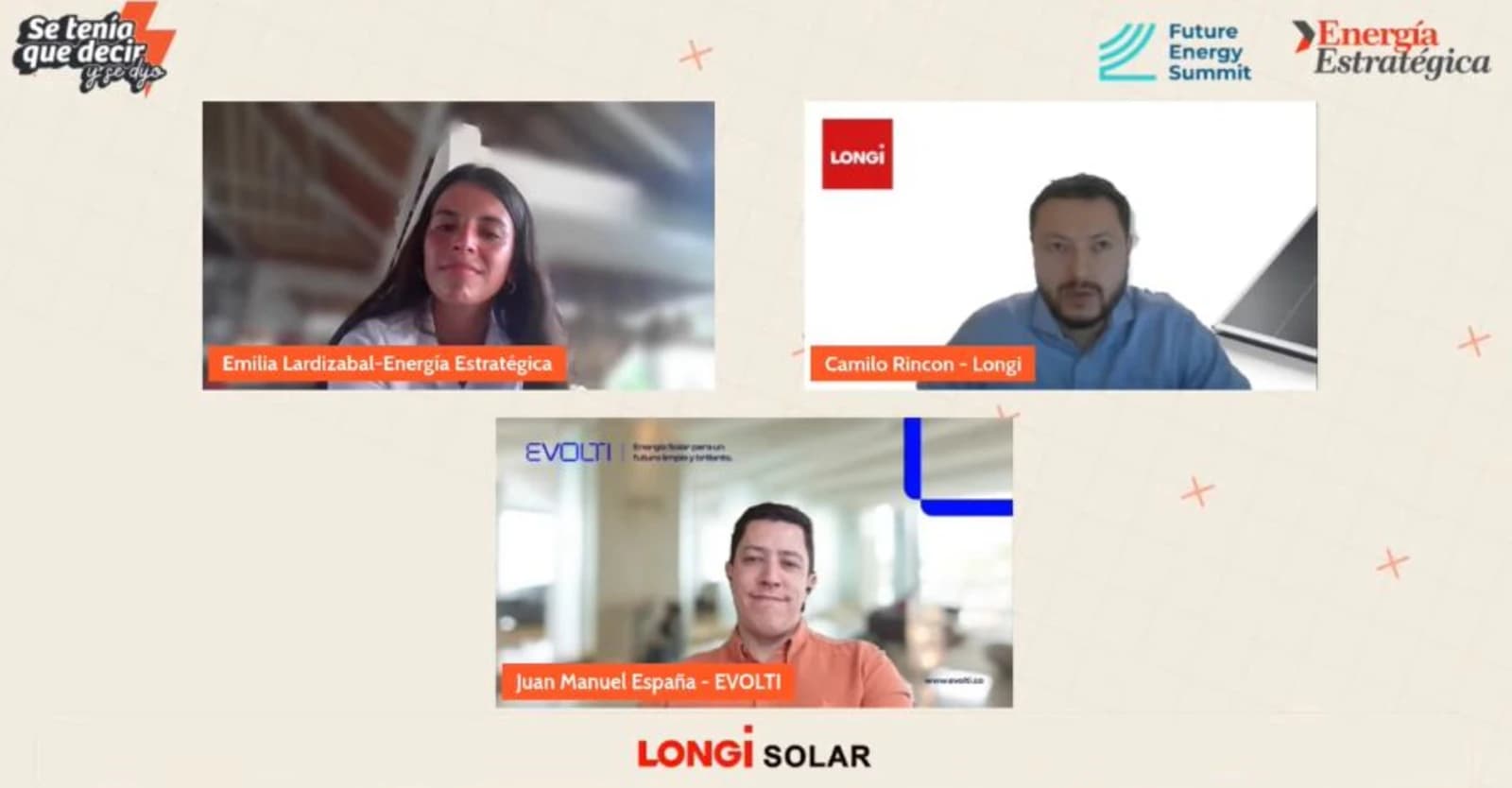
The plans were detailed by Juan Manuel España, Executive Director of Evolti , and Camilo Rincón, Country Manager of LONGi Solar , during an interview conducted as part of the streaming event “It had to be said and it was said”, organized by Energía Estratégica.

The business strategy coincided with a period of increased pressure on the Colombian electricity system. During September, the National Interconnected System (SIN) registered a record high demand of 266.6 GWh per day , while in August consumption had reached 7,696.79 GWh, 6.75% higher than in the same month of 2025 , according to XM.
In parallel, the country faced a projected firm energy deficit of 8,030 GWh/year for 2026-2027 , equivalent to 8.6% of the system's needs , along with delays in new generation and transmission infrastructure. This scenario reinforced interest in projects capable of becoming operational in short timeframes.
For Evolti, that speed had been one of the main advantages of its business model. The company concentrated its developments on mini-farms of approximately 1 MW connected to medium-voltage distribution networks , with a presence especially in western Colombia.
“ In Colombia, the regulations give us a nine-month window from the time we obtain approval until the date of commissioning, which cannot be extended ,” España explained.
The company stated that it managed to develop approximately 20 MW in a period of two to three years , compared to the four or five years that, according to its experience, a large-scale photovoltaic project could require.
The rollout also reached regions with a historically limited presence of renewable energy generation. In Nariño, a department bordering Ecuador , Evolti installed solar projects after decades without significant new power plants and linked its territorial expansion to the creation of more than 300 jobs .
From solar MW to the first BESS: the bet on six hours of storage
The next step in the collaboration between the two companies aims to incorporate 1.5 MWh of storage using a 250 kW power conversion system (PCS) , which acts as a bidirectional inverter and allows for the management of both charging and discharging the batteries, in one of the mini-farms developed by Evolti.
The planned configuration would allow for the supply of 250 kW of power for six hours . “ What we are looking to do is shift energy from midday to deliver to the system during the night block, from five in the afternoon until ten at night, for now ,” España explained during the interview.
Construction of the first system is scheduled for November or December 2026 , with LONGi participating in the supply and technological support of the installation. This experience will serve as a starting point for evaluating higher-capacity configurations.
According to the executive, the initial sizing responded to the needs of energy buyers, although the possibilities for expansion were considerably greater.
“ Under ideal conditions to take advantage of the connection capacity of the mini-farm, we should be talking about 3.5 or 4 MWh installed in each one ,” he specified.
Energy storage is beginning to establish itself as a key component for improving the profitability of photovoltaic projects for distributed generation and self-consumption.
“ In 2028, it won't make sense to do a solar project without storage, both because of the regulatory benefits that may exist and because of the return on investment from the decrease in storage costs that occurs month by month ,” Spain stated.
The executive went even further, projecting a structural transformation of the segment towards the end of the decade.
“ By 2029, I expect there won’t be a single solar project without batteries. It doesn’t make sense. And I think that, ultimately, storage will further enable the deployment of solar energy ,” he said.
The company considered that this transformation could also reach existing facilities through retrofit projects , not being limited to new photovoltaic developments.
Continue reading
“ That’s why we’re going to install our first storage system with a mini farm, because the return is already attractive enough for us without needing any regulatory support ,” he said.
LONGi aims to expand its regional presence while Evolti prepares its expansion
The collaboration between the two companies also had a technological component linked to the productivity of the solar modules and the speed of execution.
According to Spain, virtually all of Evolti's projects, except one, used LONGi technology . The business relationship was based on both performance criteria and the requirements for coordinating suppliers to complete the installations within regulatory deadlines.
Rincón estimated that LONGi has a market share of between 30% and 40% in the Colombian segment of solar mini-farms , while in Ecuador its share would have exceeded 50% , according to the company's own calculations.
The manufacturer also presented results of tests conducted in conjunction with the National University of Colombia, where it compared the performance of its HPBC back-contact technology against other photovoltaic solutions.
“ We are talking about superior performance versus TOPCon technology of between 3% and 6%, depending on the month ,” Rincón noted.
For Evolti, the differences in production became especially relevant in projects that had to maximize their generation within limited surface areas and connection capacities.
Meanwhile, LONGi is preparing to present new photovoltaic modules during ExpoSolar Colombia 2026, scheduled for October 28-30 in Bogotá .
Among the main new features, Rincón announced a new panel of between 660 and 680 W , which will maintain the dimensions of the conventional modules of its category, but will incorporate performance improvements and an efficiency that, according to the executive, will exceed 25% .
The solution will be available for order in the coming months and will be part of the manufacturer's strategy to offer greater power without proportionally increasing the installation area.
LONGi will also present its Edge Clear technology, designed to reduce the accumulation of dust and dirt through a configuration that minimizes the presence of the frame at the edges of the glass.
“ One of the main advantages of this module is that we can transport 820 units per container, which means more than 500 kW per container ,” Rincón highlighted.
Another development is aimed at rooftop installations with structural restrictions. It is a lightweight module weighing approximately 16 kilograms and with a load capacity of seven kilograms per square meter , intended for projects where the load-bearing capacity of the roof limits the use of conventional panels.
The portfolio of innovations also includes AntiGlare technology, designed to minimize glare and light reflection in facilities located near airports and other sensitive infrastructure.
Specifically, LONGi and Evolti are preparing their first joint project in Colombia using AntiGlare modules . The installation is planned for Popayán in early 2027 , and according to Rincón, the equipment is already in transit.
“ It will be the first project in Colombia with Evolti, it is called Antiglare ,” anticipated the Country Manager of LONGi Solar.
Looking ahead to 2027, LONGi projected to increase its distributed generation developments by 50% and expand its technological offering in the region.
For its part, Evolti will advance in consolidating its presence in Bogotá, the Coffee Region and southwestern Colombia , while analyzing opportunities for internationalization.
Ecuador emerged as the primary target market , with plans to evaluate a couple of distributed generation projects in the north of the country during 2027. The company also expressed interest in Venezuela, although without announcing any specific projects.
The planned expansion occurred in a context where Colombia had accumulated 275 generation projects with delays of more than a year , while nearly 60% of transmission initiatives were delayed , according to the official diagnosis released in September.
In that scenario, mini-farms offered Evolti a smaller-scale and faster-executing alternative, although conditioned by the availability of land and connection points.