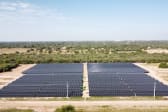
The Peruvian photovoltaic market is beginning to incorporate new hybrid configurations with energy storage systems , while the implementation of technical requirements for connecting generation plants to the National Interconnected Electric System (SEIN) is approaching.
In this scenario, Sungrow is already listing solar projects in Peru that include batteries equivalent to between 30% and 40% of the installed photovoltaic power , as revealed by Luis Fernando Biagini, Head of Sales Southern Cone of the company, within the framework of the streaming event "See you at FES".
The executive clarified that these percentages correspond to specific commercial transactions and not to a general market estimate, which demonstrates the emergence of projects that consider incorporating storage from their initial configuration.
This trend coincides with the evolution of the technical requirements of the Economic Operation Committee of the National Interconnected System (COES), whose Technical Procedure No. 20 establishes new conditions for the integration of generation plants.

In particular, from January 1, 2028, the synthetic inertia contribution parameters, defined by the Supervisory Body for Investment in Energy and Mining (Osinergmin), will come into effect for power plants that enter service or commercial operation from that date.
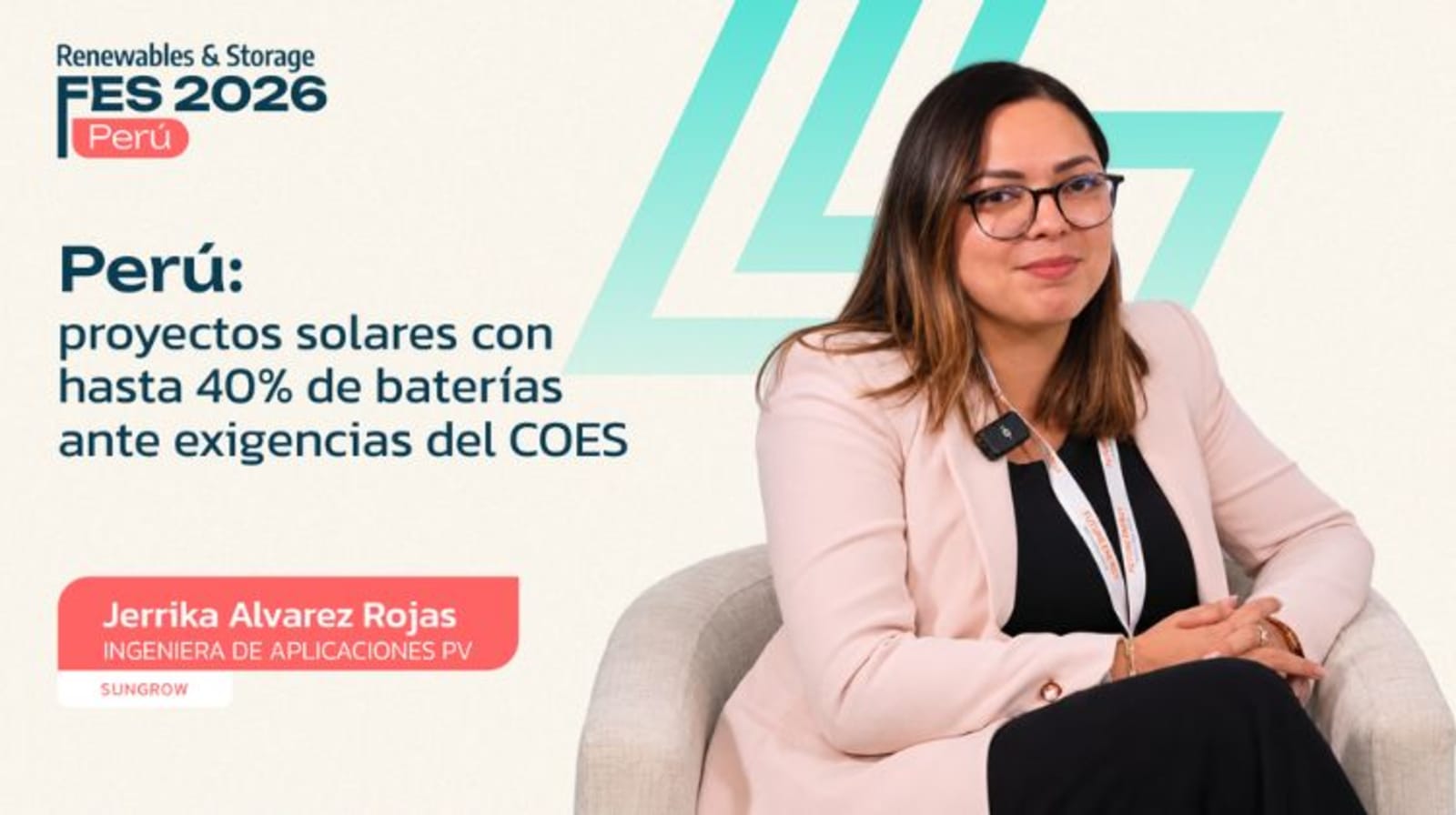
In an exclusive interview during Future Energy Summit (FES) Peru 2026 , Jerrika Alvarez Rojas , PV applications engineer at Sungrow, addressed the challenges the industry faces with the evolution of connection and operation requirements.
“For us, it has been very important to understand the needs of the Peruvian market very well. We believe that this is a historic moment for the country, where we are seeing the evolution of how new needs are emerging and the requirements that we, as manufacturers, must also meet,” Alvarez Rojas stated.
The specialist identified adapting technological solutions to new regulatory requirements as one of the priorities to support the development of photovoltaic generation in the country.
Synthetic inertia from 2028: the new technical challenge for solar projects
The evolution of the Peruvian regulatory framework incorporates requirements related to frequency stability and the response of power plants to disturbances in the electrical system , aspects that are especially relevant for generation technologies connected through power electronics.
Through Resolution No. 173-2024-OS/CD, Osinergmin approved the COES Technical Procedure No. 20, which establishes the conditions for the entry, modification and removal of SEIN facilities.
Subsequently, Resolution No. 176-2025-OS/CD , published in December 2025, defined the parameters that power plants required to provide synthetic inertia must meet.
These include a contribution equivalent to 6% of the nominal power , which must be achieved within a maximum period of one second from the start of the contribution.
Likewise, a maximum time of 0.15 seconds is established to start the contribution from when the event occurs and a minimum response period of eight seconds, subject to a deadband of ±0.1 Hz with respect to the nominal frequency.
The regulations stipulate that, when using power electronics-based solutions, grid-forming inverters accompanied by energy storage equipment , such as BESS systems, supercapacitors or other technologies capable of fulfilling that function, must be considered.
It also supports alternative rotary technology, such as synchronous condensers and flywheels, with a minimum inertia constant of three seconds.
Therefore, the regulations do not establish a universal obligation to install batteries, nor do they set a percentage of storage relative to solar power. However, they do incorporate requirements that developers must consider when selecting technologies to ensure the stability of their installations.
Continue reading
Compliance will be verified during pre-operational and operational studies, which introduces new technical considerations in the design, engineering, and connection stages of the projects.
“ Our teams are very present and we have a very close relationship with COES to be able to know how it is evolving and see what new requirements are being implemented ,” the executive stated.
The specialist also emphasizes that adaptation requires supporting developers during the various stages of implementation.
Sungrow has 1.2 GW of operational solar capacity and anticipates further market development.
Adapting to the new requirements finds Sungrow with 1.2 GW of installed and operational photovoltaic capacity in Peru , as Biagini reported during a previous interview with this media outlet.
“At this moment we have the largest photovoltaic plant with our equipment in Peru,” the engineer highlighted, referring to Illa.
Part of that technological presence corresponds to two large projects mentioned by Alvarez Rojas: Illa, of 470 MW, and San Martín, of 273 MW , which add up to a combined capacity of 743 MW.
The executive believes that this experience allows the company to strengthen its ability to respond to the technical and regulatory changes that accompany the expansion of the sector.
“And for that very reason, because of this experience we have already gained, we continue to contribute the best solutions we can offer for the future,” he assured.
In parallel, the emergence of solar configurations with storage represents a new variable for structuring investments, both because of the additional equipment required and because of the operational and commercial possibilities offered by hybrid systems.
When asked about expectations for the coming years, Alvarez Rojas avoids committing to a specific growth figure, although she confirms that the company is preparing its solutions to keep pace with market evolution.
“We see the growth, and we are preparing for it. We continue to face these challenges that come with the evolution of the market and also with how the pipeline in Peru is developing,” he stated.
The engineer added that Sungrow's technical work seeks to respond to both the needs of its clients and the requirements of the electrical system operator.
“We see this development and we foresee a great evolution for the Peruvian market in the future,” he projected.
Looking ahead to 2027, the year before the application of the new synthetic inertia parameters, the specialist identifies clarity in procedures and technical requirements as a relevant condition for anticipating the needs of the industry.
“I would like to see how COES evolves, providing greater clarity on the rules of the game and how we will present our requirements, so that we can prepare and anticipate all the needs that are coming,” he said.
Thus, the photovoltaic development of Peru is going through a stage in which the incorporation of storage and the new system stability requirements are beginning to form part of the technical discussion on future projects .
While Sungrow's commercial quotations show the emergence of configurations with batteries equivalent to up to 40% of solar power, the regulatory horizon of 2028 introduces specific requirements that manufacturers and developers will have to consider when defining their generation and connection solutions.

 By Emilia Lardizabal

 By Energía Estratégica
 By Ailén Pedrotti
 By Florencia Guglielmetti