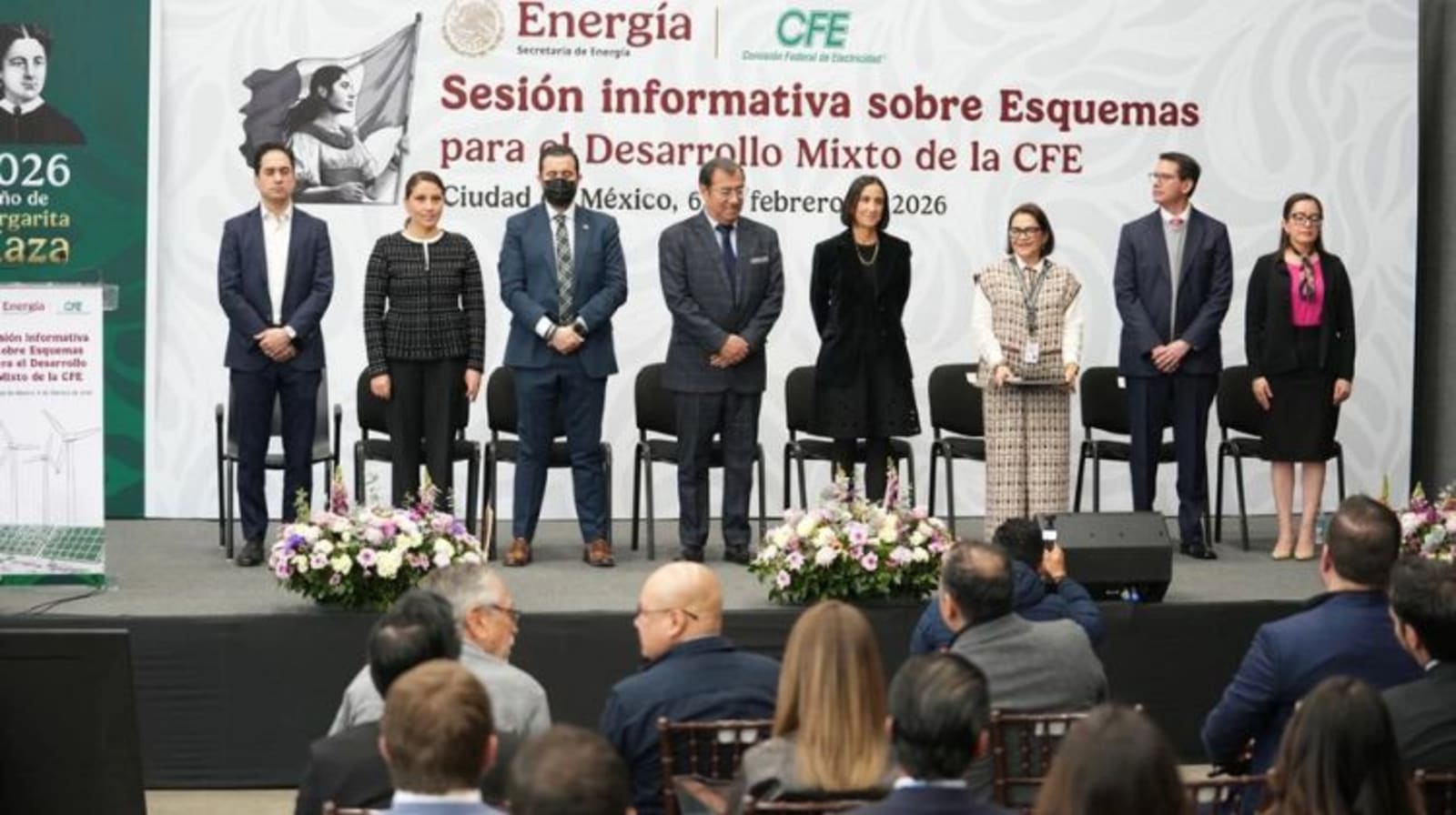
More than half of the submitted projects were excluded from the Federal Electricity Commission's (CFE) mixed scheme, which awarded 7,400 MW . Of the projects evaluated, the state-owned company declared 46 void, equivalent to 55% of the total—a result that highlights the difficulties developers face in meeting the technical, financial, and economic requirements of the bidding process.
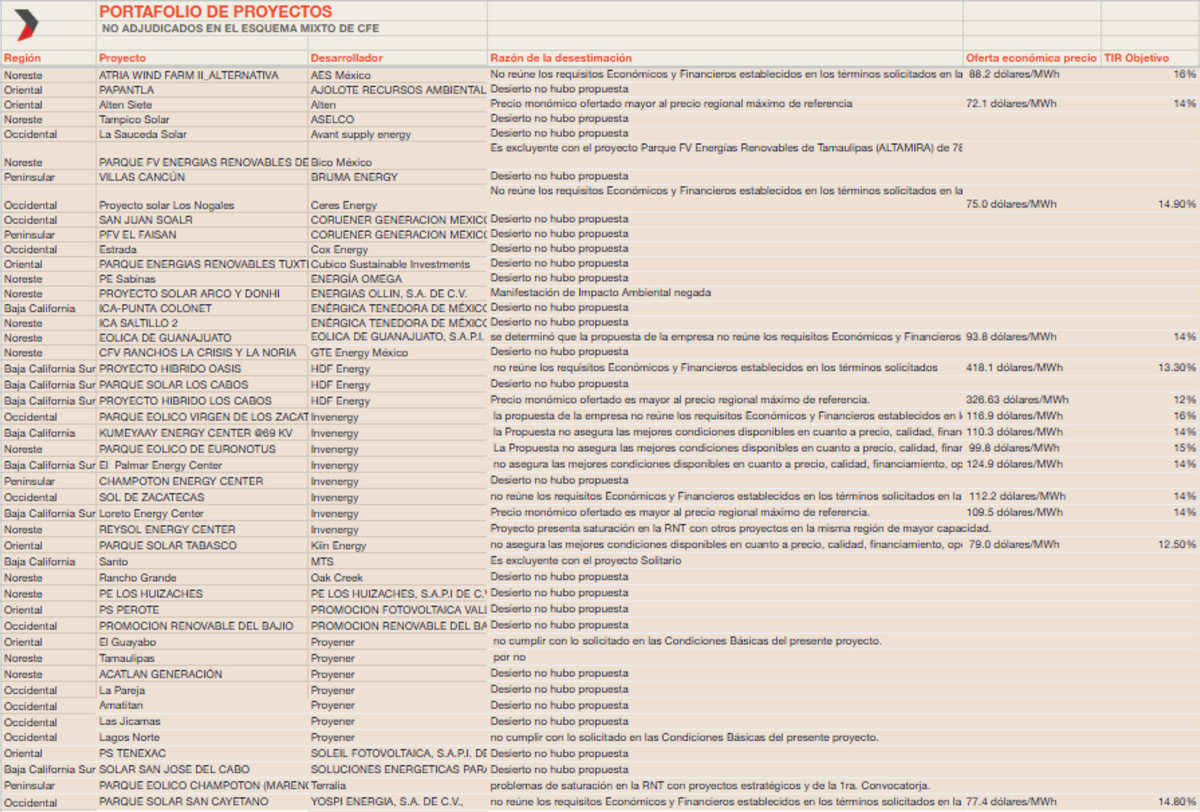
Of the total number of rejected initiatives, 24 received no proposals, 13 were rejected for failing to guarantee the best economic conditions for CFE or for offering prices higher than the reference price, and nine were declared void for various reasons, such as market saturation in the area or the lack of an environmental impact assessment. Regionally, the Northeast had the highest number of unawarded projects, with 14 initiatives , followed by the West with 12 and the East with seven . This result reflects that a significant portion of the proposals submitted in these regions failed to meet the economic, financial, and technical criteria established by the Federal Electricity Commission (CFE).
Among the companies with the largest presence within the unawarded portfolio, Invenergy stands out, which was left out with eight projects distributed in different regions of the country, including Reysol Energy Center, Euronotus Wind Farm, Kumeyaay Energy Center, Loreto Energy Center, El Palmar Energy Center, Champotón Energy Center, Sol de Zacatecas and Virgen de los Zacatecas Wind Farm.
The list also includes developers such as Proyener, HDF Energy, AES Mexico, Cubico Sustainable Investments, Kiin Energy, Bico Mexico, GTE Energy Mexico, Cox Energy, Terralia, Oak Creek, Ceres Energy and Coruener , among other actors that participated in the process without achieving an award.

Another aspect that remains unclear is the final power capacity associated with each of the rejected and awarded projects. While CFE released the results of the process and the reasons behind the rejections, the total megawatt (MW) capacity represented by the selected and rejected initiatives has not yet been published —a key piece of information for understanding the volume of investment and renewable capacity involved in this first call for proposals under the mixed scheme.
Prices as high as $418/MWh and financial problems
The economic evaluation was one of the main filters in the process. While some of the awarded projects managed to secure contracts with prices close to $50/MWh , several of the rejected initiatives submitted significantly higher bids, which ultimately made them less competitive than CFE considered.
The most extreme case is the Oasis Hybrid Project , developed by HDF Energy in Baja California Sur, which offered a single-unit price of $418.1/MWh with a target IRR of 13.3% . Within the same company, the Los Cabos Hybrid Project offered $326.6/MWh with an expected return of 12% .
At a lower level are proposals such as El Palmar Energy Center , by Invenergy , with $124.9/MWh and a target IRR of 14% ; Euronotus Wind Farm , also by Invenergy , with $110.3/MWh and an IRR of 14% ; and Loreto Energy Center , also by the US company, with $109.5/MWh and an expected return of 14% .
Among the projects that did not advance despite submitting considerably more competitive bids is El Guayabo , by Proyener , with a price of $79/MWh and a target IRR of 12.5% . Also included is Alten Siete , by Alten , which offered $72.1/MWh with an expected return of 14% , although it was also rejected for exceeding the maximum regional reference price defined for that area.
Some initiatives even offered lower prices. Proyener 's La Pareja project submitted a bid of $75/MWh with a target IRR of 14.9% , while Promoción Renovable del Bajío bid $77.4/MWh with an expected return of 14.8% .
The comparison is also relevant from a historical perspective. The last major renewable energy auction held in Mexico, in 2017, set an international record when an Enel wind project won a contract at a price close to $17/MWh. While the current mixed-price scheme incorporates new value components that were not present in those auctions, the difference reflects how the costs considered by developers have evolved and the new demands of the market.
Unlike previous auctions, projects participating in this process were required to incorporate energy storage systems. According to the call for proposals, the initiatives had to include battery capacity equivalent to at least 30% of the generation capacity, with a minimum duration of three hours —a requirement that directly impacts the cost structure and, consequently, the offered single-unit prices.
According to the analyzed documentation, the rejected projects registered an average target IRR of 13.9% and an average single-unit price of $136/MWh . It is important to note that these values include not only the energy supplied, but also Clean Energy Certificates (CELs), capacity, and storage services under a tolling arrangement , thus representing the total cost offered to CFE.
However, price was not the only determining factor. Four projects were rejected for failing to meet the economic and financial requirements stipulated in the call for proposals, while others were excluded for non-compliance with the basic conditions of the process.
In addition, there are cases related to infrastructure restrictions and permits. Some developments were rejected due to saturation problems in the National Transmission Network (RNT), exclusivity conflicts with other projects considered priorities, and even the rejection of environmental impact assessments.
The results show that the selection process was not only marked by the awards announced by CFE, but also by a significant elimination of proposals. The high number of unawarded projects highlights the gap that still exists between developers' profitability expectations and the economic conditions that the state-owned company considers competitive for incorporating new renewable capacity and storage systems in Mexico.
 By Emilia Lardizabal



 By Ailén Pedrotti
 By Florencia Guglielmetti