


Europe has just surpassed 100 GWh of operational storage capacity and 55 GW of installed power for the first time, after adding an additional 36 GWh during 2025. In parallel, some markets already offer revenues exceeding 800,000 euros per MW per year, transforming the economic equation of BESS projects.
The combination of energy arbitrage, balancing services, and new flexibility mechanisms is redefining the energy storage landscape. Today, the countries installing the most batteries are not necessarily those offering the highest economic returns, creating a new geography of opportunities for developers and investors.
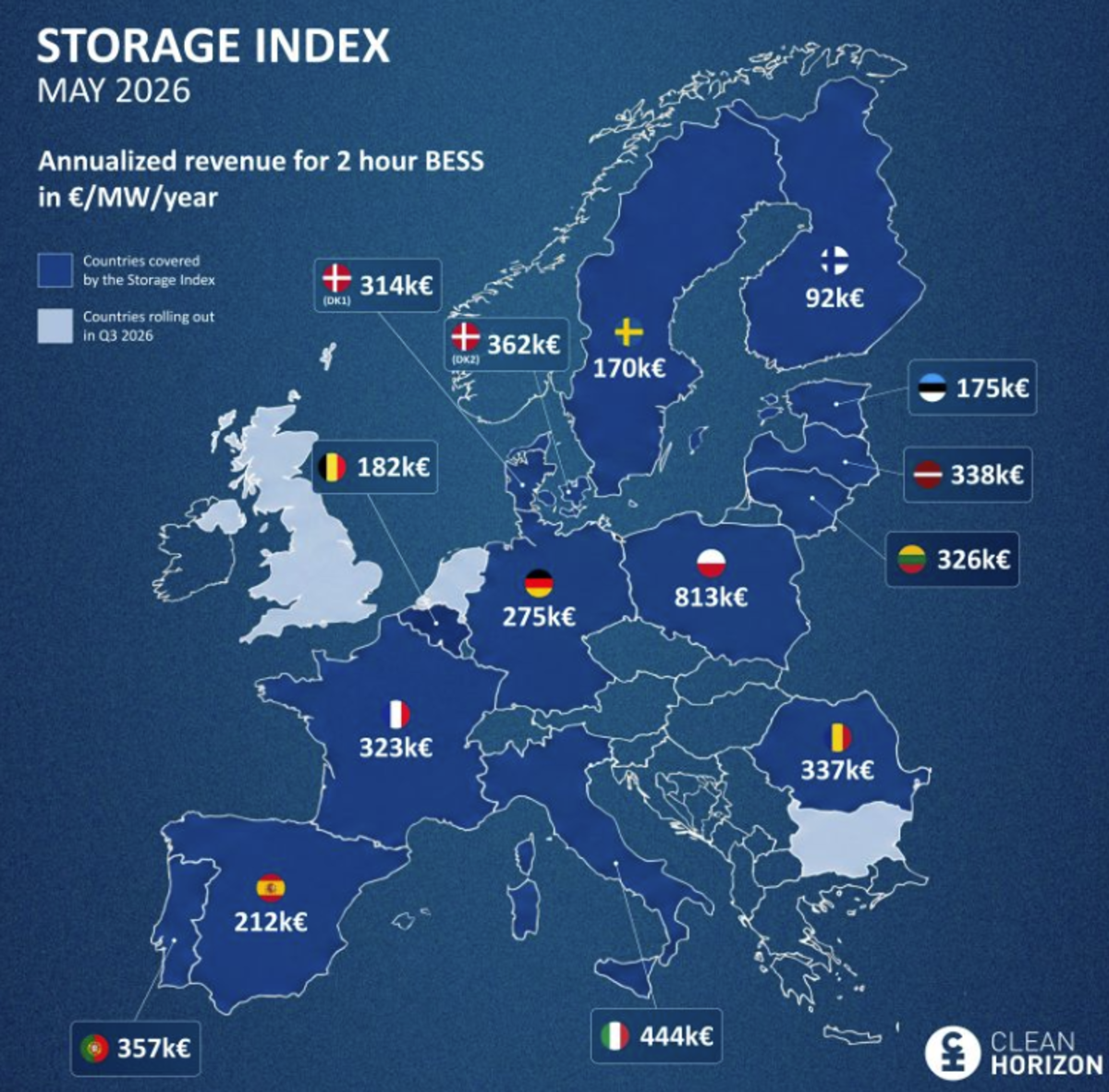
Poland once again positioned itself as the most profitable market in Europe for the second consecutive month in May. According to the Clean Horizon Index, a two-hour battery can generate over €800,000/MW annualized, thanks primarily to the high capacity reservation prices in the aFRR market, which remained above €120/MWh on average.
Italy is also making strides. The northern region achieved revenues equivalent to €654,000/MW per year for four-hour systems, while the southern region reached €640,000/MW/year and the central region €523,000/MW/year. In northern Italy, mFRR services accounted for nearly 80% of total battery revenues, reflecting the growing importance of balance sheet markets in the profitability of these assets.

Germany, for example, increased its revenues by around 5% during May thanks to the combination of FCR and aFRR markets and high daily spreads, which have remained above €170/MWh for three consecutive months.
Portugal was one of the countries that saw the most significant improvements in revenue during the month, with a 43% increase in two-hour battery sales. This increase was driven by higher capacity prices and a simultaneous improvement in spreads across the aFRR, mFRR, and Day-Ahead markets.
The Baltic countries also showed high volatility. Latvia reached revenues equivalent to €338,000/MW per year and Lithuania reached €326,000/MW/year after an exceptional event on May 29, when aFRR capacity prices climbed to €219/MW/h for a single day.
In contrast, Estonia continues to be the Baltic market with the lowest ancillary service prices, registering around €175,000/MW per year for two-hour systems.
Sweden also showed a significant improvement during May, with revenues close to €170,000/MW annualized, while Belgium remained stable at around €270,000/MW/year for four-hour configurations.
More than 100 GWh operational: how the installed capacity map looked in 2025
This trend also shows that the business is no longer solely dependent on energy arbitrage. Ancillary services, capacity reservations, and operational flexibility are becoming the main revenue drivers for storage in several European markets.
Behind these profitability levels lies an industry that continues to expand at a record pace. According to SolarPower Europe, Europe installed 36 GWh of storage during 2025, mobilizing around €17 billion in investments.
The new additions allowed the sector to surpass the 100 GWh mark of cumulative operating capacity for the first time, consolidating the twelfth consecutive year of record growth since records began in 2013.
Germany, the UK, and Italy remain the leaders in terms of volume, installing 6.6 GWh, 5.2 GWh, and 5 GWh respectively during 2025. However, the market shows clear signs of diversification. Ukraine and Bulgaria broke into the Top 5 with 2.9 GWh and 2.7 GWh installed respectively, displacing Austria and Sweden from the group of continental leaders.
Ukraine's emergence among the largest European markets is one of the most striking phenomena of the year. Four years after the Russian invasion, the country deployed almost 3 GWh of storage capacity, driven by the need for energy resilience. More than 60% of the new capacity corresponds to distributed systems associated with critical infrastructure such as hospitals, schools, and businesses.
Continue reading
Bulgaria, meanwhile, recorded the fastest growth in all of Europe with a year-on-year expansion of over 1,000%, driven by financing programs for utility-scale projects backed by the European Union.

Spain is preparing for the next big wave of batteries.
Although it is not yet among the largest European markets in terms of installed capacity, Spain appears to be one of the countries with the greatest growth potential toward the end of the decade. The country has one of the most ambitious targets on the continent, with a goal of 22.5 GW of storage by 2030, second only to the United Kingdom.
In the short term, revenue projections are already showing positive signs. The profitability of a two-hour battery could increase by 5.5% compared to the previous month, driven primarily by a 21% increase in aFRR capacity prices and improved spreads in the day-ahead and mFRR markets.
However, the sector's main expectation lies in the new capacity market. Following approval from the European Commission, Spain will have a mechanism with approximately €900 million annually for a decade to remunerate resources capable of guaranteeing supply during times of scarcity.
Although the first auctions have not yet been launched and the sector expects them to take place in early 2027, the scheme is already sending a significant signal to investors. The inclusion of capacity payments will supplement revenues from arbitrage and balance sheet services, providing an additional source of financial stability for BESS projects.
It is worth remembering that, through the ERDF funds, Spain has granted massive aid, managing to finance more than 9.4 GWh of large- scale battery projects that will begin to be connected massively between 2028 and 2029.
Despite the strong growth projected for 2025, the industry believes that Europe still faces a significant flexibility deficit. Currently, the ratio of solar capacity to storage is around 8 to 1 in the European Union, a proportion that contributes to increased renewable curtailment and episodes of negative prices in electricity markets.
To respond to this challenge, the industry is promoting the creation of a Battery Storage Action Plan at community scale, an initiative that seeks to replicate the impact of the European Solar Strategy launched in 2022.
The proposal aims to eliminate regulatory barriers for batteries, guarantee their access to all electricity markets and ancillary services, expedite permits, facilitate grid connections, and create more stable investment conditions for the development of new projects.
The official target set by the European Commission, through the AccelerateEU strategy, is to reach 200 GW of storage capacity by 2030. This represents a monumental leap, as it involves tripling the current 55 GW of capacity in just a few years.
Although the political target was set in GW, SolarPower Europe projects that the European market could reach around 580 GWh cumulatively by 2030, more than six times the currently operational capacity. In more optimistic scenarios, the figure could even approach 735 GWh.
This scenario is fueling increasingly intense competition to attract battery and energy storage system manufacturers. The continent has identified at least 13 strategic gigafactory and production center projects linked to the BESS value chain in countries such as Spain, Germany, Italy, Poland, Hungary, and Slovakia . The competition is no longer solely about installing more capacity, but about capturing industrial investment, skilled jobs, and greater technological autonomy in the face of Asian dominance in cell manufacturing.
Among the companies leading this new phase are manufacturers such as CATL, BYD, LG Energy Solutions, Samsung SDI, SK On, EVE Energy, Gotion High-Tech, and Sunwoda, along with European players seeking to gain scale in the battery business. Although Brussels is promoting a "made in Europe" energy storage strategy, much of the technology, supply chains, and manufacturing capacity remain strongly linked to Asia, which maintains a dominant position in global cell production.