Mexico faces a new phase of its energy transition with a pending allocation portfolio of 6754 MW renewables , consisting of 4595 MW photovoltaic and solar thermal, plus another 2159 MW wind.
“The goal is to have all the new plants that are needed assigned this year,” said Luz Elena González , Secretary of Energy.
The remaining capacity to be allocated is part of the current calls for bids promoted by the Ministry of Energy. The mechanisms include both private participation and mixed schemes with the Federal Electricity Commission (CFE) , a model that seeks to leverage private financing while the State maintains control of strategic assets.
It's worth noting that the full scope of this new call for bids was unknown until now, as the market was awaiting the final allocation of funds from previous rounds. In fact, some of the government's original objectives were only partially met.


On the one hand, photovoltaic projects saw strong private sector participation and reached approximately 6710 MW awarded against an initial requirement of 3550 MW , practically doubling the target capacity set by the authorities.
In the case of wind energy, the awarded capacity reached only 700 MW compared to a target of 2,850 MW , equivalent to approximately 24.6% of the planned objective. The situation was even more pronounced for concentrated solar power (CSP), which had an initial target of 100 MW but did not register any awards during the previous bidding process.
In parallel, the Government maintains an open call specifically for standalone storage systems, a sign of the growing importance of operational flexibility within national energy planning.
The new renewable energy tenders recently underwent modifications to their timelines to extend participation deadlines. The review and assessment phase by the National Energy Control Center (Cenace), a preliminary step before the interconnection studies are finalized, will continue until June 30. Subsequently, developers must make the corresponding payments by July 15 and submit permit applications to the National Energy Commission (CNE) between July 16 and August 18.
The technical evaluation of the projects and their alignment with the binding planning criteria of the electrical system will be carried out during October. The final results of the calls for proposals and the permits approved by the CNE Technical Committee will be announced that same month.
In addition to the capacity that still needs to be defined, Mexico has already secured a first phase of renewable energy contracts totaling 67 projects and 12,559 MW of solar and wind power. Of this total, 50 photovoltaic and concentrated solar power (CSP) plants represent 7,859 MW , while another 17 wind farms contribute 4,700 MW .
Much of this capacity was allocated through the new mixed schemes promoted by the Mexican government. In fact, one of the most significant processes recently culminated in the awarding of 37 projects totaling approximately 7,400 MW , in which private developers will participate alongside the Federal Electricity Commission under a model that accelerates investment without transferring ownership of strategic assets.
One of the most important aspects of these processes is that all renewable energy projects must incorporate storage systems equivalent to at least 30% of their installed capacity and with a minimum autonomy of three hours . This requirement reflects a new vision for renewable energy development in Mexico: the expansion of clean energy generation will no longer be separate from solutions that provide flexibility and reliability to the system.
Green hydrogen: CFE's new bet to store solar energy
Continue reading
During the presentation of the energy plan, the general director of the CFE, Emilia Calleja , presented the so-called Oasis Project , an initiative that will combine solar energy, batteries and green hydrogen in the isolated electrical system of Mulegé, in Baja California Sur.
Emilia Calleja, director of the Federal Electricity Commission (CFE), assured that the project includes a 72 MW photovoltaic plant, a 20 MW battery storage system, a 20 MW green hydrogen production plant for consumption through electrolysis and 6 MW in fuel cell production.
“The energy generated will be equivalent to the consumption of around 40,000 lit homes, we will avoid more than 94,000 tons of CO₂ emissions and significantly reduce the use of fossil fuels in the region,” Calleja added.
Mayor Claudia Sheinbaum highlighted the innovative nature of the initiative. “ Very few countries in the world have projects of this kind ,” she stated, referring to a solution that combines renewable energy generation and storage using green hydrogen.
The focus on energy storage is also part of the expansion of the Rafael Galván Maldonado Photovoltaic Plant (Puerto Peñasco) , considered one of the flagship projects of Mexico's energy transition. Currently, the first two phases are already operational with 400 MW of solar power and 72 MW of storage , while the remaining phases will incorporate new renewable capacity and large-scale battery systems.
According to information presented by the CFE, the third phase will begin commercial operation in December 2027 , with 300 MW of photovoltaic capacity , 90 MW of battery storage , and an estimated investment of $294 million . Subsequently, the fourth phase will begin operations in March 2028 , adding another 280 MW of solar power , 84 MW of storage , and an investment of approximately $344 million .
“ All photovoltaic plants will have battery storage ,” Sheinbaum emphasized during the presentation, highlighting that these solutions will allow electricity to be stored for several hours and delivered to the system when renewable generation decreases or demand increases.
Once its four stages are completed, Puerto Peñasco will reach 1,000 MW of solar generation and 246 MW of storage , consolidating itself as the largest photovoltaic plant in America and one of the most relevant renewable integration and storage projects in the region.
The roadmap to 2030: 32 GW new and 38% renewable
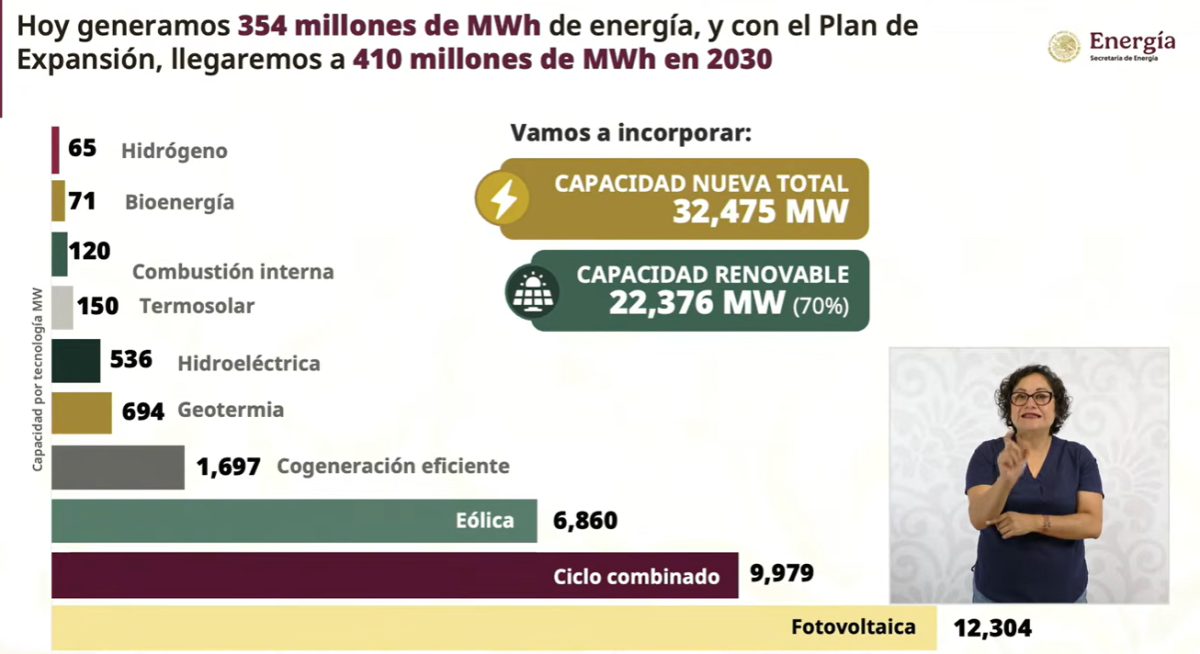
The energy strategy presented by the Government contemplates incorporating an additional 32 GW of electrical capacity during the six-year term, of which 22 GW will correspond to renewable technologies.
Of the new renewable capacity planned, solar energy will account for approximately 12,300 MW , while wind power will contribute around 6,800 MW . The program also includes geothermal and concentrated solar power projects, as well as the modernization of existing hydroelectric plants.
According to official projections, the share of renewable energy in the national electricity mix will increase from the current range of 23% to 24% to reach at least 38% in 2030, which would represent an increase of 15 percentage points in just five years.
To support the integration of this new variable generation, CFE will also develop firm capacity through new combined-cycle power plants. The plan anticipates adding approximately 9,900 MW to ensure the stability of the electrical system during the transition.
The total announced investment amounts to 739 billion pesos , with the state-owned company playing a predominant role. According to data presented by the government, CFE will contribute 79% of the new generation capacity, while the remainder will come from private investment and mixed schemes.
In this way, Mexico seeks to advance simultaneously on three fronts: completing the allocation of almost 6.8 GW of renewables this year, incorporating mandatory storage in new power plants, and exploring long-term solutions using green hydrogen.