


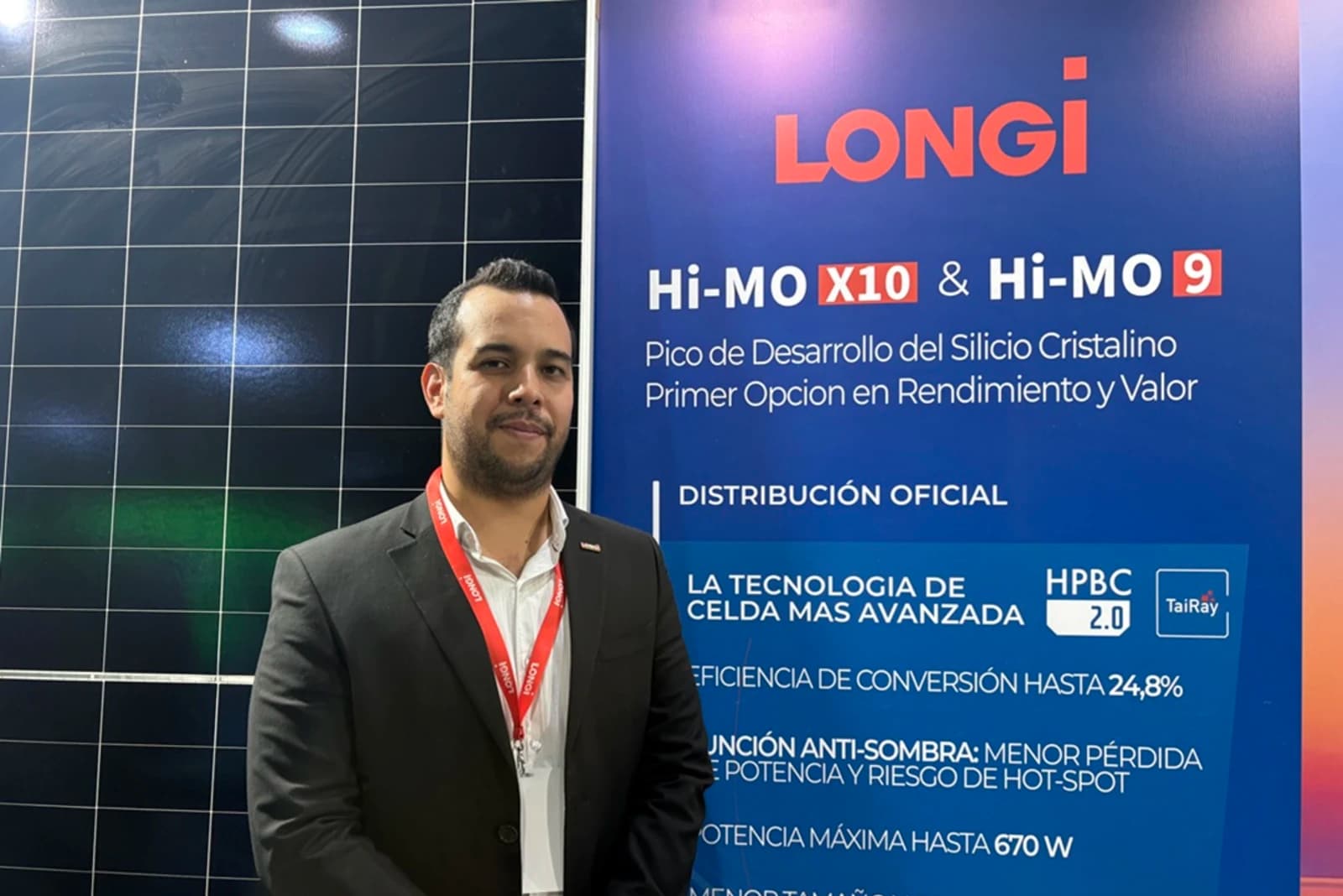
With an ever-increasing supply of products in the Argentine photovoltaic market, driven by the opening of imports, Camilo Bayona , Product Manager of LONGi for South America, warned about one of the risks he sees in the new scenario.
“The opening of the market is allowing low-quality or Tier 2 brands to start gaining ground due to their very low prices,” he noted in an interview with Energía Estratégica during the Energy Efficiency Expo in Buenos Aires.
For Bayona, the challenge lies not only in the performance or price of the modules, but also in the safety and reliability of the installations, since low-quality equipment can lead to electrical failures or even fires.
“Let’s not focus so much on prices, but on profitability, safety and new technologies,” he remarked.

At that point, he argued that the sector's expansion should be accompanied by stricter requirements for products, installers, and related services. In his view, controls should encompass not only the components used but also the design, implementation, and maintenance of photovoltaic systems.
Argentina, however, does not start from a regulatory vacuum. Within the national distributed generation regime, grid-connected equipment must be installed by qualified professionals and meet certain certification requirements.
The panels, for example, must meet IEC 61730-1/2 standards for construction and safety and, depending on their technology, standards such as IRAM 210013-17 or IEC 61215 .
Bayona took Colombia as a reference, where the Technical Regulation of Electrical Installations (RETIE) - whose latest modification was approved by Resolution 40284 of June 23, 2026 - concentrates in a single national framework requirements on products, installations and conformity assessment mechanisms.
One of the differences compared to the Argentine scheme is its scope: for electrical products covered by the regulation, manufacturers and importers must demonstrate their compliance with the established technical requirements before their marketing and, where applicable, before customs clearance.
“Fortunately, Colombia has its own regulations that restrict the entry of low-quality equipment and seek to guarantee safe facilities,” he said.
Based on that experience, their approach for Argentina focuses less on creating a scheme from scratch than on strengthening existing requirements as the market grows.
“I would seek to guarantee not only the safety of the equipment that comes in, but also the facilities themselves. That the people who do the installation, the design, and the after-sales service are fully trained to do it,” he stated.
Continue reading
LONGi sees conditions for a solar expansion in Argentina
Despite these warnings, LONGi maintains a favorable view of the prospects for the Argentine market.
The numbers support this perception. In distributed generation , the national system reached 165.5 MW of installed capacity and 4,891 user-generators in July 2026, practically double the capacity recorded a year earlier. The commercial and industrial segment accounts for 132.1 MW , nearly 80% of the total connected capacity.
At the utility level, photovoltaics also continues to expand its presence. During 2026, installed capacity already exceeded 2.5 GW , while CAMMESA anticipated the addition of 210.6 MW of solar capacity between August and October .
“The reduction of subsidies and the increase in electricity rates for certain segments open up new opportunities for photovoltaic systems,” Bayona stated.
Within this scenario, the company identifies opportunities in the commercial, industrial and residential segments, especially in projects where the available surface area requires maximizing generation per square meter.
This condition is compounded by another relevant factor for the region: high temperatures. As the executive explained, LONGi's BC modules have a Pmax temperature coefficient of up to -0.26%/°C, which reduces power losses under high-temperature conditions.
“It is a product that we developed for the whole world, but that we have prioritized for customers in our region,” he said.
The regional announcement comes after LONGi globally launched its Hi MO X10 Ultimate in June, based on HPBC 2.0 architecture, with an efficiency of up to 25.2% and power outputs of up to 680W.
The company also expects to close 2026 with favorable growth in Argentina, although it anticipates that the largest rollout will come during the following year.
“Everything points to 2027 being a year of significant growth for the industry. This year already was, but next year will be much bigger,” Bayona stated.
The roadmap includes strengthening relationships with distributors, expanding support for EPC companies , participating in new developments, and adding local capabilities. The strategy will also extend to the rest of the Southern Cone , with Chile, Uruguay, and Paraguay among the markets identified by the executive.
Energy storage will be another focus for the company during 2027, accompanying the emergence of new opportunities for this technology in Latin America. Bayona identified Chile as the main regional reference in BESS and also highlighted the evolution of Colombia, which in June 2026 approved new rules to incorporate battery energy storage systems into the National Interconnected System.
Thus, LONGi plans to combine a greater local presence, new photovoltaic solutions and storage during the next year, with Argentina and the rest of the Southern Cone among its main regional bets.