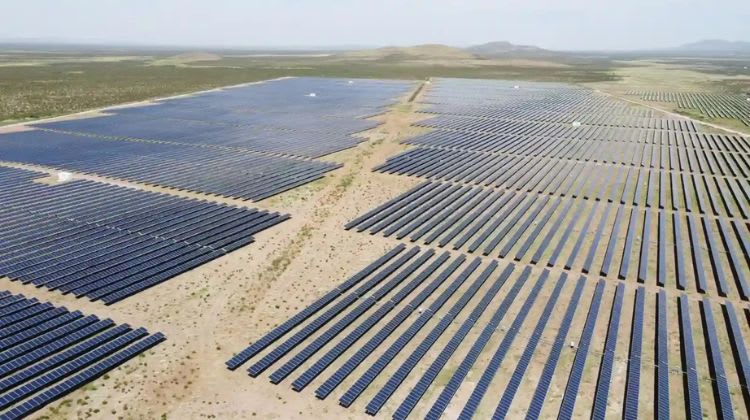
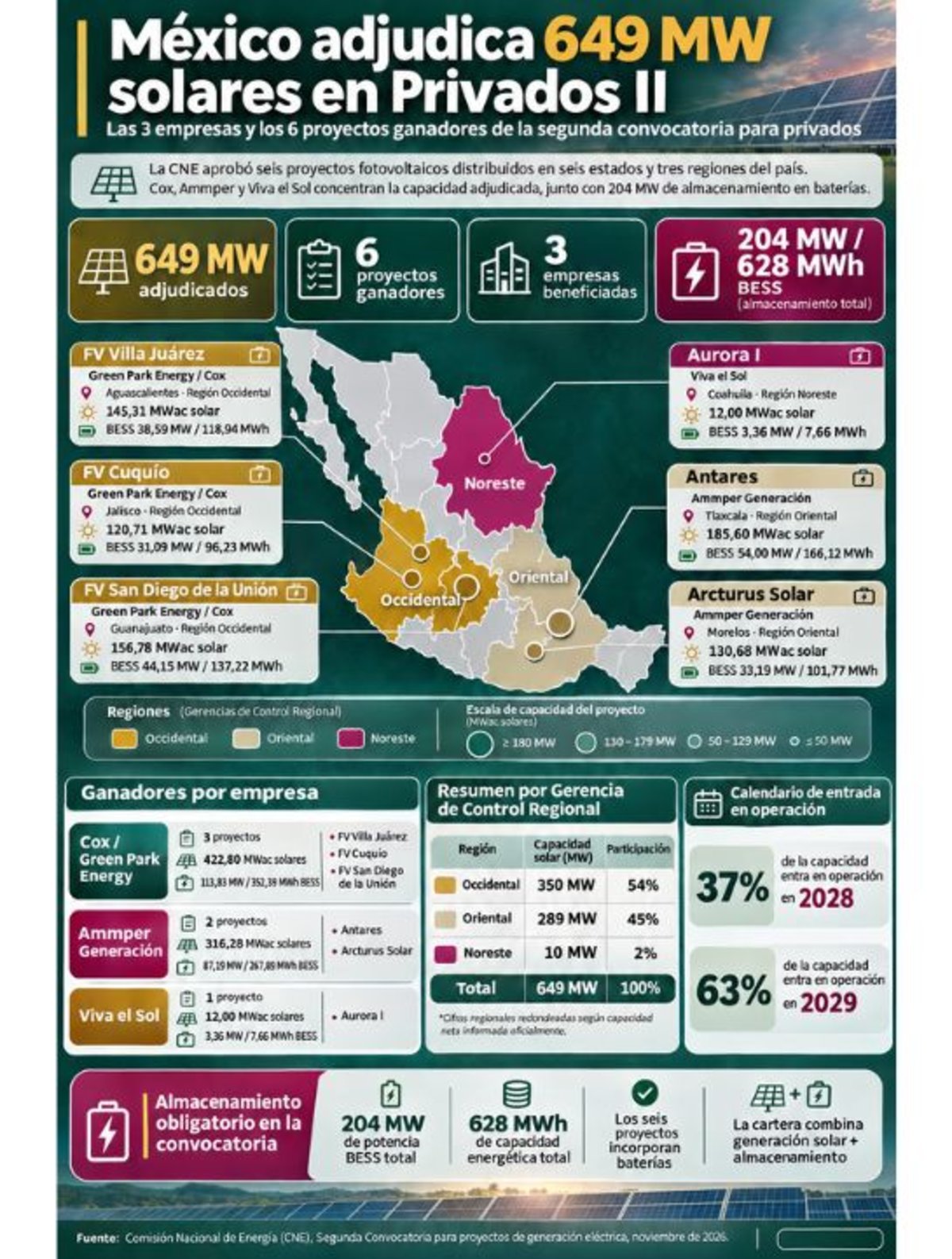
Mexico defined the results of the second call for private developers (Privados II) , with the approval of six solar projects for 649 MW of net capacity , which remained in the hands of three companies: Cox, Ammper Generación and Viva el Sol .
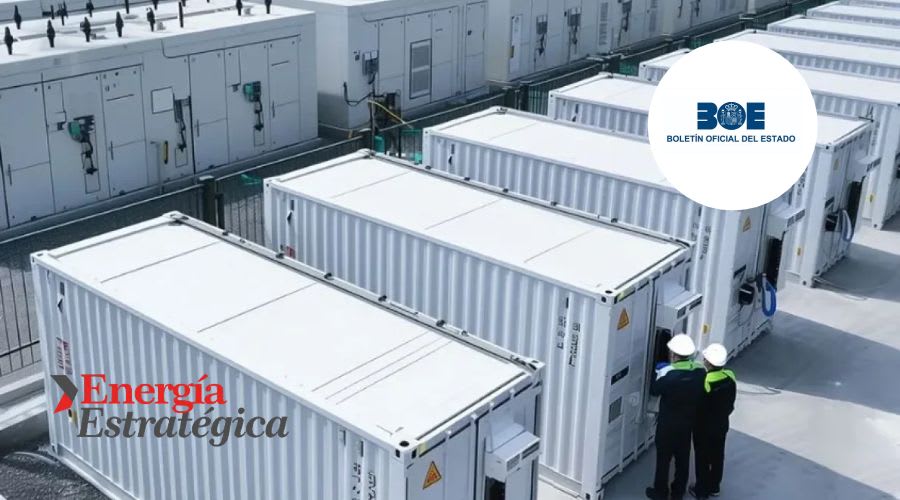
The authorizations, granted by the National Energy Commission (CNE) , include investments estimated at 750 million dollars and incorporate battery storage systems for 204 MW and approximately 628 MWh , with operations planned for 2028 and 2029.
The results were approved during the ninth extraordinary session of the CNE Technical Committee, held on November 5, 2026 , and published the following day on the Ventanilla Energía platform, after a process that received 57 applications for generation permits .
Of that universe, 31 projects met the initial requirements , although only six met all the technical and regulatory conditions required to obtain authorization, representing 10.5% of the applications submitted .

According to the official documentation of each project, the six plants add up to 751.08 MWac of photovoltaic power declared in their permit titles , while the Mexican Government reports 649 MW of net authorized capacity for the set of projects.
The initiatives will have an estimated production of 1,881 GWh per year and will be distributed among Aguascalientes, Jalisco, Guanajuato, Tlaxcala, Morelos and Coahuila, in line with the regional expansion requirements of the National Electric System (SEN).
Which companies and projects won in Privados II?
Cox is positioned as the company with the most approved permits , through Green Park Energy , which obtained three authorizations for photovoltaic installations in Aguascalientes, Jalisco and Guanajuato.
In total, the power plants linked to the company add up to 422.80 MWac of solar power , accompanied by 113.83 MW of storage and 352.39 MWh of energy capacity , according to documents published by the CNE.
The first initiative is FV Villa Juárez , located in El Llano, Aguascalientes, which includes a photovoltaic capacity of 145.31 MWac and an estimated annual production of 364.96 GWh .
The development will incorporate batteries for 38.59 MW and 118.94 MWh , while its construction program plans to start construction on September 30, 2027 and reach commercial operation, at the latest, by November 30, 2029 .
This facility is joined by FV Cuquío , located in Jalisco, whose generation capacity will reach 120.71 MWac , with a storage system of 31.09 MW and 96.23 MWh .
The project will have an estimated annual production of 298.72 GWh and will begin its construction phase on June 30, 2027 , with a maximum date of entry into operation set for December 15, 2028 .
The third development is FV San Diego de la Unión , in Guanajuato, which will have 156.78 MWac photovoltaic capacity , in addition to batteries of 44.15 MW and 137.22 MWh .
The plant is projected to generate 378.80 GWh annually and shares the construction and commissioning schedule of FV Cuquío, with work starting in June 2027 and operation planned, at the latest, for December 15, 2028 .
Thus, the three projects associated with Cox reach an estimated production of 1,042.48 GWh per year , equivalent to approximately 55.4% of the energy that the six selected power plants would generate .
On the other hand, Ammper Generación obtained two permits for the Antares and Arcturus Solar power plants, located in Tlaxcala and Morelos, respectively.
Both facilities represent 316.28 MWac of photovoltaic power , along with 87.19 MW of storage and 267.89 MWh of energy capacity .
Antares will be the largest single power plant among the six authorized , with 185.60 MWac , and will be located in the municipality of Ixtacuixtla de Mariano Matamoros, Tlaxcala.
The project will incorporate 54 MW and 166.12 MWh batteries and will have an estimated generation of 508.50 GWh per year , also becoming the development with the highest planned production within Privados II.
According to its permit title, the works will begin on June 28, 2027 , with completion planned for April 2029 and a maximum start date of July 15, 2029 .
Meanwhile, Arcturus Solar , located in Yautepec, Morelos, will have 130.68 MWac of solar generation and a storage system of 33.19 MW and 101.77 MWh .
The plant is projected to produce 297.37 GWh annually and will have a similar schedule to Antares, with construction starting in June 2027 and commercial operation planned, at the latest, for July 15, 2029 .
In this way, Ammper brings together an estimated annual production of 805.87 GWh , equivalent to 42.8% of the total projected for the six facilities .
Finally, Viva el Sol F1 obtained authorization to develop Aurora I , a 12 MWac photovoltaic power plant located in Nadadores, Coahuila.
The project will incorporate batteries of 3.36 MW and 7.66 MWh , with an estimated annual production of 32.44 GWh .
Although it is the smallest-scale project, Aurora I will be the first to become operational according to the approved schedules , with construction planned from January 2027 and a maximum start-up date of March 1, 2028 .
Continue reading
Where will the 649 MW be concentrated and when will they start operating?
One of the central aspects of the second call is the territorial distribution of the new capacity , given that the permits are linked to the regional generation and interconnection needs defined by Mexican electrical planning.
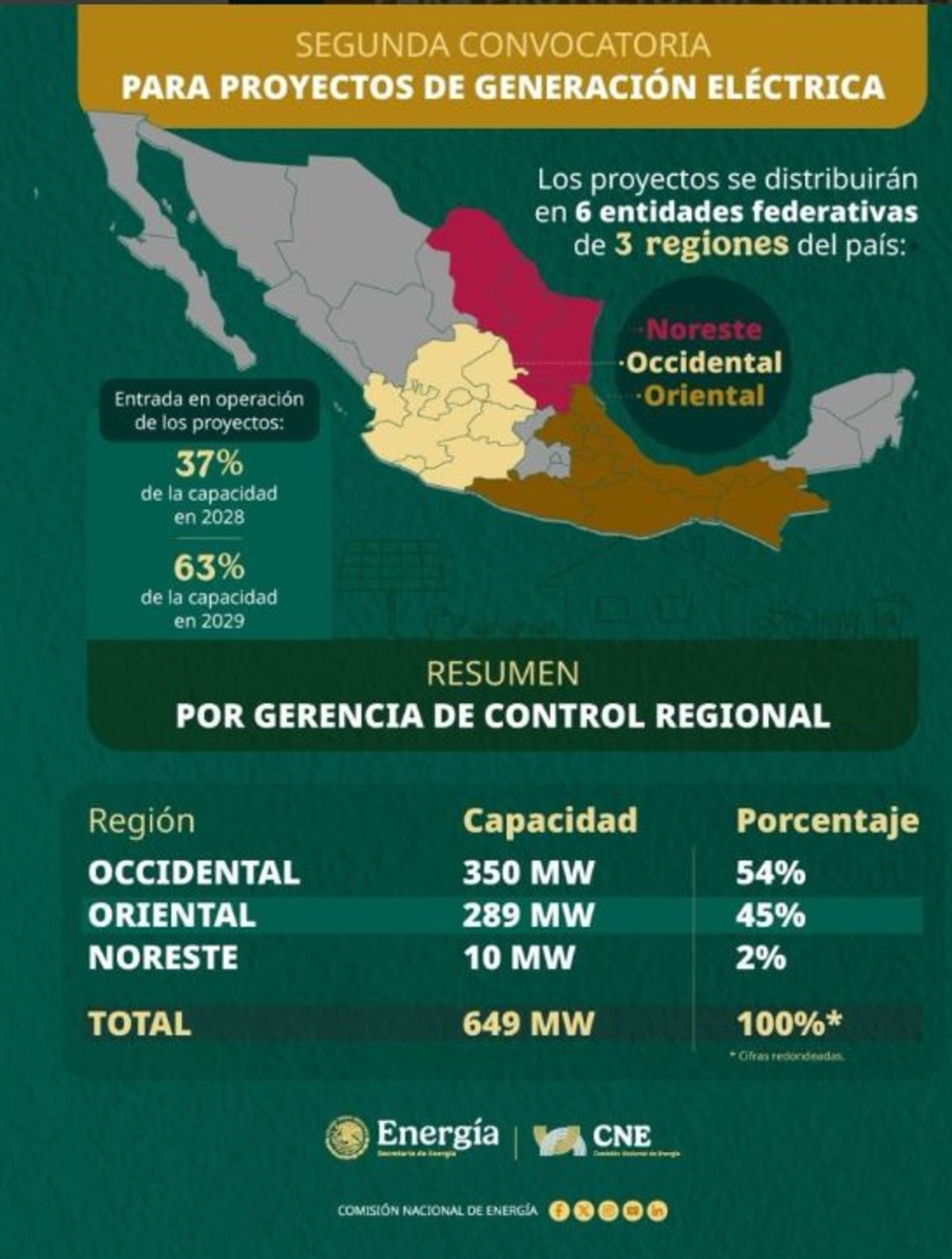
According to official information, the Western Regional Control Management concentrates 350 MW net , equivalent to approximately 54% of the approved capacity , through the three Green Park Energy projects linked to Cox.
Second place comes the Eastern Management, with 289 MW net , which represents 44.5% of the total and includes the Antares and Arcturus Solar projects, developed by Ammper in Tlaxcala and Morelos.
The Northeast Management , for its part, incorporates 10 MW net , equivalent to 1.5% of the authorized capacity , corresponding to Aurora I, of Viva el Sol, in Coahuila.
This distribution shows that 98.5% of the approved net MW are concentrated in the West and East , while the addition to the Northeast is on a smaller scale.
The location of the power plants responds to the binding planning mechanism promoted by the Ministry of Energy (SENER) , which prioritizes generation and interconnection projects according to the requirements identified for the electrical system.
In terms of timelines, the portfolio will be incorporated in stages over the next few years, with 37% of the net capacity expected by 2028 and the remaining 63% by 2029 , according to official estimates.
Aurora I will be the first scheduled installation , with operations starting in March 2028. Subsequently, the incorporation of FV Cuquío and FV San Diego de la Unión is planned, both with a maximum date set for December of the same year.
By 2029, Antares and Arcturus Solar will remain, whose permits set July 15 as the maximum start-up deadline, while FV Villa Juárez must begin operating no later than November 30.
If the authorized timelines are met, the six power plants would complete their integration into the electricity market before the end of 2029, although the execution will remain subject to compliance with the technical, administrative and financial obligations established by the CNE.
Another determining factor is storage, since the second call requires that renewable projects incorporate batteries with a power equivalent, at least, to 30% of the generation capacity and a duration of at least three hours .
Across the six authorizations, the 204.38 MW of storage represent approximately 31.5% of the 649 MW net reported by the authorities , while the total declared energy capacity reaches 627.94 MWh .
The permit titles of Antares, Arcturus Solar, FV Villa Juárez, FV Cuquío and FV San Diego de la Unión show energy capacity and storage power ratios slightly higher than three hours.
However, Aurora I declares 3.36 MW and 7.66 MWh , a nominal ratio equivalent to approximately 2.28 hours , below the three hours established as a general reference in the call for bids. This difference requires technical clarification regarding the specific conditions of the authorization.
Battery integration is a component of the planning of new facilities, aimed at complementing renewable generation and providing operational flexibility to the electrical system.
It is worth remembering that in December 2025 Mexico awarded around 3.3 GW of renewables and 1.2 GW of storage through the first call for private developers, which included solar and wind projects from different companies.
As reported by Energía Estratégica , that selection included companies such as Sunstone Power, Dhamma Energy, Iberdrola, Elecnor and GEMEX , among others, with power plants accompanied by battery systems.
Among the projects authorized at that time were FV Tecozautla and El Toro , from Green Park Energy, a company that at that time was part of Iberdrola Mexico and that is now obtaining permits again under the Cox group, after the closing of the acquisition of Iberdrola's Mexican assets in April 2026.
At the same time, Mexico maintains a different procedure for renewable projects under mixed investment schemes with the Federal Electricity Commission (CFE) .
As this media previously reported, the second mixed call registered a pre-selection of 66 projects for 8,241 MW , distributed between 57 solar initiatives for 6,310 MW and nine wind farms for 1,931 MW , with the participation of 34 business groups .
Unlike that mechanism, Privados II contemplates projects developed by private individuals , with generation permits for the Wholesale Electricity Market and specific interconnection obligations to the National Electricity System.
As for the next steps, the six titles granted by the CNE are valid for 25 years and require companies to prove their financing schemes within eight months of notification of the permits .
They must also submit the final environmental and social impact authorizations within a maximum period of six months , except for the exceptions related to prior, free and informed consultation processes, as well as comply with the guarantees corresponding to the interconnection and reinforcement works before the National Energy Control Center (CENACE).
The documentation also states that permits cannot be transferred before the plants enter into commercial operation and that failure to comply with regulatory commitments or execution deadlines may lead to their revocation.
The titles indicate that a date for the start of commercial operations after the first half of 2030 will not be justified , thus setting a time limit for compliance with the investment and construction programs.
Thus, the authorization of 649 MW net of solar capacity and 204 MW of storage represents a new stage of incorporation of private projects into the Mexican electricity system, with Cox, Ammper and Viva el Sol as holders of a portfolio that must complete its construction and commissioning between 2028 and 2029.


 By Energía Estratégica

 By Emilia Lardizabal
 By Ailén Pedrotti